
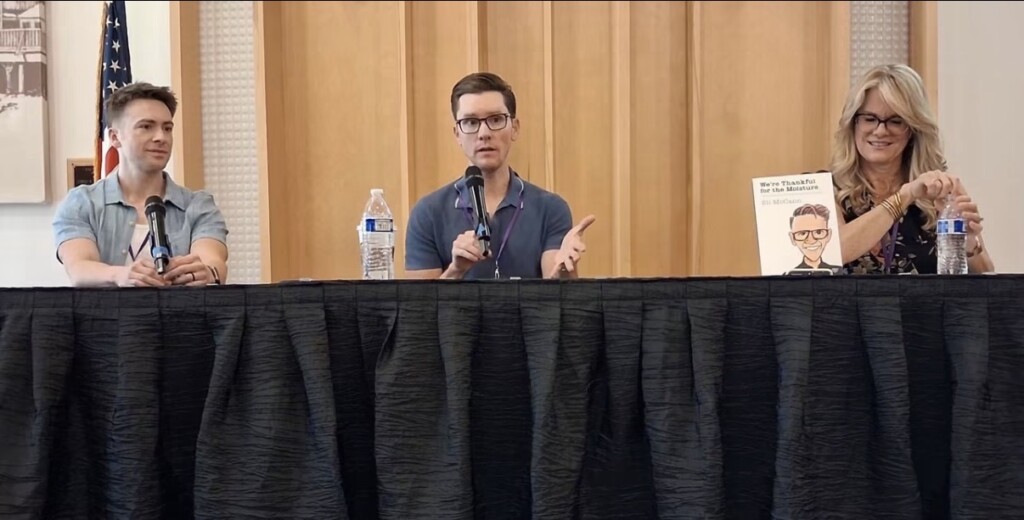
EDITOR’S NOTE: This is the 11th in an ongoing series of features highlighting authors and new books published by Torrey House Press in Utah.
There are two boffo fiction releases this year in Torrey House Press’s outstanding catalog. In both instances, the authors make a solid case for the wise stewardship independent publishers offer in keeping American literature intimate, fresh and relevant for readers who believe the heart and soul of humanity must always be celebrated and protected.
STITCHED: ELI MCCANN
A delightfully witty novel shining in poignant themes of individual dignity, Eli McCann’s Stitched also is a vindicating case of an author’s steadfast authenticity and an independent small publisher’s wise willingness to open the gates for a story that many others saw as unmarketable.
In the 16 years that Torrey House Press, which primarily has published nonfiction about natural environments and the American West, has existed, a book’s release for that category of publisher is a marketing success if sales top 5,000 copies. Several of its award-winning fiction releases have enjoyed sales of approximately 10,000 copies.
Now in its third press run, which means more than 100,000 copies are available in print, Stitched has become a juggernaut. It debuted in fifth place on The New York Times’s bestseller list, and third on Publisher Weekly’s trade paperback list of top sellers, along with mentions on USA Today and Independent Publishers Caucus bestselling lists. In months leading up to its formal release date, the novel was among the most popular in racking up preorder sales.

The novel, for example, has been described as part Schitt’s Creek and part Golden Girls. As a small northern Utah community prepares to host a major quilting competition, a group of older women who comprise a quilting group in Ogden believe that they could leverage the homecourt advantage and finally beat their rivals for top regional honors. To these women, having the competition in Utah is like winning the bid to host the Winter Olympics. Meanwhile, the group has welcomed, at the behest of one of its members, two much younger gay men, who are novices at quilting, into their circle.
Six pages into the story, readers learn that the competition theme is “I wish I knew how to quilt you.” It is an opening for one of many affectionately humorous moments McCann infuses into Stitched. Likewise, he skillfully anchors Utah as the essential mise-en-scène in the narrative while graciously accommodating readers who are not Utahns, Mormons or quilters.
Betty Lou Dearden, a Mormon who leads the group, is curious about why her youngest son (Matthew), who is gay, finds the competition theme so funny. He explains that it’s a spin on the iconic line from the Brokeback Mountain film . When Betty asks if she and his father would enjoy the film, he says that is unlikely. To her credit, Betty follows up asking her son if this film is important to him and his friends.

McCann, who grew up in a Mormon household and is gay (in fact, his husband. Skylar, a dermatologist, was responsible for encouraging him to write the novel), uses this moment for a clever snippet of foreshadowing the larger theme. He writes, “Matthew’s coming out five years earlier, had turned into a project for Betty Lou and her husband, Marvin… They were determined to support their son. The next time he visited his parents. Betty Lou showed him she had cut out of a religious magazine a drawing of Noah’s Ark with a full rainbow spanning the sky above and had taped it to the inside of the living room window facing outward. She eventually replaced this with an actual Pride flag, which Marvin propped in the flag holder at the front porch dutifully each year on June 1.”
As readers discover, the relationships among the women in the quilting group are as complex a project as is creating a quilt for the competition. They may have known each other for many years, but they also still find it difficult to embrace their bonds with unconditional acceptance and affirmation. This is pitched most eloquently in the exchanges between Betty Lou and Leera, each as irascible as the other even when they are unlikely allies.
No doubt the women take their quilting association seriously. They even have an oath: “We are the sisters of the Ogden Quilters Association. Vow each day to create beautifully, quilt mindfully, and warm arms, legs, and hearts of all we meet. Our values are charity, clarity, diligence, and creativity. We promise together and to one another to respect ideas and cherish souls, but never at the expense of courage.”
When Betty Lou abruptly leaves the group which she has been most passionate about for more than 20 years, the tension sharpens an emotional void which makes readers wonder if the rift will ever be resolved. In an important chapter that is a flashback to 11 years earlier, when one of the women collapses on the floor during their regular gathering and they await the arrival of EMTs, Leera viciously scolds Betty Lou: “‘Can’t you do something to make yourself useful for once?!’ Those words would ring in Betty Lou’s mind for years to come.”

McCann creates credible, natural characters in these women. They are not caricatures and he has rendered them empathetically. When he was querying publishers and agents, many advised him to change the setting, make the women much younger, or add a romance subplot. He refused.
As for Byron and Rob, the two gay characters in the novel, they are catalysts as the often silent observers. Byron, who works in a craft goods and materials store, becomes fascinated by the seemingly cutthroat dynamics and gossip in the world of quilting competitions. While some women are skeptical at first, others are open to the idea of opening the group to men. “Rhis is silly,” Diane said. “This group could use a couple of flamboyant gay men. It might bring us a little fresh color we really need… It will be good for us to have people who aren’t old gossiping ladies.” To which Byron responds, “ just to be clear we’re young gossiping men.”
The more subdued Rob has one pivotal moment late in the narrative arc. He didn’t know anyone when he moved to Salt . Salt Lake City save for Byron. “ he always felt he was more broken, socially, than words like that [quiet and shy] could ever convey. The truth was, Rob didn’t like to speak up because he assumed the more he spoke, the less people would like him,” McCann writes, “People had routinely misjudged him over the years as stuck-up and inherently unfriendly— they had assumed considering how attractive Rob was, his antisocial behavior couldn’t possibly come from a place of insecurity.” The more outward and gregarious Byron is generally an amalgam of McCann and his husband while Rob is based on an artistically talented friend who is also shy.
These unlikely newcomers to the Ogden Quilting Association also symbolize the importance of recognizing that quilting today is much more than just continuing traditions of Mormon heritage and craft. In the blog By Common Consent, J. Stapley cited minutes from the Salt Lake City 19th Ward Relief Society: “The first year—1868—proceeds with an impressive regularity. The teachers visited the women in their blocks and solicit donations. The women met to quilt, knit, and sew. While the ‘different branches of needlework were attended to,’ someone read poetry or exhorted. The lines from that same blog post echo thematically in Stitched.
Careful stitches form our work,
Needles sew waxen thread,
Saving all we’ve learned together here,
Keeping dreams for years ahead.
Indeed, the presence of Byron and Rob also emphasizes a point Kirsten Campbell made in 2024 for the Exponent II magazine: “It is a way for us to let sisters know that we see them, we hear them, and we love them.” Amidst the drama of gossiping, bickering and plenty of unfiltered verbal jabs at each other, the women in the Ogden Quilters Association rediscover the value of why they have gathered together for so many years.
McCann was steadfast on keeping Stitched’s provenance intact. In an interview with The Utah Review, McCann said, “I was told by the industry that I was going to have an uphill battle getting it published and there was a lot of pressure to rewrite it and have it be about younger women and write more men into the story.”
There was a period when McCann thought the book would never see the light of day and wondered occasionally if he was the only one interested in this story. Skylar, his husband, was just as steadfast, convinced that people would take to the story’s charming humor.
Once he signed with Torrey House Press, McCann took the reins for priming the social media ecosystem with posts on his blog as well as his Instagram and TikTok accounts. Kirsten Allen, founder of Torrey House Press, told Publishers Weekly, “He already had tens of thousands of people who were following him because he’s a good storyteller, and that translated into wild interest. The penetration on the number of his followers who probably placed a pre-order is just shocking.” Likewise, Will Neville-Rehbehn, who recently succeeded Allen as publisher, believed that intimately charming novels from fresh voices such as Stitched are primed to become sleeper hits.

The current reality is that publishing houses, large and small, rely more heavily than ever on authors to be proactive in marketing their books. A lawyer by trade and author, McCann has cultivated his own quilt of visibility. He has a podcast (Strangerville), which also is part of a series of live storytelling events; a blog (It Just Gets Stranger), and a monthly humor column for The Salt Lake Tribune. He has, as this publishes, 73,500 followers on X, 141,000 on Instagram, and 400,200 followers on TikTok. The TikTok reel he posted about how the novel was conceived has been viewed more than 1.1 million times and counting.
The reel succinctly encapsulates the conception of Stitched. The idea emerged from a restaurant dinner with McCann, his husband and his parents, back in 2021. At one point during the meal, his mother announced that there is a lot of drama going on in the quilting community, “especially the Australians.”
His mother (who has been in a quilting group for more than 40 years) continued for two hours sharing riveting gossip and news about cheating in quilting competitions. After the dinner, his husband told McCann that he must write a book about this. Buoyed by his husband’s relentless cheerleading and his mother’s invitation to let him sit in on her quilting group— which McCann said is akin to the quilting version of the ILLUMINATI— he turned a whimsical lark of an idea into a successful manuscript. In the novel, he writes, “From Byron’s perspective, groups of elderly competitive quilters were harder to get into than the ILLUMINATI. It was not lost on him in this moment how uncommon it might have been for a group of Richard geriatrics., steeped in tradition and routine, to welcome in someone they just met.”
From observing his mother’s quilting group, McCann crafted the foundations of characters such as Betty Lou and Leera, as well as Candace, the 65-year-old manager of the fictitious Fab Funky Fabrics located in Salt Lake City. Many of the conversations from the quilting group that McCann heard ended up practically word for word in the novel. “I wrote a lot of my mom into Candace and I patterned the character of Diane off my mom‘s best friend, whose name is also Diane.” Regarding Candace: “She looked like a woman in her early forties, and she carried herself with an air of confidence that would have been intimidating to most people if they weren’t simultaneously disarmed by her noticeable lack of pretense.”
And, of course, there is Patricia Davies, the most fearsome rival, at least in how the members of the Ogden Quilters Association see her. Throughout the novel, the women throw so much shade on Patricia that it constantly feeds Byron’s curiosity to finally see this woman in person at the competition.
Pieces of personalities describing the grandmothers from both sides of McCann’s family as well as a great-grandmother also found their way into the characters in the quilting group. It is impressive how one can immediately visualize hearing these older women talk aloud. “I wanted to write a book about older women in Utah because I think their lives are worth examining,” McCann said. “I’m very close with a lot of older women, including my grandmothers and I have spent a lot of time in my life talking to them.” He explained, “and so it felt natural to write that suggests this is how grandma talks and this is how my mom talks with her friends, while listening to them talk to each other and how they interrupt each other.”
McCann credited Neville-Rehbehn for his developmental editing, even as the author was unsure about killing some of the darlings he thought were most important to the story. Admitting he initially felt very defensive about the suggested edits, McCann recalled, “There were two chapters where he [Neville-Rehbehn] said they weren’t needed and I was like, ‘but I love those chapters.’ I left that meeting and thought about it for the next couple of weeks and slowly once my defensive edge wore off, I realized, ‘Oh, I think he’s right about nearly all of this.’ So it was painful to go back in and change things that I had initially loved, but we ended up with the draft that I had to admit was 20 times better than what I had initially written.”
McCann definitely had done his homework, Quilting in Utah is as popular as ever. Established nearly 50 years ago, the Utah Quilt Guild has thousands of members. Next week, the annual Quilt Fest in Layton, Utah will draw impressive crowds. In 2022, the Utah Museum of Fine Arts hosted a traveling exhibition about quilting from the American Folk Art Museum in New York. And, statistics from the Craft Industry Alliance indicate that, in the broader landscapes of North America, younger demographic groups are becoming more interested in this heritage art, as 35% of quilters are under the age of 45, and new participants now account for almost one-fifth of the consumer base.
Stitched has struck a constructive nerve. While its provenance is regional, McCann examines thoroughly a pillar of Utah culture via a story that initially might strike non-Utah readers as too offbeat and unusual for their tastes. But the novel goes further in its expanded geographical appeal. McCann constructs a story that differs from the preferences of editorial gatekeepers who cannot imagine a story about older women as quilters being just as amusing, provocative and touching as the younger, trendy characters they envision on their manuscript wishlists. Just as moviegoers took heart to Napoleon Dynamite more than 20 years ago, Stitched is poised to enchant readers who might never have expected the lives of older women in a quilting group could make such a gratifying read. Don’t be surprised if Stitched is soon picked up to be adapted into a film.

THE ORIGIN OF AVA: ANNIE LAMPMAN
Annie Lampman is happy that her latest novel, The Origin of Ava landed with an independent publishing house such as Torrey House Press. Six years ago, her full-length fiction debut Sins of the Bees was published by the Pegasus imprint of Simon & Schuster. That novel won the 2020 American Fiction Award in the thriller and crime category from American Book Fest, along with a 2020 Literature Fellowship Special Mention from the Idaho Commission on the Arts and a Dogwood Literary Award in Fiction. Set in 2001, Sins of the Bees follows its female protagonist who was sexually assaulted and became pregnant and eventually crosses paths with an anti-government, survivalist cult in Hell’s Canyon.
Lampman, who originally wanted to pursue a writing career in nonfiction, has always been meticulous about backgrounding her fictional narrative in actual events. For the story in Sins of the Bees, she researched the occupation of the Malheur National Wildlife Refuge in Harney County, Oregon, where more than a decade ago, far-right extremists seized and occupied the wildlife refuge’s headquarters until law enforcement ended it in February 2016. She also has drawn from her own history, such as mentioning that the main character was interested in Bonsai art, an homage to the author’s grandmother who was skilled in this artistic practice.
While that novel took several major honors, Lampman— a birdwatcher and gardener who lives in Pullman, Washington and has been busy restoring a home listed on the National Historic Registry— said in an interview with The Utah Review, that her experience with a major New York City publisher left her, in her words, “frankly, pretty dissatisfied.”
With her newest novel, The Origin of Ava, Lampman explained that she was hoping to have a different experience in the quest to match up with the ideal publisher, especially with people who sincerely speak to the issues she cares about and who understand the American West. As in her first novel, for The Origin of Ava, Lampman draws upon actual events and circumstances as well as her personal experiences. Readers will recognize events such as wildfires in the Northwest and appreciate the background about ravens. They will engage with Ava, the protagonist who also happens to be an ornithologist and a professor (Lampman is a creative writing professor in the Washington State University’s Honors College). They also will be introduced to various geographical settings, ranging from the wilderness of western Idaho to a residential bird sanctuary in Ecuador.

The story opens with Ava tending to an injured raven, which she named Persephone. In the midst of the North Fork wildfire, a wildland firefighter rushed five hours from the backwoods to deliver the injured bird to Ava at her university research lab.
The setting in the opening part of the book stems from Lampman’s experiences about a family backpacking trip in the North Central Idaho country and the mountains, a region with which she has been familiar for more than 40 years. “North Fork country was the true middle of nowhere,” she writes. “The largest, most unique interior rainforest in the world, the furthest inland temperate rainforest in North America, and the largest continuous wild force in the Lower Forty-Eight.”
Returning from a specific trip, she recalled, “My husband was a wildland firefighter and we spotted a huge mushroom cloud ahead of us and we knew it was bad.” That was in August, 2012, when wildfires in Idaho raged, causing extremely poor air quality. Lampman frames the scene with details of that summer wildfire, and recreates an actual incident where a sawyer was cutting snags in order to fell a tree weakened by the wildfire but as the tree collapsed it struck and instantly killed a 20-year-old female Forest Service firefighter.
The line between fiction and reality in The Origin of Ava is blurred in many spots. Lampman had just moved to Moscow, Idaho where the young woman firefighter was based. The author’s two sons were also firefighters who had worked in the same area where the tragedy happened. A sanctuary was established in memory of the firefighter who died in that wildfire. “It’s an intense story that has stayed with me,” Lampman added. In the novel, Ava learns on the same day about the death of her star research student who died in the wildfire and then the news from the county sheriff about her father being found dead from a gunshot wound in his home.

with the little green Lada Niva, which is featured in the novel.
One of Lampman’s most effective literary devices brings the reader into the story, with a plentiful serving of mythological references which add marvelous textures to the narrative and character arcs. There are references to Midas as well as Daedalus and Icarus. About the firefighter who brought the injured raven to Ava, Lampman writes, “He hadn’t realized he was carrying a message to Ava herself. Like Odin‘s messenger ravens Huginn and Muninn. Like Raven of the Nimiipuu creation story, long distance, messenger of warning. Like the ravens associated with Apollo, god of prophecy. Birds of the abyss. Birds of the underworld. Birds who knew more than anyone would ever understand.”
Lost and distressed at this sudden wreckage, Ava is compelled to abandon her beloved partner Sibley and the equally cherished natural geography which her father had named Fairyland. “Her father told her story after story about its magical inhabitants,” Lampman writes. “And it was magic— its earth enchantment always calling her home, so intertwined with her she didn’t know how she would unravel herself no matter her pending absence, no matter what her father had said about her misplaced priorities, no matter how estranged they had become from one another before he was suddenly gone for good.”
Meanwhile, Ava tells Sibley: “I can’t let you wreck your whole life because of me. There’s too much riding on your research— your tenure, this new project, the North Fork.” Lampman excels at transporting the reader to North Fork’s heart. “Leaving Sibley to the North Fork project was not just betraying their professional plans; it felt like abandonment of Ava’s child self,“ she writes. “Summer spent on the banks of the river. A forest refugia, a riparian , a coastal disjunct community. It’s vascular plant species found only in Oregon and Washington Washington’s coastal rainforests: thickets of red alder, western Hemlock, western red cedar, under stories of maiden hair, and Swordfern, Rocky Mountain maple, buckthorn, new species of earthworms, terrestrial beetles, and macro invertebrate communities.”
Lampman’s experience of living in Ecuador also was transported to the narrative. Ava’s uncle, Alfred, is a knowledgeable birder and has a beach casa in Puerto Cayo. “But she knew being at the equator didn’t mean being free from crisis,” Lampman tells us about Ava in the novel. “ There could be no haven when she couldn’t escape herself— or the warnings nature had been screaming for decades, come to fruition. Wildfire and intimate loss now forever coupled in her brain— permanent connections formed deep in the hippocampus, the amygdala, forging a new registry of peril.”

Lampman said writing the novel really challenged herself, especially as she sorted out how three characters from completely different backgrounds eventually intersect in a narrative which takes readers from the high country of Idaho‘s Woodlands through Central America to coastal Ecuador.
In addition to Ava, there is Greer Groff, 11, who is on the run in the Idaho wilderness. With a dog and two llamas, Greer is attempting to survive on her own after witnessing a murder. The third character is Ezra Kittredge, a felon who is on parole. He escapes on a cargo ship destined for Central America and desires a new life where he can set fresh terms for a fruitful, just existence. Ezra initially balked at the idea of the prison labor crew being turned into a wildland fire unit. “With his release date at the end of summer and a good safety record, he’d been appointed the inmate wildland fire crew boss,” Lampman tells us in the story. “In reality, he was nothing more than an indentured servant. An expendable U.S. felon. Once he was out, he was leaving the country for good.”
Ecuador is his ideal destination. Ezra rereads Darwin’s On the Origin of Species. He figures that he is less likely to be extradited back to the U.S. if he is there. Lampman’s language is vividly accessible. “His coming release glimmered like a waterborne mirage, promising a new life— the one that he dreamed of as a teen. Ecuador, the Galapagos, beach after beach, surf break after break, until we became one with the sea,” Lampman tells readers. “Back then, it had just been about the surfing, but for the last decade locked up, it had become much more. A quest to be fully alive again. A life transformed by water instead of fire.” He meets new friends in Ecuador who become more important in his life and is settling into the exhilaration of his new surroundings. Yet there are still close calls which could end his dream instantaneously.
The character of Greer is ingeniously crafted for the narrative task Lampman. Greer has also escaped but this incredibly resourceful girl draws clarifying parallels to Ava’s emotionally intense predicaments. “Greer would ask Mr. Estmund [Ava’s father] to tell her one of his river stories, when he and Ava swam across rapids to where forest fairies lived.” Once again, Lampman brings us to the ancient classics: “He and Ava had even spotted one once, starting through the ferns before it disappeared into the ancient cedars he said were thousands of years old— growing when Homer wrote the Iliad and the Odyssey, which Greer has never heard of. So he told her it was when Moses was alive. He said the cedars were like giants.” The stories he tells are recorded, which become Greer’s most important possession.
While Ava had insisted that her father should get help perhaps through Alcoholics Anonymous, he tells Greer, who didn’t know at the time who he was talking about, that Ava was lost, working herself to death and forgetting to enjoy life as it was happening now. Through many flashbacks, Lampman channels the thematic building blocks of the epiphany and outcomes through the words of Ava’s father. He tells Greer, “Pay attention to everything nature says. You’ve got to listen to nature if you want to know anything about yourself or this earth— breathing its air, drinking its water, eating its plants and its creatures. Nothing else can teach you what you need to know about real things. You must learn to hear it. To see it. To taste it. To smell it. To feel it. To know it. To be it. Only though you know what it means to be real and alive.” Unfortunately, these prophetic words turn out to be the last Greer will hear from him.
The Origin of Ava is a story of great convergence where our connections are surprisingly made, not through the artificial digital means of communication, but rather through the enduring forces of nature. Persephone, the injured raven introduced early in the story, is the linchpin. Lampman takes us through the raven’s significance in the mythological traditions expansively explored in Celtic, Greek, Norse and Native American cultures. As chapters alternate between the principal characters of Ava, Ezra and Greer, readers engage with the sometimes unsettling transformations each one undergoes. Lampman elegantly achieves the objective with satisfying clarity. When we are tempted to escape the darkest shadows looming in our most familiar surroundings, we can trust our intuition to congregate with the realms of nature, as we struggle to embrace the unknown territories that lie ahead of us.