
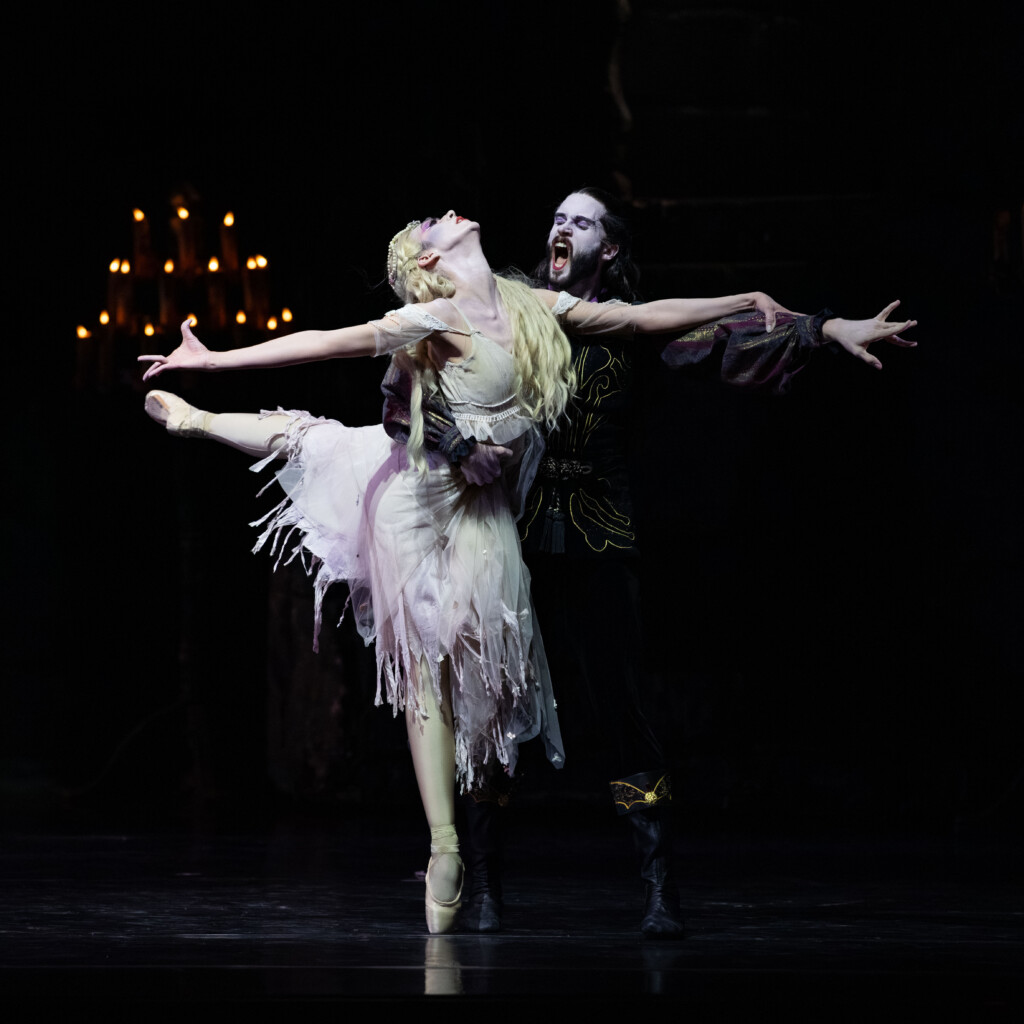
Ballet West has performed many enchanting, delicately choreographed storybook ballets with great success. Meanwhile, Ben Stevenson’s Dracula truly allows the company to flex their artistic muscles in a contemporary theatrical vein where many wraithlike characters demand intricate revealing choreographic flourishes which not have been usually seen since the likes of silent film classics such as Nosferatu.
Stevenson created the ballet 30 years ago to coincide with the centennial of the publication of Bram Stoker‘s famous Gothic novel. While the ballet is reminiscent of 19th century classics (notably Coppelia), Stevenson’s Dracula effectively compacts the loosely adapted narrative in a neo-Romantic framework. As Adam Sklute, Ballet West artistic director, explained in a note, “This is not too dissimilar to how Bram Stoker himself borrowed from other famous Gothic horror stories to create his novel.”

Ballet West’s brilliant opening night performance in the Capitol Theatre proved the case for Dracula’s artistry. Adrian Fry’s Dracula is far from the loathsome creature in Stoker’s novel. He ratchets up the seductive dynamic which the Hungarian-born actor Bela Lugosi (who in real life was addicted to drugs just as suggested by his famous character) shaped when the cinematic horror classic of the 1930s introduced audiences to a vampire driven by romance just as much as bloodlust. Fry’s stamina for the role must be admired, just by the sight of the cape with its broad wingspan which surely must weigh in at least 30 pounds.
As Flora, Nicole Fannéy is stunning in her seamless transformation from an innocent villager who is ravished by Dracula during their pas de deux to a tormented growling ghostly fragment of her pristine self. Katlyn Addison’s Svetlana, daughter of the innkeeper (incidentally portrayed on opening night by Tyler Gum who also performs as Dracula in one of the rotating casts) and Hadriel Diniz’s Frederick, her suitor and the hero of the night whose third act appearance brought loud cheers and applause from the house, put on a clinic of exquisitely executed lifts. Their partnering is naturally luminescent, with both dancers staying in character even as they execute complex movements. Addison’s repertory of en pointe and flat foot dance movements, along with demi-ballonés, brought generous applause each time they were performed. Likewise, Diniz won the audience’s vigorous endorsement with his leaps and tours à la seconde.

The cinematic expanses in this production are emphasized by the large cast’s presence. The technical demands are equal across the board. Because Stevenson associated each movement choice with supernatural and phantasmagorical character features, the expectations for the corps are even more rigorous than what might typically be expected in secondary roles in storybook ballets. William Lynch’s Renfield is magnificent, with his maniacal scurrrying energy. Bryan Gregory and Jadson Santos deserve honorable mention as the horses pulling the ghostly carriage. Equally exceptional is the corps of Dracula’s brides: numbering 18 plus two (Ruby Bennett and Natalie Clayton) who performed the flight choreography. The surrealistic phantom-like brides move in unison serpentine forms, with their arms and hands stretched and fingers bent into clawlike shapes. In their interactions with Dracula, their scenes are enriched in ectoplasmic sensuality. The medley of village dances in the second act, part of a celebration of Svetlana’s 18th birthday, evoke the vibes of their Central European and Transylvania provenance in the story.

As usual, the Ballet West Orchestra, led by Jared Oaks, accentuates the overarching mood in this balletic blockbuster. John Lanchbery’s arrangement of music from the great 19th century composer Franz Liszt is outstanding, considering that the composer never wrote for the stage. It’s an exacting score, with excerpts taken from Totentanz (based on Gregorian plainchant for Dies irae), Mephisto Waltz No. 1, From The Cradle to the Grave and Orpheus symphonic poems, Prometheus, Hungarian March and Hungarian Battle March, among others. Liszt’s piano solos are exclusive for the role of Dracula, and pianist Vedrana Subotic gave them their superior choreomusic impact. In the strings, solos by concertmaster Aubrey Woods and principal cellist Cassie Olson heightened the emotional expressions on stage. Special mention also is due to the section of French horns who enhanced the color textures in the score (principal Brian Blanchard, as well as Nathan Basinger, Steve Park and Anita Miller).
Ballet West’s production of Stevenson’s Dracula is a surefire audience pleaser, with Gothic sets, special effects enhanced by resourceful lighting design, moments of flight choreography and a climactic explosion that brought gasps from a good number of patrons. The special effects are as gratifying as those encountered when visiting one of Salt Lake City’s nationally recognized haunted house attractions.
Performances continue through Halloween. Tickets are moving quickly but several performances including today (Oct. 28, 7:30 p.m) and Halloween (Oct. 31, 2 p.m. and 7:30 p.m) have still good availability. For tickets and more information, see the Ballet West website.
