
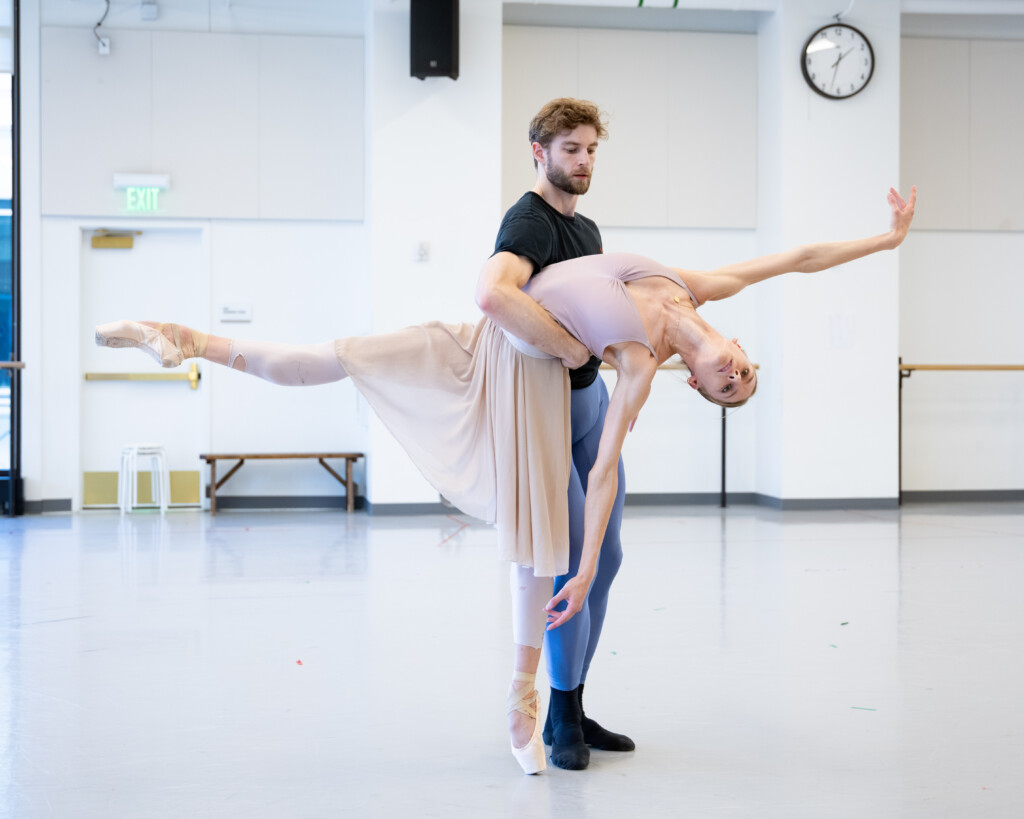
Intimate and pristine are perfect adjectives to describe Ballet West’s newest production, Rolling with the Stones, a quintuple bill which will include four Utah premieres. Opening Friday at the Capitol Theatre, this production also carries special meaning for Adam Sklute, artistic director who is celebrating his final and 20th anniversary season with the company. The production runs through Nov. 14, with five performances.
“This program features repertory in unique ways and it is quite a different program than I originally conceived for a multitude of reasons, as it went through a bunch of incarnations,” Sklute said in an interview with The Utah Review. “It was a question of how do I split this program, which has some associative aspects of my personal life story and what I would like to share with the public in my final season.”

He added, “There is nothing literally that comes straight from my life story, but there are aspects that either took place during my time as a dancer or things that I might have experienced in my life or work which have connected to me in sometimes unexpected ways. It’s a very personal program for me which I didn’t initially expect.”
Likewise, the audience’s journey through these five works will emphasize the throughlines and links in the respective histories of classical ballet, modern dance and contemporary ballet, which became just as integral for realizing Sklute’s thoughts for this program.
The choreographic canvas covers a broad spectrum of emotions. One of Ulysses Dove’s last works, Dancing on the Front Porch of Heaven, featuring Arvo Pärt’s Cantus in Memory of Benjamin Britten, will have its Utah premiere.

The Royal Swedish Ballet premiered the work in 1993 and received its U.S. premiere three years later at a Lincoln Center benefit to raise funds for AIDS research and treatment, just days after Dove died. He created the three-movement work to channel his grief after losing 13 loved ones to death and illness in one year. Two years ago, Ballet West presented Dove’s Red Angels which crossed back and forth across the realms of the sacred and profane, with music associated with images of demons and devils.
As Sklute mentioned in another interview earlier this year with The Utah Review, this latest Utah premiere transports the dancers and audiences to heavenly skies. In his most recent interview, Sklute said Dove was choreographing his own eulogy in this work.
“This was created during the height of the AIDS epidemic and which was still a few years before the turning point with medical breakthroughs occurred,” Sklute explained. Each time we hear the peal of a bell in the work, it represents one of the people that Dove lost in his life.

“I was a dancer in New York during the height of the epidemic and we were losing so many people. It was a very difficult, emotional time to lose so many connections and this work represents that time that I lived through,” Sklute said. “But for any of us who at some point experience loss and must navigate the emotions which come with the death of a loved one, this work allows all of us a way to honor and remember them.”
During rehearsals, Sklute said the dancers have felt such deep emotions, in working with Alfred Dove, a choreographer, dancer and artistic director who stages his brother’s ballets to ensure their original intentions are preserved. In the first few days of rehearsal, Dove didn’t put the music on, which compelled the dancers to dig inside and discover the energy and dynamics of their experiences to recognize and shape the emotional bearings encountered in the work.
“When he finally put on the music, you could see the emotions wash over the dancers because they had been so sure about the steps, but they hadn’t yet fully connected to the feelings expressed in the music. It was a unique process. I hope that it also will be a profound experience for our audiences in the same way that it has been for our dancers,” Sklute said.

The program includes three pas de deux compositions, only one of which the company has previously performed. The two Utah premieres will be Christopher Wheeldon’s Je ne t’Aime Pas (featuring music by Kurt Weill) and This Bitter Earth (featuring music by Dinah Washington as recorded by Max Richter.
Wheeldon is a master of the pas de deux in contemporary ballet and his works fit beautifully in Ballet West’s wheelhouse. One pas de deux captures the emotional pain encountered when relationships end (a dynamic that certainly Sklute and many of us can relate to) and the other reflects, as Sklute explained, the experience of some type of discrimination in their lives or those who have fought against it on the behalf of others.
Je ne t’Aime Pas (I Don’t Love You ) is inspired by a 1934 song of the same title which Kurt Weill set as a French cabaret chanson. The choreography mirrors the process of romantic breakup, where conflicting emotions make the decision of heartbreak more emotionally painful and difficult to contemplate. The piece will include piano and vocalist on stage.
The second Wheeldon pas de deux, This Bitter Earth, premiered in 2012 as part of a larger work. It is inspired by the song of the same title which Clyde Otis wrote and Washington covered in a popular recording. This is remixed with Richter’s music On the Nature of Daylight, which was included in the soundtrack for the 2010 film Shutter Island.
The only composition on this bill not a Utah premiere will be Ben Stevenson’s Three Preludes (featuring music by Sergei Rachmaninoff). This Stevenson work, first produced in 1968 for New York’s Harkness Youth Ballet, was one of the first ballets Sklute brought to Ballet West during his tenure as artistic director.
The three sections span the phases of a relationship : courtship, honeymoon and milestone anniversary. “I look at this piece as a personal celebration for me and my spouse [Christopher Renstrom], as we have been together for 34 years,” he said.

Another personal connection is tied to Jared Oaks, now the conductor of the Ballet West Orchestra. Years ago, Oaks, who had just graduated from Brigham Young University, asked Sklute if he could play piano classes for the company. When Sklute brought this ballet to the company, Terry Kern, who was then music director for Ballet West, asked Oaks to play the piano accompaniment on stage.
When he was considering staging this work as part of his final season, Sklute said that Oaks offered to play the music because the initial experience had created such an important connection to Oaks’ place in the company. “It means so much to me that it will be played by our Maestro [Oaks] and it is such an honor to have this very personal touch,” Sklute added. Of course, the Preludes also offer a second tribute (after Dracula) the company is making in memory of Stevenson who died earlier this year.
Completing the quintuple-bill will be the headliner: the Utah premiere of Christopher Bruce’s Rooster, a 1991 work with eight dances, each set to a Rolling Stones song. The vibe switch will rivet the audience, as the choreography incorporates jazz, disco and contemporary dance techniques, along with elements especially seen in contemporary dance, including pedestrian movement, gesture, social and folk dance.
For those who know the Rolling Stones catalog well, it will be intriguing to see how Bruce has selected movement motifs to align with a specific song track. The set list includes Little Red Rooster, Lady Jane, Not Fade Away, As Tears Go By, Paint It Black, Ruby Tuesday, Play with Fire and Sympathy for the Devil.

The 27-minute work received its world premiere in 1991 at the the Ballet du Grand Théâtre de Genève. Its American premiere came 20 years later at the Houston Ballet. Sklute said that Bruce’s ballet style is brilliant for how it ingeniously combines with the vocabulary of Martha Graham’s modern dance technique. This approach has been equally integral in Ballet West’s efforts to expand and diversify its repertoire during Sklute’s tenure.
Sklute recalled his childhood days when he lived in Europe when he heard the rock music of this era and noticed the counterculture which had emerged. Later during his time as a ballet dancer, many choreographers, such as Bruce, were pioneering ways to combine rock music with classical ballet. Rooster’s nostalgia seems timelessly buoyant, even as it tips its hat to songs that are more than 60 years old. Rest assured, the dancers will move with the alluring swagger of Mick Jagger, simultaneously ramping up the natural comedic stakes along with the clever ironies of women who know how to chasten and control the ‘rooster’ in the dating game.
For tickets and more information, see the Ballet West website.