
Several late summer exhibitions at the Utah Museum of Contemporary Art (UMOCA) are set to close soon. The Utah Review offers a roundup.
Eleanor Mahin Thorp: Snowtrickle, feldspar, dirt (through Sept. 19)
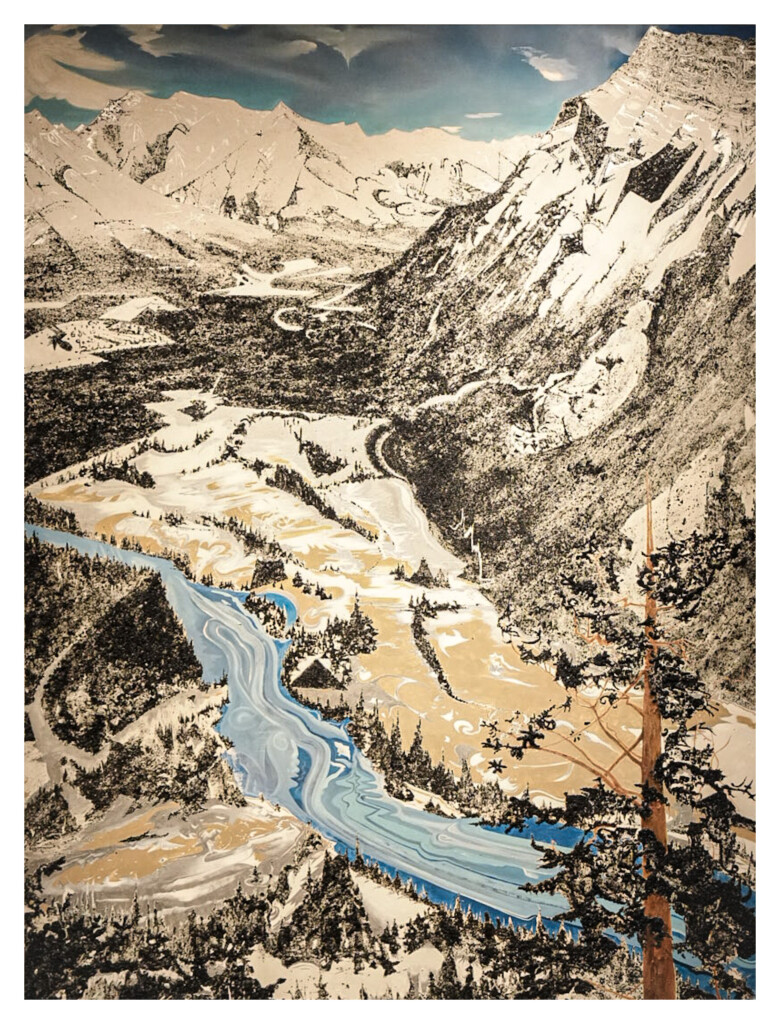
In her show, Snow-trickle, feldspar, dirt, Eleanor Mahin Thorp adds rich textures (pigment, mineral matter, and surface disruptions) to her paintings which documents the effects and impacts of human interventions even though there is no literal representation of humans in these extraordinary paintings, rendered both in large and miniature sizes. Some have topaz, sapphires and moonstones which she collected in the deserts of the American West as well as in Montana. There’s also a painting which incorporates mica she collected in Chile’s Atacama Desert.

Photo: Charles Vaccaro.
The exhibition title comes from the last line of Gary Snyder’s poem For Nothing, part of Turtle Island, which was awarded the Pulitzer Prize for poetry in 1975. The parallels with Snyder’s formative experiences are striking. Snyder lived on the perimeters of logging country in Washington. Meanwhile, Thorp channels her childhood observations of mining operations in the American West and the instinctive Persian cultural roots she inherited from the fortune-telling traditions that earlier generations of her family practiced. Understanding that history is always a living thing, we rediscover these landscapes with refreshed lenses of appreciation and respect in our behaviors and responses to conservation and preservation not as colonizers but instead as natives.
While the human figure is not present in her work, Thorp said, “that our human instincts are very much present in the works and they have so much to do with the decisions we make about these places.” In one of the smaller paintings taken from an image of southern Utah, there is an arrow that could have been placed in a trending chart for the stock market imposed on the landscape. The metaphorical parallel sounds right, as we think about landscapes in valleys and plateaus and how lands are vulnerable to extraction of natural resources. The shadowy spectres are evident.

Thorp’s work is best appreciated with patient focused viewing so while one might not be able to pick out all of the textured elements on one of the larger canvases, the smaller scale works are gateways to a more intimate understanding of the way Thorp responds to the landscapes so that even in their larger scale the viewer can gain a similar degree of appreciation for how each of these details had a specific placement in the painting.
“His writing drew attention to the moments and places where we were imposing ourselves on the landscape, but he never made it feel like some kind of doomscape,” she explained in an interview with The Utah Review. Likewise, her paintings, like Snyder’s etymology in his essays and poetry, are deep weaves between human presence and nature with animistic connections.

Photo: Charles Vaccaro.
Growing up in a home with Persian heritage, Thorp remembers niche images such as one depicting the Prophet Muhammad’s face which was made up of images of camels and foxes as well as images of faces trapped in stone. Looking at a lot of mines in Utah, Thorp imagines what if the facades of demons were cast into stone and then thinking more broadly about casting human images on the landscape. She also was captivated by the mystic beliefs and fortune telling her mother enjoyed practicing. Thorp considered that perhaps there are no inanimate materials and that even something as benign as a rock and stone could contain an image that signifies animacy. In his literary output after modernism, Snyder, who spent many years studying Zen Buddhism and the richly detailed imagery conveyed by Tang dynasty poets, considered this representation as extensively as Thorp has pursued in her art.

Alfredo Jaar: The End (through Sept. 19)
In The End, in UMOCA’s Projects Gallery, international award-winning artist, photographer and filmmaker Alfredo Jaar from Portugal, captures the dire days of the Great Salt Lake’s existence and the painful realization that it will disappear. The presentation is stark. The series of photographs, which the artist describes as “visual whispers,” are printed in a small, unspectacular format. This is a lament and elegy, vividly expressing the perspective of the lake’s existential crisis. Take care to inspect the unique vantage point captured in these extraordinary photographs from a master. His portfolio honors include the following: Guggenheim Fellow (1985), MacArthur Fellow (2000), Hiroshima Art Prize (2018), Hasselblad Award (2020), IV Albert Camus Mediterranean Prize (2024), Edward MacDowell Medal and the 11th Prix Pictet (2025).

Alexis Rausch: Rapture | Rupture (through Sept. 12)
In UMOCA’s Artist-in-Residence (AIR) Space, Alexis Rausch’s installation Rapture | Rupture articulates, visual imagery, representing roadside, memorials, and billboard evangelism without the context of what the artist calls “a clear, moral hierarchy.” the installation refers to found imagery of Christian gatherings and dances sourced from around the country. One intriguing parallel reference in the exhibit harkens to the late Ralphael Plescia’s conversion of a three-story State Street warehouse near downtown Salt Lake City which Plescia turned into a cathedral-like installation of devotional art for more than five decades. The artist’s efforts were documented in a 2016 short film by Torben Bernhard, Travis Low and Marissa Lila in association with KUER-FM’s VideoWest initiative and Artists of Utah’s 15 Bytes.
Plescia’s work certainly challenged a viewer’s perceptions and biases of what they think as appropriate religious experience, just as Rausch’s installation interrogates gallery visitors. There was an obvious curiosity, novelty and unconventionality of Plescia and his work. He was viewed by many as eccentric to the extreme yet, as the short film that documented his works, Ralphael’s Gospel interpretation revealed its profound and utterly moving beauty. Viewers could feel the creative manifestations of Plescia’s emotions. Those reverberated for him personally in discovering the darkness and uncertainty of longing for the inevitable reunion with all (especially his loved ones who died suddenly or so tragically young) and in God’s grace, as he explained it. Grief was always a constant in his life. There was a great deal of emotional pain he experienced.
Rausch’s work effectively amplifies these same questions. “I am not trying to sell anything other than knowledge,” Plescia said in the short film. “In art I am trying to show how I think it was. [I am] defending the Bible as written.” When asked about where he derived his authority, he explained that everyone, regardless of church or individual, has the authority of free agency to “write and see and look and observe and do anything [they] want. And we all have that right and authority.”
The images Rausch incorporates also show that suffering is not necessarily physical but is also borne as spiritual or emotional suffering. Plescia’s theological aesthetics that transformed an ordinary warehouse space into an extraordinary place of veneration were driven by exploring the deeper meanings of symbols to find a spiritual interpretation that directed him to his accepting the literal realities of The Bible as it was written and to find solace in his own turbulent existence.

Rick Silva: Dirt Nap (through Jan. 2)
UMOCA visitors should make the habit of including the Codec Gallery in their visit. It is the site of a wonderfully curated set of video art in the short film format, ranging in duration from a few minutes to a half hour or longer. The current offering, Dirt Nap by Rick Silva, is one of the longest that has been screened in the gallery but it also is appealing especially for those who are looking for a visual take on the power nap to destress and realize why nature is beneficial to our psyche and physical well-being.
With no music or text save for the ambient sounds of each natural setting, the film comprises 46 one-minute excerpts of the artist napping in nature. With locations including those in Utah, the film captures settings in many American West states as well as Hawaii. It’s also curious to spot in each excerpt where the artist is napping. Occasionally, he folds into the backdrop so effectively that one wonders if he actually is there.
To make the experience enjoyable and perhaps to encourage visitors to watch all 46 segments, UMOCA staff have placed overstuffed bean bag chairs. Silva succeeds at making the “dirt nap” metaphor relevant and complete here. Indeed, if one is distressed and concerned after viewing Jaar’s photos of a dying, distressed Great Salt Lake in The End exhibit and Thorp’s extraordinary renderings of showing the impact of human presence on natural landscapes without making human figures visible in the Snowtrickle, feldspar, dirt exhibit, spending time with Dirt Nap to understand why Silva asks, “Where will we find healing of these places disappear.”

Photo: Charles Vaccaro.
Review of Interdisciplinary Art Collective performance: Cornelius Cardew: Treatise
It was quite the monumental undertaking by the Interdisciplinary Art Collective (IAC) in an Aug. 28 performance at UMOCA, a definitive exploration of conceptual art, highlighting Sol LeWitt and Cornelius Cardew. Starting with Lewitt’s Wall Drawing No. 39, which is on loan from the National Gallery of Art in Washington D.C., the IAC presented dance, spoken text and live music in realizing the entire score of Cardew’s landmark graphic composition, Treatise, completed when he was 31 in 1967. Rarely is this work performed in its entirety and this certainly was a Utah premiere.
The 193-page score does not indicate preferred duration, instrumentation, or size of the performing ensemble. Cardew created an intricate visual landscape of lines, curves, geometric shapes, and open space, inviting performers to translate graphic logic into art, which Indigo Cook directed for this performance.

Photo: Charles Vaccaro.
Lewitt, who died in 2007 at the age of 79, had declared “the idea becomes a machine that makes the art.” Monumental wall drawings such as the one currently on display at UMOCA include meticulous guidelines for preparing their installation, a process that transforms how galleries and museums think of authorship in the presented art as well as how the visual arts can be a collective dynamic experience. Therefore, Cardew’s Treatise is the perfect companion to Lewitt’s work.
Next weekend, UMOCA will open three new exhibitions. For more information, see the UMOCA website.