
Collin Bradford: Every Rock is a Cloud
Marking Material Art Gallery’s first solo exhibition since it significantly expanded its gallery space in South Salt Lake (2970 South West Temple), Collin Bradford’s Every Rock Is A Cloud will open tomorrow (Oct. 24).
Now based in Utah, Bradford, whose art comes from video, photography, sculpture, drawing, and other forms, examines perception, language, scale and time, using close observation and subtle interventions to make familiar landscapes and natural processes visible. Every Rock is a Cloud embodies his artistic response to encountering the exposed geology of Utah’s landscapes, which have led to think differently about permanence and transformation, and about the ways human experience intersects with much longer processes of geological change.

Many artists who come to Utah from elsewhere often address in their work how their perceptions evolve in viewing the state’s unique nature and landscapes and how to reconnect with them. Bradford came from Grand Rapids, Michigan and the Lake Michigan area where there isn’t much exposed geology. In Utah, he said in an interview with The Utah Review. “I was surprised because I didn’t expect to see how the exposed geology would shape my sense of myself in the land and how that was being integrated into my creative processes.”
As for the title of the show, Every Rock is a Cloud, he explained, “It was an outgrowth of some work that I’ve been making where I’m trying to create situations in which you can see a rock and a cloud in the same moment or even see the rock in the cloud.” However, Bradford’s creative concept goes much broader and deeper than pareidolia, where one’s stimulated brain naturally tends to inscribe some familiar visual imagery or shapes in abstract objects such as rocks and clouds. Many scientists explain that it is a normal extension of our evolutionary mechanisms for survival where we find meaning and comfort in our natural surroundings.
Bradford said that in learning about the geological history and processes which formed this region in the Intermountain West, he recognizes that this land doesn’t feel static. For instance, when an earthquake in Utah occurs, geologists study the extent of tectonic subsidence, by observing how much the valley floors lower and tilt on the down-dropped side of a fault line. The ideals of Utah’s natural landscape as liquid and always in motion and flux have inspired many artists and creators who are struck by the magnitude of the landscape’s geological scale and how so many unseen natural forces are constantly evolving and affecting what is happening beneath the surface of these lands.

John McPhee’s Basin and Range, published in the early 1980s, discussed how early history discounted the idea of continental drift. For instance, McPhee referred to Benjamin Franklin who contended that the Earth’s crust was floating about on a liquid interior. Bradford’s expression, “Every stone is fleeting. Every rock is a cloud,” resonates accordingly.
“I sense that my body is made up of parts of the Earth and one day it’ll go back to the Earth and it’ll become the next generation of bugs and it’ll get absorbed into different kinds of plants and eventually become rock in the future,” he added
When comparing the scale of human time to geological time, Bradford’s exhibition sparks us to rethink the delusional wisdom of phrases such as ‘rock solid’ or ‘steady as a rock.’ For many, clouds are handy metaphors for the human psyche, signifying dreams, ambitions and success. We often think that rocks actually have much less meaning to us, unless that rock becomes valuable for making a profit or it costs to excavate and remove it. But the rock actually carries a great lode of information about the Earth’s geological history and ultimately our own.

“A cloud is an alluring yet ephemeral object that we still point at and identify as a distinct object, and we continue to watch as the clouds float across the sky. constantly morphing, and by the time it’s out of our view it’s probably something totally different or it’s dissolved, but it’s totally changed,” Bradford said. “But we think of a rock as static, stable and maybe permanent which are being arranged and rearranged in many forms but at much different speeds.”
“It will always be, at some point, changing or transforming even if we don’t necessarily see it within a specific frame or range of time,” he said. Bradford added that we typically are “so permanently rooted in our fear of our own impermanence that we try to do things that will outlast us as a sign that maybe we existed and were significant.”
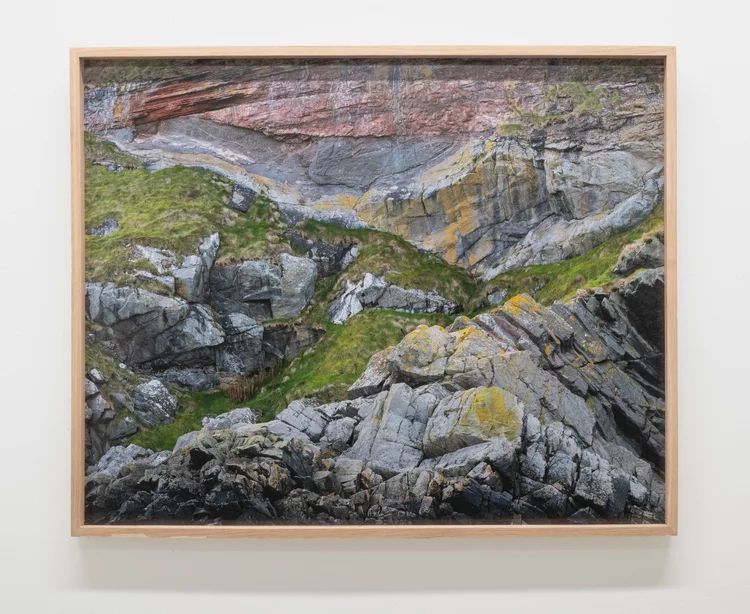
Bradford, who has worked extensively with video in his creative milieu, is sensitive to finding poetic rhythms and cadences in his work,especially as they illuminate a conceptual path for making deeper meaningful comparisons in the counterpoint between the respective scales of time in human civilization and the Earth’s geological evolution. As viewers engage with his new show at Material Art Gallery, a useful elucidating starting point could be his three straightforward landscape photographs, which were captured at a location in Scotland, considered the birthplace for geological science’s understanding of ‘deep time.’
In 1778, James Hutton visited Siccar Point, located on Scotland’s east coast overlooking the North Sea. As BBC’s Stuart Kenny noted in a feature this year, which also marks the 300th anniversary of Hutton’s birth, “Hutton realised that for those darker rocks to have formed in horizontal layers, then tilted upwards, eroded away and buried beneath the younger sandstone, immense spans of time must have passed. So Earth, he concluded, couldn’t possibly have been created in 4004 BC, as was the Biblical view at the time. Rather, it must be unfathomably older.”

Bradford rented a boat and basically retraced Hutton’s journey to glimpse upon and experience what the famous scientist must have thought about in realizing how Siccar Point convinced him that the Earth’s geological age was much, much older than what many believed at the time.
Bradford’s work has been exhibited nationally and internationally in traditional art spaces as well as film and video festivals, including the Urban Institute for Contemporary Art in Grand Rapids, Michigan; the Utah Museum of Contemporary Art; Anthology Film Archives in New York; New Insight at Art Chicago; the Cologne International Video Art Festival; and Channels Video Art Festival in Melbourne, Australia.
The exhibition opens tomorrow (Oct. 24) with a reception at 6 p.m and a brief talk by Bradford at 7 p.m. The exhibition is open through Nov. 20. For more information, see the Material Art Gallery website.
After the Unmaking: New Ground
Marking its third anniversary, Material Gallery celebrated it by featuring works by seven artists in its recently expanded gallery space. After the Unmaking: New Ground was curated by artist and educator Moses Williams, featuring work by David Onri Anderson, Isabella Covert, Elise Drake, Fawn Krieger, Ron Lambert, Kiera Ohrn, and Jacob Riddle.
The exhibition represented a diverse range of creative formats, including painting, sculpture, textiles, video, performance, and mixed media. The organizing thematic question posed what might become possible when familiar systems and predetermined outcomes no longer define the limits of our imagination. As Williams noted, the principles of materiality, experiential knowledge and corporeal relation comprised the conceptual foundations of the exhibition. He noted, “ “The future we reach for is not a better version of the past. It is something else entirely.”

The show successfully evoked this auspicious celebration of Material Gallery’s quickly earned success in the Wasatch Front’s ecosystem of art galleries and exhibition space which have fortified the thriving presence of contemporary art in Utah.
The show was notable for its draw from artists elsewhere in the country. Among the most vivid examples embodied in this exhibition’s creative brief was Progeny Tangle (2026), a nylon and latex sculpture, by Isabella Covert, a sculptor and painter based in New Jersey. The strikingly recognizable synthetic recreation of human physiology reflects the artist’s astute understanding of the body’s external features and appearances as they relate to the body’s interior structures and responses to changes, injury, trauma and healing.

Many of the artworks shown are products of substantive materials research which touch on concerns explored in other disciplines. Elise Drake’s resourceful ingenuity comes through in works such as Chewy Noodles (2026), made of latex tubing, which looked convincingly like the noodles one might find in a package with ingredients to make macaroni and cheese or Parasite, made from cast paper, aluminum, biodegradable thermoplastic polyester and yarn. Her large-scale Stream, 2024-2026, with natural and synthetic fibers woven throughout, chronicles her interests in transforming archives, accumulated materials, and domestic remnants into works, which jolt us back into thinking about the deep concerns we have for protecting and preserving our identities and rights for human agency as unproven and untested technologies threaten their existence.
A New York-based artist, Fawn Krieger extends these considerations in her long-running series Experiments in Resistance, which, as she explains, press under-glazed and fired clay volumes into ceramic troughs containing wet, usually dyed cement. The dark, foreboding colors emphasize the mood and tone in the series, which she began during the first Trump administration and whose relevant connections appear more urgent than ever.

The sociopolitical emphasis emanated in works by other artists just as prominently. Couched in psychology and the naivete and vulnerability of human perceptions of trust, Ron Lambert’s Wolf In Sheeps… (2024) immediately caught the eye and its sleight of appearance, a work comprising rock, plaster, steel, glass, and sheepskin. Kiera Ohrn’s study of our bodies’ intersections with and impacts from our immersive relationships to technology, consumerism, surveillance and digital worth came through in a nine-foot-tall sculpture, Ctrl+Shift+Cbb.ignoregameplayunlocksentitlement (2026),made from silicone, vinyl tubing, stainless steel, and hair. Jacob Riddle’s interests in reverse engineering and degenerate processes, fueled by his background in construction, labor and rural Appalachian life, were represented in several pieces, including a strikingly elegant ensemble of Degenerative Nails, (2026) made from foraged Pine Resin
Providing an illuminating companion to Ohrn’s work, David Onri Anderson’s three works on raw canvas were just as captivating. Saturn’s Return (2023), comprising marigold dye, acrylic and metallic paint, and graphite on raw canvas, came from his Inter-Dimensional Beings series. He began the series during the pandemic, inspired by his research on occult, tantric and spiritual practices.
