
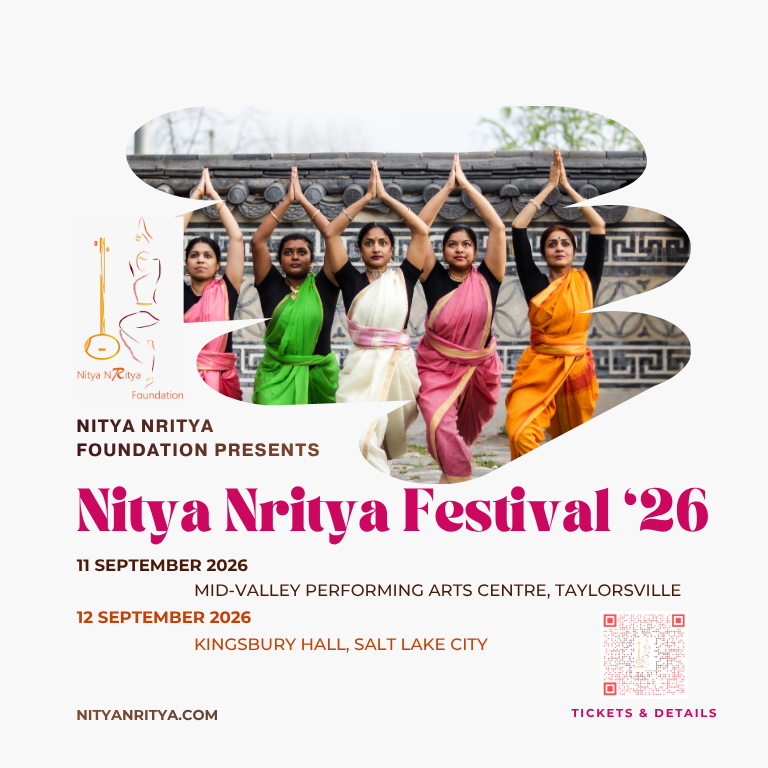
One of the most extensive weekends of events ever held in Salt Lake City focusing on Indian classical and contemporary dance and music, including Bharatanatyam repertoire (pronounced Bah-rah-the-na-tee-yum) as well as a fusion of Carnatic classical music with contemporary jazz and funk styles will take place Sept. 11-12, respectively, at the Mid-Valley Performing Arts Center and at Kingsbury Hall, in coordination with UtahPresents.
This is the Nitya Nritya Festival’s 10th anniversary but there are two new venues. The first nine events were held at the Rose Wagner Center for Performing Arts. Organizers believe that with the SLC metro area’s rapidly growing South Asian community, the anniversary is an opportune moment to heighten the visibility of India’s contributions to the extraordinary, diverse fabric that has long made Utah a champion for dance and music cultures, according to Jyothsna Sainath, originally from Bengaluru, India, who studied under numerous renowned gurus and scholars.

The emphasis on how traditional forms of dance and music can translate to appreciative impact is notable. As The Utah Review has explained previously, For viewing, Bharatanatyam is an entrancing experience, as this dance form dates its origins to the late 16th century. It is a surprisingly approachable form because human emotions are effectively communicated even in the movement of arms, hands and fingers a well as subtle facial and eye gestures. One does not necessarily have to understand Bharatanatyam’s underlying cultural manifestations. But it whets one’s intellectual curiosity to learn more about the art form, especially in how it celebrates the power and divinity of the feminine. While the art form was conceived within the upper-class realms of the royal courts, its current practices resituate its significance and reclaim its value for the egalitarian purposes of empowering women.
“Traditional Bharatanatyam repertoire does not lack philosophy or complex thought; there is much that forms the foundation,” Sainath said. “Yet, it often relies on the literal and on concretization through storytelling to connect within a shared cultural framework within India.”
For the benefit of those attending this weekend’s events, Sainath emphasizes, “When one operates outside that framework — such as here in Utah — that same literalism can create a barrier, alienating audiences from the core ideas. In this context, one can probably gain more by going in the opposite direction, which is through abstraction.” Thus, audiences can immerse themselves in the gifts of classical and contemporary Indian arts without worrying excessively about a singular interpretation.

The festival will open with a Sept. 11 performance at 7 p.m. in the Mid-Valley Performing Arts Center, featuring Vilāsa by guest artist Praveen Kumar and Punaha by the Nitya Nritya Dance Ensemble. Bridging traditional Bharatanatyam choreographic elements with modern motifs. Kumar founded the Chithkala School of Dance. Effusive in joy and charm, Vilāsa emerges as a playful conversation between the Divine and the devoted believer. Before the Nitya Nritya Dance Ensemble takes the stage, Sainath and Kumar will talk briefly about the shifting ground for aesthetics in Bharatanatyam expression.
Punaha explores the multiple dimensions of the divine feminine in South Asian sociocultural contexts, marked by the dichotomy of such divinities as creators-nurturers and protectors of community. “The ancient Shakta tradition of worshippers of the feminine divine has over the millennia developed into a sophisticated philosophical study of psychology of human failings,” as indicated in a program note. “Often times, the ill-understood metaphors of natural phenomena stand for astute observations on the human mind. Joining Sainath for the performance will be Sarayu Ramanan, Aiswarya Josyula, Parimala Maremanda, Rashmi Hungund, Anusha Manchi and Soundarya Jayaraman. Again, as noted previously in The Utah Review: We are accustomed to the physicality of movement in other dance forms especially as artists strive to transform themselves into the characters of the narrative being told choreographically. In Bharatanatyam, dancers strive for similar effects but their subtle poise, eye contact and facial expressions go a long way beyond physical limits.

The first of three Sept. 12 events at Kingsbury Hall will feature an 11 a.m. performance by The Alaya Project, which was established more than 20 years ago in Oakland, California. The trio features Indian percussionist and drummer, Rohan Krishnamurthy, Prasant Radhakrishnan on saxophone, and keyboardist Colin Hogan.
Having received initial training on the mridangam with Damodaran Srinivasan in his hometown of Kalamazoo, Michigan, Krishnamurthy also studied with legendary maestro Sri. Guruvayur Dorai in Chennai, India. He explores the intersections of Indian percussion with a contemporary jazz and funk drum kit, which he perfected in his studies at the California Jazz Conservatory. His hybrid kit bridges drum set and Indian percussion, and stick and hand drumming. He has worked on extended techniques on tabla, and adapted Carnatic and Hindustani rhythmic repertoire across mridangam and tabla. He also designed and patented a drumhead tuning system now available worldwide.
A saxophonist well versed in South Indian Classical (Carnatic) and jazz, Radhakrishnan studied with the definitive Carnatic saxophone pioneer, “Padmashri” Dr. Kadri Gopalnath, Radhakrishnan was initiated into the world of Carnatic music in a format seldom available today in India, much less in his native Arizona. Radhakrishnan has performed in concert halls in India and jazz venues in Japan,as well as concerts, cultural festivals, and lecture demonstrations in North America. He has also lectured in several universities in the U.S., including U.C. Berkeley, UNC Chapel Hill, University of Chicago, and Wellesley College, among others.
A member of the jazz fusion trio The Hogan Brothers, Hogan’s cosmopolitanism is exceptional, incorporating jazz, funk, R&B, and pop, along with Timba, Tango, Gamelan, Highlife, Soukous, Afro-pop, North Indian Classical music and others. The brothers, born and raised in the San Francisco Bay Area, also have studied internationally with master musicians in Indonesia, Cuba, Ghana, and Brazil. The brothers are collectively involved in many projects and have performed extensively throughout the U.S. and Brazil, Turkey, Indonesia, England, France, Switzerland, Italy, Canada, Mexico, Barbados.

The second Sept. 12 will be a free hourlong lecture and demonstration of Indian classical arts, led by festival artists, beginning at 1 p.m.
The festival will close with a 7 p.m. performance at Kingsbury Hall, Rogue Gestures/Foreign Bodies with five dancers from Nava Dance Theatre. Founded by Dr. Nadhi Thekkek, Nava Dance Theatre is dedicated to choreographing contemporary Bharatanatyam works that explore identity, migration, and belonging through a South Asian diasporic lens. Founded in 2012, the group’s artistic mission is to shape Bharatanatyam as a medium to explore identity, place and politics through the lens of lived experience. Rogue Gestures/Foreign Bodies, set by Thekkek, encompasses Bharatanatyam, experimental movement and music celebrating women and immigrants in the U.S. The work is based on themes of collective strengths, originally inspired by the oral histories of Indian nurses who arrived as a result of the 1965 Immigration and Nationality Act.
For tickets and more information, see the Nitya Nritya website.