
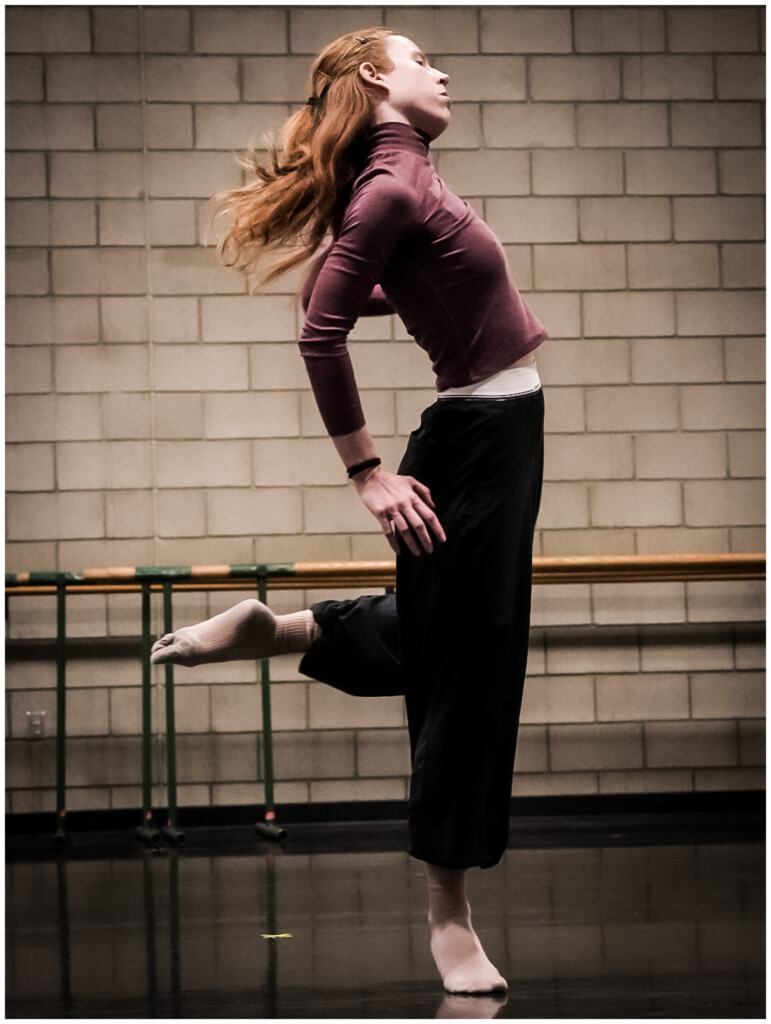
The world premiere of Penny Saunders’ Legend Has It will fit perfectly into Repertory Dance Theatre’s (RDT) 61st season opener, Legend & Lore. It’s a smart segue from the company’s exceptional 60th anniversary season celebration of its own history.
Saunders’ commission is the inaugural offering in RDT’s Living Landscapes initiative. Legend & Lore also features a restaging of a 1994 commission, the second RDT performance of a 1946 Martha Graham work which was recreated in a 2016 suite and a 1956 work, which RDT acquired in 1970, set by a dancer who founded the University of New Mexico’s dance program in the 1940s.

Photo: Charles Vaccaro.
LEGEND HAS IT: PENNY SAUNDERS
While Saunders’ starting point might have been Great Salt Lake’s geography, one spark for her commission came from her curiosity about the 23-foot-tall whale sculpture which breaches the roundabout in Salt Lake City’s Ninth and Ninth neighborhood near 1100 East. An internationally known choreographer who has traveled extensively to set new works but is based locally, Saunders explained as she contemplated the show’s theme, she connected the sculpture’s peculiar provenance to an elaborate hoax that first popped up in a Utah newspaper in 1888. The story indicated that an English entrepreneur, James Wickham, transported whales via train in the 1870s so they could thrive in the Great Salt Lake. The aptly named Out of the Blue sculpture, erected just a few years ago, has rejuvenated a 140-year-old legend.
A freelance choreographer, former Hubbard Street dancer and Princess Grace awardee, Saunders has created a choreographic counterpoint about the whimsical and darker implications of urban legends and myths. Accompanying dance movement that is imagistically clear throughout the work, there are recorded snippets of voiceovers by dancers sharing their thoughts and recollections about the lake and its history. These are interspersed with a sound score composed by local musician Daniel Clifton which includes a clip of a song by The Swingle Singers.

“I wanted to bring the darker side out because there’s a very thin line between a myth, a lie and a conspiracy theory and how easily the masses can be manipulated,” she said in an interview with The Utah Review. Considering that misinformation has become such a huge issue, Saunders wanted to explore what makes us celebrate and romanticize a particular legend or myth which potentially might be good for society while another can shock and alarm us about dire circumstances of a legend or myth that metastasizes into a foreboding conspiracy theory. When most of the company dancers admitted they didn’t hear about the historical hoax that suggested humpback whales had thrived in the lake, they took to Wikipedia. That became a useful prompt to start setting the work, which blossomed over the matter of a few days. In addition to gathering and recording the dancers thoughts, Saunders turned to quotes by famous authors who have written about the art and culture as well as the more consequential implications of myths and legends.
For the task of designing the sonic canvas for the piece, Saunders selected soundbites that could naturally be spoken in a casual conversation. Some are humorous. For instance, one dancer said, “I think about the brine shrimp.” Everyone laughed after hearing that during a studio rehearsal. “I do think dance gets a little too serious sometimes and it’s not always palatable or accessible to an audience,” Saunders added, “especially when the work is very serious about expressing the huge concerns about the shrinking of the lake.”

With a structured script, Saunders said, “I knew that I had to choreograph off the script,” adding that she often does a lot of the sound design herself where she can slip into the world she envisions without necessarily having a middleman. She envisioned the soundtrack with sounds of whales, ocean waves and trains in the distance. Once she processed her vision, Saunders said this made it that much easier to work with Clifton on the dance score. “He knew exactly what I meant,” she explained. “I let him initially create a soundtrack using other works and then I told him, ‘ I need something like this,’ and we went back and forth.” The one track upon which Saunders and Clifton decided not to touch featured The Swingle Singers.
This new commission captures the zeitgeist of the lake’s prominence on the public’s radar. In the last couple of years, the Great Salt Lake has been discussed in many ways extending beyond the typical channels of Utah news.

Photo: Charles Vaccaro.
In 2025, Plan-B Theatre produced The Great Salt Lake Plays, part of Wake the Great Salt Lake, a temporary art project supported by Salt Lake City Arts Council, Salt Lake City’s Mayor’s Office, and Bloomberg Philanthropies Public Art Challenge. One was Just Add Water by Matthew Ivan Bennett and Elaine Jarvik while the other, Eb and Flo by Jarvik, was part of Plan-B Theatre’s 13th Free Elementary School Tour (FEST) production. In January, Abby Ellis’s documentary film, The Lake premiered at Sundance. Recently. Torrey House Press published The Once and Future Lake: Stories for Great Salt Lake anthology, which spanned genres of poetry, nonfiction and fiction. More than a few touched on the territory of Legend and Lore. Lake Woman Leaving: after the Inuit legend of Fox Woman by Nan Seymour frames the warning and consequences of underappreciating the lake’s estimation in plainspoken terms: “Only two traces of lake woman remained: the outline of a great body imprinted in the bed and a fine dust hanging in the air, ubiquitous. They cried out into the night, pleading for her to come back. Their pleas would go unanswered. They were too late, and it was not enough.”
Saunders’ Legend Has It puts a fine point on how we can synthesize these diverse dimensions, as we sort out which legends and myths could be most instructive for cultivating the mindset essential for expanding public awareness about saving, rehabilitating and conserving our natural landscapes and lake ecosystem.

LIQUID INTERIOR: MARGARET JENKINS AND ELLIE KLOPP
Ahead of Utah’s centennial celebration of statehood in 1996, RDT commissioned numerous artists to create the Centennial Landscape Suite, with dances celebrating the Colorado Plateau, Great Basin, Utah rivers, mountains and forests. The second work was Liquid Interior, choreographed by Margaret Jenkins and Ellie Klopp. Premiered in March 1995, at the Capitol Theatre in Salt Lake City, the work explores the Great Basin region of Utah and Colorado through a fragmented, dreamlike landscape of memory and place: “A place of indiscernible boundaries, shards of landscapes, and fragments of memories.” It also features an original score by Philip Bimstein, an Emmy-Award winning composer. It has been 25 years since RDT last performed the piece.
Jenkins and Klopp recently returned to Salt Lake City to restage the work. In an interview with The Utah Review, Jenkins, who founded her own dance company in 1973 and was a Guggenheim Fellowship recipient and a multiple Isadora Duncan Award winner, recalled her Salt Lake City ties: “I had known Linda [Smith who cofounded RDT] and we were in the same generation having had companies for decades.” In her childhood days, she studied with Virginia Tanner, who led the expansion of dance in Utah when she founded the Children’s Dance Theatre in 1949 at the University of Utah. Jenkins’ company also had performed on tour in Salt Lake City.
“Linda [Smith] was very generous, as she took Ellie [Klopp] and me on a tour of the Great Basin landscape,” Jenkins said. She added that she was struck by the magnitude of the landscape’s geological scale and how so many unseen natural forces are constantly evolving and affecting what is happening beneath the surface of these lands.
“A major question for Ellie and me became how does a landscape live inside the body,” Jenkins said. “We explored this through the dancers’ bodies and the forces that transform, shift, gather, separate, release pressure and alternate between rising and falling cycles.” The title comes from the same phrase found in John McPhee’s Basin and Range, published in the early 1980s. Discussing how early history discounted the idea of continental drift, McPhee referred to Benjamin Franklin who contended that the Earth’s crust was floating about on a liquid interior.
The two choreographers also met author Terry Tempest Williams, whose 1991 book, Refuge: An Unnatural History of Family and Place, is a seminal resource and influence on how many writers have covered Utah’s Great Salt Lake ecosystem over the last 35 years. “She also talks about memory and personal interactions in the intimate relationship between a person and a place and how that combination individually guides our outer as well as inner experiences with that landscape,” Jenkins added.
Liquid Interior is bona fide meta. Revisiting the video of an earlier performance of the piece, the choreographers acknowledge how memories shift. Jenkins explained the process of reconstructing the dance becomes another excavation as they work with a new generation of dancers who have their own imaginations of these interiors. The RDT dancers learned the work primarily by the movement archived on video before Jenkins and Klopp came to the studio. “They looked good doing the steps, but that also is not quite what you really want to come through the work,” Jenkins said. “But they [the dancers] were quick learners and they adjusted very easily.”

Klopp, who at the time had been with Jenkins’ dance company for 11 years, was also an artistic associate. Jenkins added that they had equal roles in creating Liquid Interior.
The timelessness is evident in Liquid Interior’s creative brief. In an interview with The Utah Review, Klopp, who is a psychotherapist based in Eugene, Oregon, talked about the effects of distance in time she experienced from when they created the piece more than 30 years ago. “After watching it on video as I prepared to go rehearse with the dancers in Salt Lake City, I was surprised by what the piece said to me in a way that you don’t really see when you’re creating it because you become so involved in the details,” she explained. She added that now she realized how Liquid Interior is untethered to a particular time.
“I think it stands up extremely well and I now find it quite poignant,” she said. Revisiting this work coincides with the ever-expanding realization just how dire and urgent the existential crisis has become not only for Great Salt Lake but also for the region’s landscapes and the overall planet’s environmental health. Liquid Interior resonates for these dancers because RDT has presented more than a handful of commissions in recent years dealing with Utah’s natural ecosystem, including an evening-length work about the Bears Ears National Monument.
“These dancers were so delightful to work with,” Klopp said, adding that it was “quite stunning to see the levels of acceptance, generosity and openness in the RDT studio.”
Working with Bimstein, who composed the score, Klopp said that because she and Jenkins were accustomed to commissioning original music for their dances, the collaboration focused less on rhythmic counts and musical motifs and more on the ideas articulated through Liquid Interior. Klopp said that Bimstein observed rehearsals in the studio; then shared musical ideas which were finessed through ongoing dialogue between him and the choreographers.
In an email statement, Bimstein explained that the score was “built from sounds that I recorded in the Great Basin and Zion National Park.” He added, “the sounds are intentionally distorted (as the choreographers requested) into an abstract and severe sonic landscape.” Bimstein also emphasized a caveat: “If you’ve heard my songs or my more whimsical cow, cat, coyote or casino music, please know that this piece is not at all like that! — but is rather extreme, though minimalistically so … until the soaring conclusion ;-).” Some of the musical material in a slightly altered form would later be incorporated into one of his most popular compositions, Half Moon at Checkerboard Mesa.

DARK MEADOW SUITE: MARTHA GRAHAM
This work received its company premiere last spring in Anthology, which capped RDT’s blockbuster 60th anniversary season, The suite for Dark Meadow was created 70 years after Graham premiered the work, with music by Carlos Chavez. “Both the unison dancing and the partnering have been recognized as some of Graham’s most architectural, ritualistic and profound creations,” Smith explained. “They are clearly inspired by Graham’s love of the rituals of the natives of the American Southwest and Mexico, which she observed as a young woman.” In her original program note, Graham wrote, “Dark Meadow is a re-enactment of the mysteries which attend the eternal adventure of seeking.” As Linda Smith explained in an artistic statement, “I will always cherish taking a class from Martha Graham and remember her whispering, ‘Travel across the floor as you were listening to the secret that the beating of your heart is telling you.’”

Castor & Pollux: Elizabeth Waters
Originally choreographed in 1956 by Elizabeth Waters, Castor & Pollux returns to the RDT stage for the first time since 2021, when the work was performed and recorded on film in Homage, which concluded RDT’s 55th season. Live performances then were not allowed during the pandemic.
Waters was a vaudeville performer-turned-dance artist, teacher and choreographer. Waters, who died in 1993, moved to New Mexico, where she observed and was inspired by the Pueblo tribes’ dance rituals. Prior to moving to the Southwest, Waters had become absorbed with the technique of Hanya Holm, popularly known as one of the Big Four founders of modern dance. The technique emphasizes geometric concepts of planes, space and patterns.

RDT first performed the work 55 years ago and its sense of timelessness comes through the incredible music that Harry Partch wrote for it. Partch, sometimes described as the Magellan of sound, built his own instruments for the music, including bells from glass bottles and a customized marimba.
It’s in two sections: the first, Castor and the second, Pollux, each with three duets and then the company ensemble. Simply, it is a magical fertility rite culminating at the end in the miracle of birth. In Castor & Pollux, we see total harmonization and all eight dancers in perfect conjunction with each other.
For more information about tickets and the season, see the Repertory Dance Theatre website.