
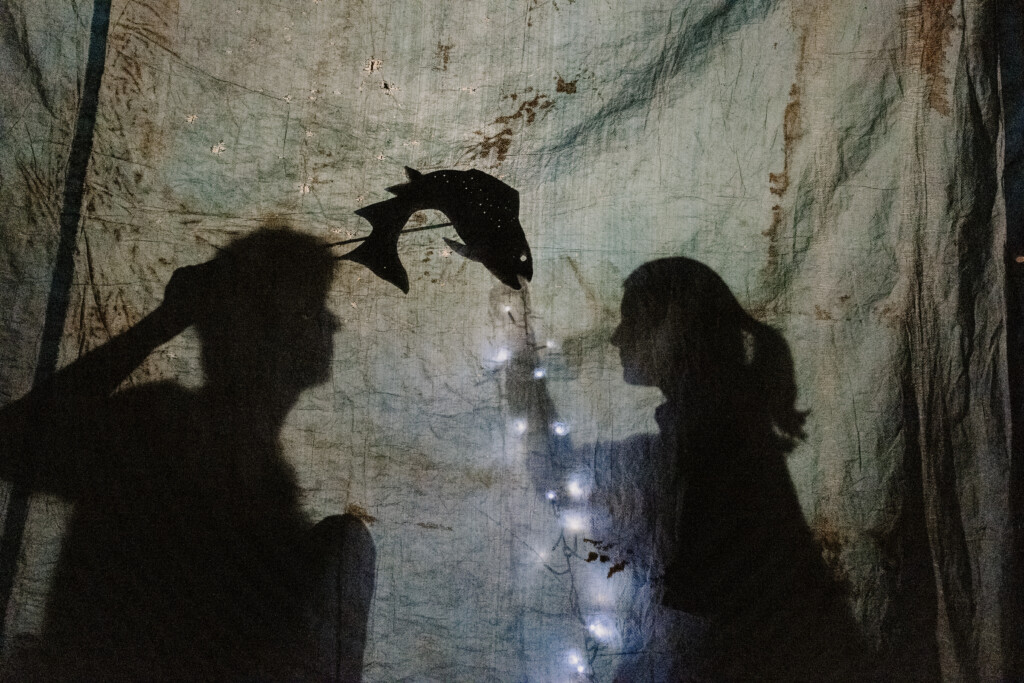
WESTERN MINERALS AND THEIR ORIGINS: FOOTPATH THEATRE COMPANY IN ASSOCIATION WITH FLYING BOBCAT THEATRICAL LABORATORY AND UTAHPRESENTS
Setting an impressive benchmark for UtahPresents’ Stage Door Series opener, Western Minerals and Their Origins by Footpath Theatre Company in collaboration with Flying Bobcat Theatrical Laboratory is among the best chamber theater plays that have emerged over the last 20 years with a setting in Utah’s desert and southern landscapes. Along with its almost cathedral-like scaffolding for its set design, live music and original songs magnify this production’s evocation of the expansive sensations in these landscapes and Utah’s geological uniqueness.
Presented by Footpath Theatre Company and featuring Jessica Graham, Connor Johnson and Harrison Lind, its first iteration occurred two years at the Great Salt Lake Fringe Festival, where it won one of the Best of Fringe honors and sold out its venue. At the time, The Utah Review noted: It is about three amateur rock hunters who venture into the deserts of southern Utah in search of a legendary deposit of Leopard Beryl, the rarest gem in the West, but unexpectedly turns into a much larger exploration going well beyond geology. The story is anchored in flashbacks, and we see history splashed with psychedelic narrative elements.

While The Utah Review also noted that the second weekend performance at Fringe did not provide the full benefit of live music, which would have elucidated a lot more about the play, it was evident Western Minerals had a lot of promise. A good number of shows that started in the incubator that is the Great Salt Lake Fringe have matured into productions which have found success on other stages, including those outside of Utah. Because of its strategically smart creative organic and fluid nature, Western Minerals has made a marvelous case study of this.
The play evolved from its tiny black box frame where pages from an old book set the imaginary plane of its narrative to a garage interior packed with stuff, when its Footpath creators received a Making Space for Artists Grant from the Salt Lake Acting Company. In Kingsbury Hall, all of Western Minerals hidden gems flourish as a young woman is clearing out her brother’s garage before the house is sold. Throughout the play, she is drawn deeper into remembering her brother and the forces of geological time in the Colorado Plateau.
In sum, the play is a moving paean to the Utah wilderness, an emotional panegyric we need to humanize the political discourse which is being shadowed by a dehumanizing administration bent on violating the sacred trust and integrity of protected lands.

The cast and music were consistently good, with Ari (Jessica Graham), Rion (Connor Johnson), Seth (Harrison Lind), Charlie (Ammon Faatau) and Ike (Max Bastiani). The production was directed and co-created by Alexandra Harbold, with co-creators Graham (set supervisor) as well as Johnson (playwright) and Lind (sound designer). Bastiani also wrote the songs. Robert Scott Smith served as artistic producer and production manager.
NEVERMORE: THE PERFORMING ARTS COALITION AT THE ROSE WAGNER CENTER FOR PERFORMING ARTS
The six resident companies at the Rose Wagner Center for Performing Arts have done a fine job at keeping their annual Performing Arts Coalition show fresh every time when it is presented in late August.
In the last three years, the show has clicked with especially gratifying results but the 15th edition, which played to a sold out house in The Rose’s Jeanné Wagner Theatre, turned out as the best of the lot. In NEVERMORE, referencing Edgar Allan Poe’s most famous poem The Raven, the comedy flowed abundantly, featuring the artists of Gina Bachauer International Piano Foundation, Plan-B Theatre, PYGmalion Theatre Company, Repertory Dance Theatre, Ririe-Woodbury Dance Company and SB Dance.

Directed by Fran Pruyn, the production fortified the smart comedic treasures in playwright Matthew Ivan Bennett’s script. The trio of actors was wickedly good. A writer who more recently has enjoyed performing on stage, Bennett reveled in the character of the appropriately named Ham, whose attempt to recite eloquently the poem’s famous lines is interrupted by the no-holds-barred fierceness of the muse Kalliope, magnificently played by Noelani Brown. Representing the Gods of Postmodernism, Brown would be a dynamite game show host anywhere.Rounding out the trio was the costumed and erudite raven Caw played by Aaron Asano Swenson who practically stole the show every time Caw was on stage.
Anchoring the show was pianist Scott Holden who set the opening atmosphere with the fifth in Rachmaninoff’s Op. 39 set of Études-Tableaux, its fervid theme driven by triplet chords all g with arpeggios that accompany a doleful melody. Bennett also scripted prompts for the interludes performed by the dance company. Set to the opening Allegro of Mozart’s Piano Sonata No. 17, Repertory Dance Theatre’s dance, choreographed by Nicholas Cendese (RDT’s co-executive/artistic director) in collaboration with the company artists,ramped up the comedic stakes. They did splendidly in imagining the many ways that Lenore could die, including tuberculosis, dysentery, a stubbed toe and being pecked relentlessly by ravens.

Three of Ravel’s noble and sentimental waltzes accompanied Ririe-Woodbury Dance Company which was darker in tone in its personification of love and death but surprisingly keeping with the show’s overall fun-filled flavor. Finally, to the opening Allegro con brio of Haydn’s Piano Sonata No. 50, SB Dance followed Ham’s declaration: “I give you the dance entitled, ‘Why Is There No Balm In Gilead? ‘ Based upon my suspicions the narrator and Lenore in Edgar Allan Poe’s ‘The Raven’ had an extramarital affair, which ended badly and possibly affected their afterlives.” The choreography heaped the proper irony upon Haydn’s extensively embellished witty musical landscape, while infusing with the subtlest of old-fashioned naughty impropriety.
Rounding out the show was Holden’s dazzling performance of the third movement (choral et variations) of the Dutilleux Piano Sonata, a 1947 masterpiece bursting with a spectrum of tonal colors. It was the dessert for a perfect sampler highlighting the gifts of all six performing arts companies.
THE DEATH OF NERO: THREEPENNY THEATRE COMPANY
NOTE: This show continues through Sept. 13 at the Alliance Theater Main Hall at Trolley Square in downtown Salt Lake City.
Among the bolder moves that this critic recently has seen an independent theater company take in Utah, ThreePenny Theatre Company‘s world premiere production in a translated adaptation of Mikhail Kuzmin’s The Death of Nero is a hot mess, but in the most positive way that this can be expressed. It’s rightly over the top, with its abundant expressions of gender fluidity and drag, which fit the tenor of the play.
Directed by Syd Peronnet with an adaptation by Keenan Shionalyn which translates the Kuzmin the 1929 original script from Russian into English, the production is best appreciated as a passion project, a love letter to Russia’s foremost gay writer who easily could have stood with Great Britain’s Oscar Wilde.
As noted in a preview at The Utah Review, Kuzmin, born in the era of Tsarist Russia and Old Believers and then banished to obscurity as the Bolshevik Revolution became the Stalinist regime, produced an extraordinary output, including poetry, novels, critical essays, musical scores, and plays. For instance Wings, a gay novel by Kuzmin, published in 1906, came 42 years before Gore Vidal’s The City and the Pillar, considered a breakthrough in American literature.

There is a lot of queer heart and soul in this production, which has the benefit of creative license, given that the 1929 play was not published until the 1970s and Kuzmin’s literary output emerged into the light of review and appreciation after the Soviet Union was dissolved in the 1990s.
The play comprises two narratives woven together. Traveling in Rome, Pavel Lukin, a Russian poet, has written a biographical play about Nero which critics have ridiculed. Meanwhile, Nero’s life is the other narrative, as chronicled by Suetonius in his Twelve Caesars. It can become confusing to follow but the company does a good job at elucidating the alternating scenes between the narratives. Yet it is not always easy to find connecting threads of motif between the narratives, which is more the result of Kuzmin’s approach than anything else.
The cast is solid throughout, with Viviane Truman nicely handling the switches from Nero to Pavel. Likewise. Rambelotle does well alternating between Sporus and Marie, Pavel’s wife. Rounding out the cast are Hans Fenton as Friedrich and Mitch Tyler, Camas and Peronnet in the utility cast of jesters.

What stands out in this production is how effectively this company demonstrates the objective of creating upon a usable past, especially from a writer who actually was well-known and respected for his work, with examples that affirmed his sexual identity before he was relegated to near-total obscurity. The contemporary references almost appear naturally in this 21st century adaptation. Watching Turman’s Nero on stage invokes the 2025 comment by veteran politician French Claude Malhuret who said, “Washington has become the court of Nero: an incendiary emperor, submissive courtiers, and a buffoon on ketamine tasked with purging the civil service. This is a tragedy for the free world, but it’s first and foremost a tragedy for the United States.”
For tickets and performance dates and times, see this link.