
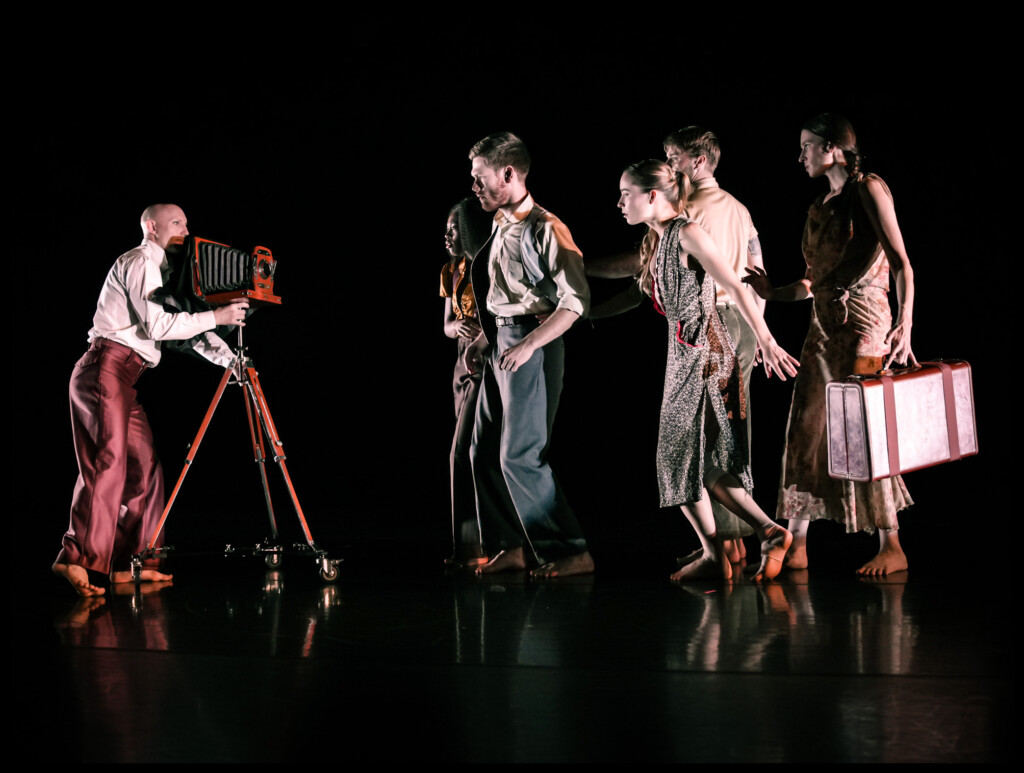
RIRIE-WOODBURY DANCE COMPANY: ACT 1
Expanding the possibilities of dance theater, Ririe-Woodbury Dance Company’s 63rd season opener, Act 1 was as spiritually entertaining and satisfying as it was artistically successful. With two new works by eminent New York choreographers, the production rose upon the company’s legacy of innovative artistic directions that its founders Shirley Ririe and Joan Woodbury trailblazed.
It was notable for Leslie Kraus, who has entered her second season as artistic director, with her first curated season of productions. Act I emboldened audiences to intimately connect with evolving ideals of dance as well as the company’s artists in their genuine selves.

The two Act I premieres instinctively and subconsciously were linked to each other, as audiences were introduced to the complex authentic characters the dancers embody on stage and off stage. Set by the award-winning New York choreographers Dual Rivet (Chelsea Ainsworth and Jessica Smith), Smile Pretty was brilliant. As noted in the preview, Dual Rivet’s piece incorporates a clear narrative arc on the theme of how humans act differently in front of a camera or video lens, a relevant update on the classic dynamics of the Hawthorne Effect. Simply, the camera prop is an integral element in the mise-en-scène of the choreographic staging.
In its broadest definition, the Hawthorne effect, which has been vigorously contested by generations of researchers, referred to studies from a century ago at a factory where workers actually improved their productivity because researchers paid attention to them. Thus, a camera functions like a catalyst altering our perceptions about the purity of reality and the experience of how individuals play to it.
The dance movement investigated the complications of such effects which have implications on how we approach as well as avoid social intimacy. On stage, an ensemble of six dancers comprise a convoy of social support which is mutually offered and reciprocated between them. They even experience moments of exclusive intimacy which they might privately share with each other through their life routines. But there also is a paradox because those same conditions can sometimes make people feel cloistered or self-absorbed. For an unknown reason they insist on keeping themselves private, with such vulnerability that they avoid becoming too close in tightly-knit group settings.

In a remarkably surprising way, the second world premiere, the longer work, Evermore, by Kayla Farrish, ingeniously scaffolded upon Smile Pretty’s thematic premises. Farrish liberates the dancers, as they navigate and push the boundaries explored in Smile Pretty. Here, we see how many of us alternate between the expectations and desires for exclusive intimacy and the seemingly impermeable boundaries we use as personal shields for our deeper vulnerabilities. The fact is that these social modes are possible because of the same social forces mentioned earlier.
Inclusive intimacy happens in our most familiar tightly knit social groups and networks, especially when we know that we can confidently be ourselves, knowing that our individual right to privacy will be respected, when needed. By the end of Farrish’s work, we become aware of and empathetic to the six dancers resplendent in their holistic personalities. The dramaturgical foundations in both of these premieres have set what might be in the company’s Act II and Act III productions later this season. To wit: Act II will be performed at the Utah Museum of Contemporary Art, in a work that completes Kraus’ final installment in a trilogy that started last season.

Just as impressive in Evermore was Alex MacKinnon’s score, which incorporated a script created by Farrish, along with improvised texts and additional material by the company dancers (Megan McCarthy, Cody Potter, Fausto Rivera, Sasha Rydlizky, Miche’ Smith and Luke Dakota Zender). In Smile Pretty, former company artist Peter Farrow performed in place of Rivera and Farrow’s presence melded just as effectively with the five other dancers.
Kraus’s new generation of curation is exciting for how it extends the heritage of what the founders Ririe and Woodbury envisioned during their stewardship. There are plenty of examples in the company’s history. The April 1990 of Pizazz and Percussion turned out to be a scintillating experience of dance theater and live music, featuring The Saliva Sisters, The University of Utah Percussion Ensemble, The Lymph Notes, guitarist Todd Woodbury and actor Lynne Van Dam. Among the works then were Ririe’s Madame X, based on a painting of the same title by John Singer Sargent and Woodbury’s Refusal to Dance, which featured poetry by Gayle Sternefeld, featuring actor Van Dam and guitarist Woodbury. Also, there was Woodbury’s Ladies, Ladies, Ladies, which featured The Saliva Sisters, The Lymph Notes and a faculty quintet from Westminster University.

Finally, at that same program, there was Ririe’s Banners of Freedom, a work which the company last performed in the Groundworks production that opened the 60th anniversary season in 2023. In 1990, premiering just months after the Berlin Wall came tumbling down, it was an artistic tribute to those who were part of history unfolding on live international television. Described then by one critic [Horizon’s Jerry Wroble] as “the purist’s dance of the evening,” it was “enhanced by beautiful banners streaking across the stage.”
Smile Pretty and Evermore signify how dance theater has evolved from the likes of Pina Bausch and Alwin Nikolai, for example. Both Act I works embrace intimate community storytelling and the collective ensemble’s involvement in the creative process, by demonstrating how the vocabularies of dance movement incorporate diverse ethnicities, street culture and art, sociopolitical activism and emancipated expressions of gendered identities.
It is going to be a thrilling season.
REPERTORY-DANCE THEATRE: LEGEND AND LORE
The entwined concept of legend and lore made sense for a dance company’s new season foray after a monumental yearlong celebration of its 60th anniversary. In its latest show, Repertory Dance Theatre (RDT) did not pump the brakes when it came to curating a quadruple bill requiring rigorous technical and stamina demands, which included a world premiere commission.
RDT calls its 61st season one for gratitude and the performances of the company’s core of eight dancers, including two new members, along with guest appearances by an RDT alumna and a Ballet West artist telegraphed a sincere appreciation of the company’s legacy.

The first half comprised two dances by American masters, celebrating the southwestern U.S. high desert landscapes. Originally choreographed in 1956 by Elizabeth Waters, Castor & Pollux was performed with astute awareness of its significant place in RDT’s historical catalogue.
A vaudeville performer-turned-dance artist, teacher and choreographer, Waters studied and performed under German dance master Hanya Holm. Four years before she founded the University of New Mexico’s dance program in 1946, she moved to Albuquerque and lived at the Zuni Pueblo to learn their ceremonial dances and the Pueblo Indian tribe’s knowledge of and artistic connections to their lands. Thinking about integrating this primary research into her dance experiences where the movement language was influenced by its geometric and geospatial contexts, Waters was meticulous about what was allowable in terms of cultural and aesthetic appropriation.
Linda C. Smith, RDT’s cofounder and director emerita who performed the company premiere of the work in 1970, restaged it. This latest performance emphasized the dancers’ collective respect for its cultural sensitivity. Harry Partch’s original score, recorded on instruments he built himself, also has ripened beautifully over its 70 years.

The first-half companion piece was RDT’s second performance this year of the suite for Dark Meadow (2016), arranged by Janet Eilber 70 years after Martha Graham premiered the work, with music by Carlos Chavez. This is a work where the performance quality separates an elite dance company from an ordinary one.
“Both the unison dancing and the partnering have been recognized as some of Graham’s most architectural, ritualistic and profound creations,” Smith explained in an interview last spring. “They are clearly inspired by Graham’s love of the rituals of the natives of the American Southwest and Mexico, which she observed as a young woman.” In her original program note, Graham wrote, “Dark Meadow is a re-enactment of the mysteries which attend the eternal adventure of seeking.” As Smith explained, “I will always cherish taking a class from Martha Graham and remember her whispering, ‘Travel across the floor as you were listening to the secret that the beating of your heart is telling you.’”

Shepherded by Blakely White-McGuire, the regisseur, the RDT octet was joined by guest performers Jaclyn Brown, a former RDT artist, and Jadsom Santos Reis, of Ballet West. While last spring’s performance was solid, this latest rendering was visibly sharper and much tighter in its ensemble work. The solos by Lindsey Armada and Jacob Lewis reinforced just how far the company has come along in engaging with this particular suite. The dancers were in control, especially focusing on the breathing techniques which leverage the dancer’s stamina to ensure Graham’s movement conveys the intended emotional undercurrents being explored in the suite.
The second half opened with Liquid Interior, choreographed by Margaret Jenkins and Ellie Klopp, which was commissioned by RDT 32 years ago as part of its Centennial Landscape Suite initiative. Its technical demands are on par with the Waters and Graham pieces of the first half. But Jenkins and Klopp also give the dancers and audience more than a few layers of expressive information to contemplate. It’s as expansive a psychological exploration of its dancers as it is a symbolic reflection of how we respond to and are touched by natural landscapes such as the Colorado Plateau and the Great Basin. Philip Bimstein’s score, with its good dose of synthetically processed sounds, adds to this introspective intellectual meditation.

The closing work, the world premiere of Legend Has It by Penny Saunders, immediately endeared the audience to it. As noted in the preview published by The Utah Review, Saunders created a choreographic counterpoint about the whimsical and darker implications of urban legends and myths. Accompanying dance movement that is imagistically clear throughout the work, there are recorded snippets of voiceovers by dancers sharing their thoughts and recollections about the lake and its history. These are interspersed with a sound score composed by local musician Daniel Clifton which includes a clip of a song by The Swingle Singers.
This work germinated quickly in the studio. It was evident that the audience clicked just as quickly with the new commission, the inaugural offering in RDT’s new Living Landscapes initiative. The script from which Saunders choreographed the work resounds with the zeitgeist where the public is acutely aware of the Great Salt Lake’s urgent existential crisis. The link to Legend and Lore is channeled via the public’s enchantment with Out of the Blue, the whimsical 23-foot-tall whale sculpture which breaches the roundabout in Salt Lake City’s Ninth and Ninth neighborhood. This same weekend, Whale Fest celebrated the new look for the sculpture, Open Your Eyes by artist Jiyoun Lee-Lodge.

In Legend Has It, Saunders connected the sculpture’s peculiar provenance to an elaborate hoax that first popped up in a Utah newspaper in 1888. The story indicated that an English entrepreneur, James Wickham, transported whales via train in the 1870s so they could thrive in the Great Salt Lake. That same hoax also is the linchpin for a new theatrical comedy (and a good one at that), which received its world premiere at the same time elsewhere in town—Salt Lake Acting Company’s production of Troy Deutsch’s Very Like A Whale.
RDT’s performance of Saunders’ commission was just as delightful as a dance theater piece could be and the choreography matched word-for-word in the accompanying script. Sometimes, even when a story such as whales in the Great Salt Lake strains credulity to the point of wildly humorous dreams, it can still lucidly point us to the sobering realities and risks of ignoring the warning signs about the lake’s health that have been triggered for way too long.