
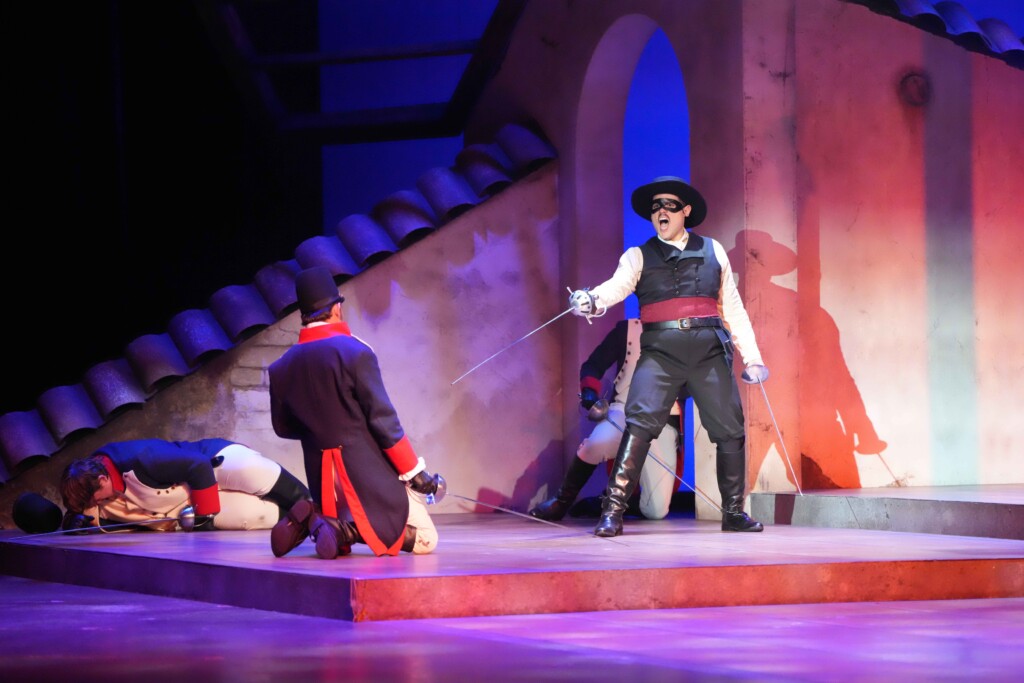
For the closing performance of Utah Opera’s thoroughly pleasing production of Héctor Armienta’s Zorro, the Sunday matinee audience which packed Capitol Theatre in downtown Salt Lake City roared its approval.
This was the eighth production of Armienta’s Zorro, as noted in an earlier preview published at The Utah Review. The opera goes beyond Zorro’s swashbuckling adventures, which have endeared generations of people who discovered the character through reruns of a popular television series as well as film and animated adaptations regarding the double identity of Diego de la Vega.

Utah Opera should be proud for selecting this production as a season opener. Opera lovers, as well as those engaging with the art form for the first time, who come to the hall without concrete preconceptions or expectations, but with an open mind relished the opportunity to witness a contemporary opera that feels like a world premiere, such as Zorro, which is still in the formative youth of its life of live stagings. Without privileged perspectives, many in the audience saw an accessible, generously entertaining treatment of a very familiar pop culture icon, one of the first widely recognized masked superheroes of pulp fiction, television and film history.
With Zorro, Armienta deftly leads us to the bounty of emotional sensations that come with such operatic acts of artistic revealing. There were many moments in the production, thanks also to the grace of David Radamés Toro as stage director, which felt like purely electrifying moments of spontaneous coordination and intuitive alignment between the singers on stage and the audience, which was quite diverse for what one might typically witness at the opera.
It was a refreshing, rejuvenating opener for Utah Opera’s 49th season. In recent years, pop culture icons have become source material for contemporary opera. Rufus Wainwright’s Prima Donna by Rufus Wainwright draws on the legacy and legend of Maria Callas. Perfect American by Philip Glass centers on the final months of Walt Disney‘s life while Anna Nicole by Mark-Anthony Turnage is based on the star-crossed life of Anna Nicole Smith, who initially gained stardom as a Playboy model. Other examples have gained critical acclaim. Steeped in magical realism, El Último Sueño de Frida y Diego (2022: The Last Dream of Frida and Diego) composed by Pulitzer Prize winning composer Gabriela Lena Frank with a libretto by Nilo Cruz had its New York Metropolitan Opera debut last spring. Nicolás Lell Benavides’s Dolores, which is set in 1968 and is based on the life of labor leader Dolores Huerta (incidentally, who is a cousin to the composer), was premiered last year by West Edge Opera in Oakland, California.

To wit: Utah Opera will close this season next spring with The (R)evolution of Steve Jobs by composer Mason Bates and librettist Mark Campbell, which reflects on the later years of the life of Apple’s famous cofounder.
Armienta, who also wrote the libretto, deepens the dramatic narrative stakes and the historical complexities of the border’s sociocultural footprints in Zorro, which historically was a seminal affirming representation of Latinidad in popular culture.
The excellent score is definitely neo-Puccini and Alex Amsel was superb in conducting the opera pit of musicians from the Utah Symphony. Puccini tended toward the exotic when he would incorporate signature bits from other cultures into his Italian works. But Armienta’s score is a more authentic and interesting fusion of Spanish and Mexican musical idioms referencing corridos, boleros, and flamenco. Amsel shaped the score in flattering ways, making Alta, California in 1811 feel relatable, appealing and engrossing to contemporary audiences, even as the undercurrents of racial politics in Mexico are evident in the colonial history touched upon in Zorro.

With such a score resplendent in full-bodied tuneful richness, the singers generally rose to the task. As Diego de la Vega and Zorro, tenor César Delgado effectively embodied a compassionate aristocrat who hesitates about his ultimate role as a revolutionary hero. Meanwhile, Soprano Zulimar López-Hernández, as Diego’s childhood friend Ana Maria Soza and mezzo-soprano Stephanie Sánchez l as Carlota de Obragón, Diego’s former love interest, had their greatest moments in a second act duet. This happened outside the chapel scene, when Carlota confesses she still loves Diego and she gives a handkerchief to Ana Maria, who promises to be always true to Diego. This was one of the opera’s most Puccini-reminiscent moments.
Making the opera’s most formidable villain to the extent that in bows the audience half-jokingly booed him, baritone Octavio Moreno was dynamite as General Octavio Rivera y Moncada, the town mayor who uses fear and torture to squelch rising revolutionary sentiments. Audience members were delighted by the light-hearted encounters between Luisa (played coquettishly by Arianna Rodriguez) and Sergeant José Maria Gomez (played with lovable near-buffoonery by Armando Contreras). Secondary roles were equally good, with mezzo-soprano Sishel Claverie as Toypurina, whom Diego remembers fondly as his nana from his childhood days, and baritone Stephen Pace as Zazueta, the Spanish sword master who christens Diego with his iconic Z.

Other musical highlights magnified the score’s narrative elements, including the ever-solid Utah Opera chorus, well prepared by Austin McWilliams. One of the strongest highlights in the first act came in Katie Sheen-Abbott’s choreographed Flamenco dance. The accompanying bulería in the masquerade ball scene of the first act was co-written with Adam del Monte, the acclaimed flamenco guitarist and composer.