
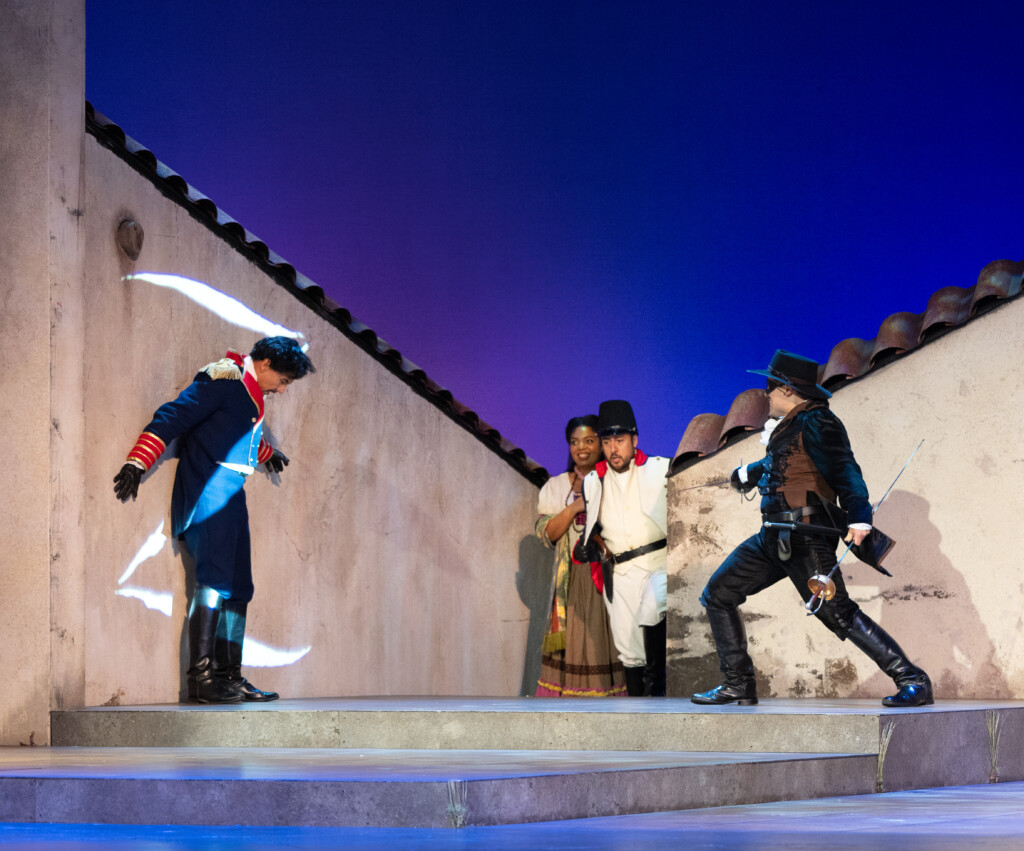
The hero’s journey has been explored in many famous operas: Prince Tamino in Mozart’s The Magic Flute, Richard Wagner’s Siegfried and Parsifal and Leonard Bernstein’s Candide, just to name a few. Composer Héctor Armienta adds Zorro to that genre in the operatic canon, which is about to receive its Utah premiere in a production by Utah Opera.
For many, the exhortation of ¡Viva el Zorro! will jumpstart heartwarming waves of nostalgia about a cultural icon whom Johnston McCulley introduced more than a century ago in a pulp fiction magazine. The opera goes beyond Zorro’s swashbuckling adventures, which have endeared generations of people who discovered the character through reruns of a popular television series as well as film and animated adaptations regarding the double identity of Diego de la Vega.

Armienta situates the story in a period of history when California was still Mexican and Spanish, before statehood. Rather than just a story of a man who comes from wealthy means and a privileged position in society, this Zorro opera embodies the hero who epitomizes the revolutionary cause for justice and independence on behalf of the poor and the disenfranchised who are tortured and terrorized by a tyrant.
Utah Opera’s production, which runs Oct. 10-18 in the Capitol Theatre, is Zorro’s eighth production in the U.S., following productions with Fort Worth Opera, Opera Southwest, Opera Santa Barbara, Opera San José, Arizona Opera, Pacific Opera Project, and Opera in Williamsburg. David Radamés Toro is stage director. Scenery and props for this production were created by Opera San José.
“I wanted to write an opera with all of the bells and whistles that make it enjoyable for audiences, but I think for anyone who looks a little deeper, they will find it’s rooted in California history and an empire that was on the verge of crumbling yet still trying to maintain power,” Armienta said in an interview with The Utah Review. “It is the essential story of humanity, of us searching for something greater than ourselves. I think for Zorro, it’s about justice; it’s about liberty; it’s about freedom, which I think those words resonate with an American audience. Yet it is being told through the prism of a Latino perspective, which I think is important.”

The significance of the historical period setting
Armienta said he chose 1811 as the starting point because sword fighting was at its pinnacle in the early 1800s as well as that specific time was very critical in terms of Spanish history. In 1808, Napoleon’s army invaded Madrid, gaining access under the pretense of establishing an alliance to invade Portugal. Charles IV and his son were forced to abdicate and Napoleon installed his brother as the new Spanish king. Meanwhile, coinciding with the timeline Armienta set for Zorro, in history, the Peninsular War was being fought in Spain and by 1813, the defeated French army retreated.
This understanding of history is captured in the opera’s opening scenes. As Toro added, “I also like the parallels of Zorro’s origin story with the origins of what eventually becomes the Mexico War of Independence.” In a published statement, Toro explained, “The opera’s historical setting reminds audiences that Latino culture is an American culture. That we have always been here and that we belong. Even the way in which the text flows seamlessly between English and Spanish reflects how intertwined Latinidad is in America’s heritage. As the American opera canon continues to expand, I am honored to be a part of a production that celebrates Spanish language opera’s place in telling the multifaceted and diverse stories that make up the history and culture of the U.S.”
The first act opens in Spain and moves quickly to the protagonist’s childhood home in New Spain (Alta, California, 1811, just as the Mexican War of Independence is expanding). This is earlier than in McCulley’s stories, which occur more than two decades later, when Spanish missions became more secularized by the new Mexican authorities.

Born into a Spanish noble family, swordsman Diego de la Vega is impressive in his marksmanship with the Mountain Fortress of the Order of Zazueta in Spain. In his final test, he defeats the entire contingent of master students. Zazueta carves a ‘Z’ into Diego’s upper arm and sends him back to his childhood.
The opera, like the original stories, makes it abundantly clear that Zorro fully comprehends the Spanish code and customs of his upbringing. This is clearly represented in the opera score, which also is infused with Spanish and Mexican musical idioms referencing corridos, boleros, and flamenco. For instance, the bulería in the masquerade ball scene of the first act was co-written with Adam del Monte, the acclaimed flamenco guitarist and composer.
In colonial California, scenes of the poor and enslaved, as seen in Reina de Los Ángeles (outskirts of the pueblo), foreshadow Zorro’s new destiny. The first act also introduces the two women who are the focus of the opera’s tensions in romantic interests. They are Carlota, his love interest from his Seville days, and Ana Maria, a childhood friend from his earlier days in California. After the plaza encounter, Carlota takes Diego to meet General Moncada, who is the alcalde (mayor).
Moncada has been given permission to enforce el sistema de castas. This is an important element in comprehending the complexities of Mexico’s colonial history. The casta system was the product of colonial rule that also influenced social hierarchies and racial perceptions. This is reinforced in scenes, such as when Ana Maria tells Diego that she cannot go to the masquerade ball because she is a mestiza.

Diego learns from the estate caretaker about how his father, who was a hacendado (land owner), died. She tells him that before he died, he sympathized with the suffering of the poor and disenfranchised and had left Diego his sword as a weapon for justice.
At the ball, Ana Maria doesn’t recognize Diego, who is dressed in full costume as Zorro with the sword. Intending to quiet the elements fomenting revolution in Alta, Moncada announces measures to suppress insurgents. A fight ensues after a soldier brings a prisoner to the plaza. The first act concludes with the masked Zorro leaving his signature mark on the wall.
Subtle yet profound nuances
While the composer deepens the historical undercurrents which enrich his telling of Zorro’s heroic journey, he also preserves Diego’s self-awareness of the caballería model essential to his upbringing. In turn, this motivates this revolutionary resolve to do good and bring justice not only to the poor and disenfranchised, but also to punish those who have twisted noble and chivalric ideals into tyrannical sacrilege.
There is a subtle but profound nuance in Armienta’s treatment. The old pulp fiction stories usually left Zorro’s resistance at the level of dealing with corrupt, bad local authorities; thus, resulting in a return to a stable societal order. The revolutionary impulse is expanded in the opera, reflecting not just the historical outcomes but also the resonant complexities in the timeline following the birth of an independent Mexican nation.

We must remember that McCulley’s storytelling, published more than a century ago, was animated by romanticized nostalgia for the bucolic Spanish missions that existed during colonial rule. There certainly were numerous historical shortcomings in the original pulp fiction stories of Zorro. It is somewhat remarkable that McCulley ignored almost totally the Mexican past of the early 1800s. Armienta fills that void wonderfully, as he reconfigures and enriches McCulley’s idealized heroic imagery of gentlemen conquistadors and noble cavaliers who were the scions of Spanish colonial rule.
It is worth remembering that McCulley wrote his Zorro stories in the wake of amplified racial prejudice connected to the Mexican Revolution in the early 20th century, the migrant flows of refugees and others looking for a stable economic life, and the crusades of Pancho Villa. Armienta’s Zorro arrives in a contemporary era of equally volatile racial prejudice, opposition, and contempt which continue to propagate negative and discriminatory portrayals of Spanish-speaking inhabitants, citizens and immigrants.

Zorro as opera
The element of sorrow is prominent in Zorro’s heroic journey in the opera, just as Luke Skywalker experienced in his transformative journey in the Star Wars stories. For a composer who respects and emulates the emotional impacts that Puccini (Armienta’s favorite here is Madama Butterfly) and the late period operas of Verdi achieved, Armienta focused on writing melodies that connect with the audience. “I want them to remember my tunes when they leave after it’s over,” he added.
Productions of Zorro so far have resonated with multigenerational audiences, also drawing in demographic groups that typically have challenged opera companies in their promotional outreach campaigns. Just as it does for those who remember reading the stories of Zorro or watching reruns of the classic TV series, Zorro’s cultural durability also appeals to Latino audiences who have been drawn to the staple of telenovelas. Many telenovelas, especially romance-driven melodramas about Mexico in the 19th century or the revolution in the last century, have stood out for exceptional production values, especially in featuring haciendas and clothing with details that are accurate for the historical period being represented.
Zorro’s staging in Utah fits beautifully with the Utah Symphony/Utah Opera’s mission statement about connecting the community through great live performances, Christopher McBeth, Utah Opera’s artistic director, explained. “I love Zorro,” he said. “I was telling people the other night that as a kid growing up in the Midwest, I watched the stories on Sunday afternoons on Chicago’s WGN TV channel. I grew up with the story legend and when you’re in my role you get to at least start with what interests you. We have a history of contemporary opera here and so those two things connected immediately.”
McBeth had been keeping an eye on the opera since 2022, when it began its journey at Fort Worth Opera. When a spot opened up for new repertoire, McBeth went to Phoenix on opening night before making the final call. “What was most compelling is that at the end of the show, the crowd immediately rose to its feet,” he recalled. “They were invested the entire night watching the action on stage.” Zorro proves that the hero’s journey continues to be a useful marker for staging a successful opera.

The stage design visuals promise to be just as striking. Making dramatic scene changes (there are nine scenes just in the first act), such as moving the narrative from Spain at the opening to agricultural fields near the area of present-day Los Angeles, a movable wall facilitates the change in front of everyone. Nothing stops and the music bridges the changes effectively.
The cast, ensembles and production team are majority Latino. Principal roles are: Diego de la Vega / Zorro (César Delgado), Ana Maria Soza (Zulimar López-Hernández), Carlota (Stephanie Sanchez), Octavio Rivera y Moncada (Octavio Moreno), Sergeant José Maria Gomez, (Armando Contreras), Luisa (Arianna Rodriguez), Toypurina (Sishel Claverie) and Zazueta (Stephen Pace). Others include set designer (Liliana Duque Piñeiro), costume designer (Ulises Alcala) and lighting designer (Tláloc López-Watermann). The pit featuring Utah Symphony musicians will be led by Alex Amsel, with assistant conductor Austin McWilliams directing the chorus. Katie Sheen-Abbott is choreographer and featured Flamenco dancer.
For tickets and more information, see the Utah Opera website.