

In fashioning complicated characters that encourage audiences to handle more than one thought about a person in their minds, playwright Jen Silverman has always deftly handled themes of isolation, paranoia and loneliness well while suggesting larger social epiphanies in her stories.
That certainly is the case in The Moors (2017) and the latest Voodoo Theatre Company’s production of this intriguing Gothic chamber theater play resonates very nicely with parallel stories that touch on counterpoints of love and power and isolation and identity. Even in its absurdist inflections, a story set in an old English mansion on the moors becomes a penetrating lesson in 2025. More people are struggling to survive in a world with the creep of neoliberal authoritarianism spreading, where many feel like they are in a tug-of-war between fearing those surrounding them while also still striving to seek their existential affirmation.
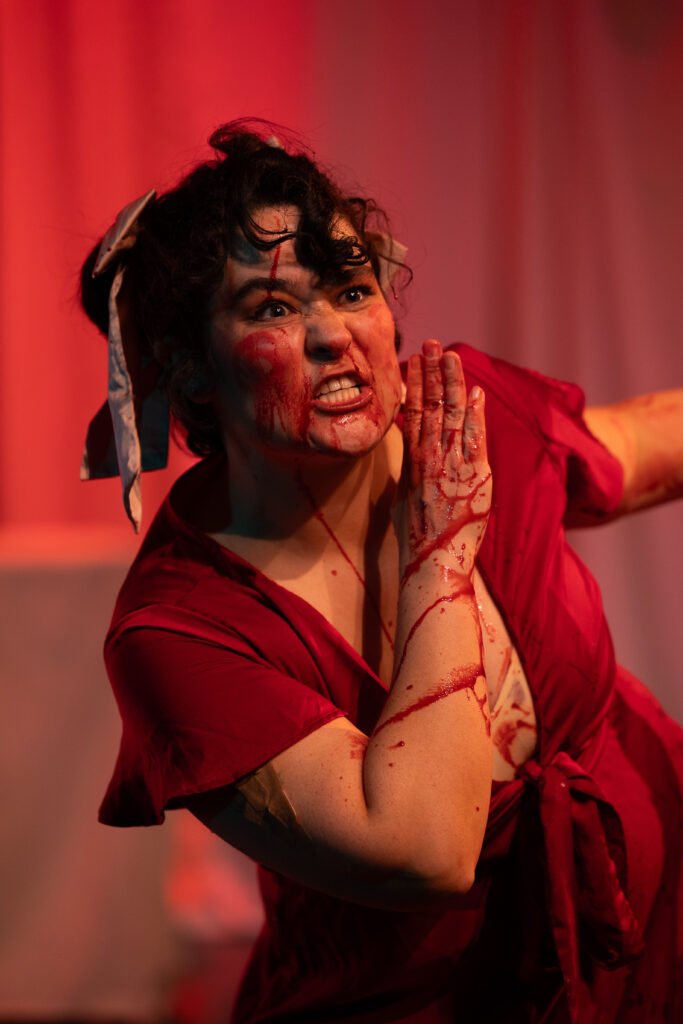
Directed by Ellie Otis, the production hits effectively on these themes, particularly with good to strong acting in the cast, as evidenced in the Nov. 15 performance. Each of the characters evolve in this bleak isolated setting and all but Agatha are chasing after happiness. Residing in this secluded mansion on the moors are Agatha (Viviane Turman) and Huldey (Addilynn Bowler), sisters, and their maid Marjory/Mallory (Nicole Finney), who has a split personality, and the Mastiff (Alvaro Cortez). Emilie (Jessica Graham) is the governess who travels from bustling London to this last stop of civilization. Master Branwell, the brother of Agatha and Huldey, is the unseen character.
Branwell’s background story provides the linchpin in The Moors. In fact, Turman, in her performance, obviously relishes the idea of how Agatha’s character sustains her power in the mansion and is resolutely unapologetic. Agatha is anything but fond of her family. We learn that Branwell was irresponsible, soaking the estate’s assets to satisfy his gambling addiction and lascivious desires. Believing that the letters were written by Branwell, Emilie was invited to be a governess for a child.
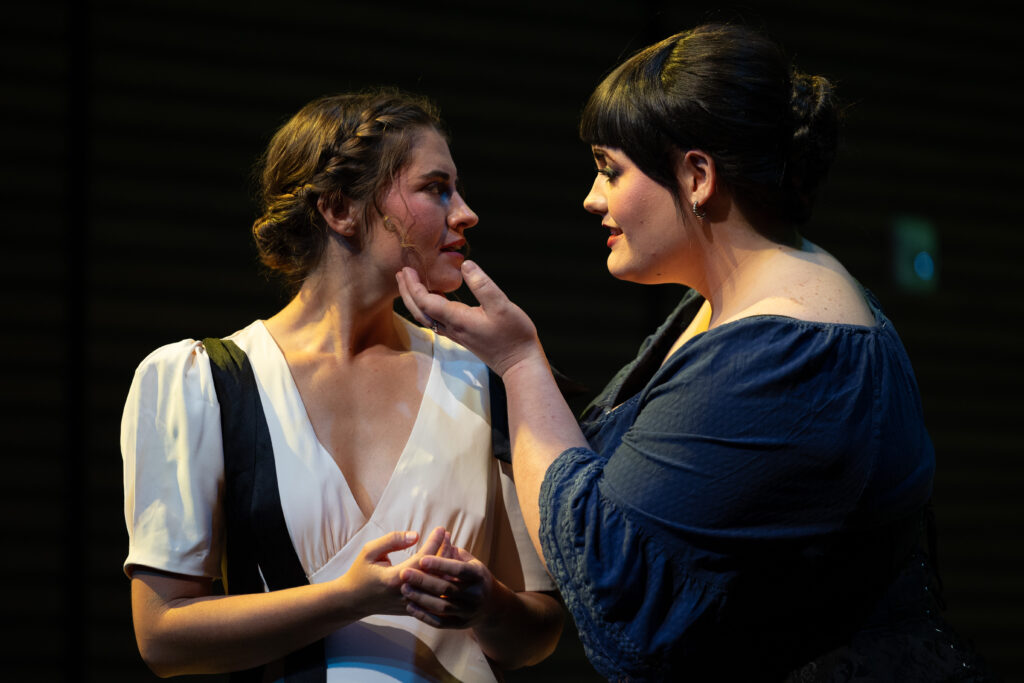
When the truth of what happened to Branwell becomes evident, Agatha tells Emilie, “Branwell’s indiscretion made life particularly irritating. Life became much less irritating when Branwell was in the attic.” When Agatha reveals that her brother is dead and that she wrote the letters, Emilie refuses to believe it. Agatha says,”I think, Ms. Vandergaard, you know very little about women and what they are capable of.” Silverman’s script abounds with simple, concise foreshadowing sentences which reward the attentive audience member.
As Huldey, Bowler occasionally unleashes a bit too much in histrionics in coping with the frustrations of her sister. Agatha has given up on Huldey, who tries to ease the pain of being isolated by keeping a diary.
Finney easily handles the duties of her split personality character: Mallory is the scullery maid with typhus and who believes she might be pregnant and Marjory is the parlor maid who looks after a child. Agatha is fine with the split personality. However, Turman, as Agatha, often speaks more harshly with Marjory, who was the accomplice in hiding the brother in the attic.

The strongest performances come in the Mastiff’s story, with Cortez joined by Merry Magee (the swing cast member) who portrayed the Moor-Hen in this specific performance. Their interaction is the only one in the play that occurs outside the mansion and their story is as significant (perhaps even more so) than Agatha’s story arc about the entwined forces of love and power. Cortez and Magee deftly extract the gravity of their respective importance as these characters. Cortez is bittersweetly lyrical in the right moments, such as when he says, “The gorse extends, the sky extends, many things extend. Happiness, I suppose, does not extend.”
Magee is appropriately naive, even as their characters warm toward each other, but that vulnerable sense also inevitably seals her fate. The Mastiff tells the Moor-Hen, “I’ll get you some hay. I’ll make you a nest. And I’ll take care of you. And even if it rains, you’ll never get wet, and when the moor-wind blows, you’ll never be cold, and I will stand over you and we will be so happy.” Cortez nails the epiphanic punch in his most important lines. When he tells the Moor-Hen, “I won’t let you drift away from me,” one immediately comprehends what will happen even if it is not explicitly portrayed in the play.
Voodoo Theatre Company continues to ripen as an independent performing arts company that should be on more people’s radar in the Salt Lake City metropolitan area. Performances continue this weekend in Studio 5400 at the Mid-Valley Performing Arts Center in Taylorsville. For tickets and more information, see the company’s website.