
This year’s selections in The Utah Review for the top ten moments of the Utah Enlightenment in 2025, the eleventh annual edition, stood out for being fearless, fierce and indomitable in human spirit. Wholly liberated, art ensures nothing is erased, censored or compromised. Reiterating the core premise of the Utah Enlightenment: In Utah, there are creative producers in the arts who are genuinely elevating the contemporary experience – with the sum of its tensions, problems, conflicts, disappointments and crises – to an enthralling sensation of healing, revelation, atonement and empowerment. They also represent new directions which always are worth the efforts in taking risks.
Throughout 2025, we were repeatedly impressed with the independent creator in Utah. These ten are a distinguished sampling of the many examples that could have been considered for special recognition. This was one of the most thrilling years that The Utah Review has covered in the chronicle of Utah arts and culture. We are optimistic that 2026 will even be more exciting.
COUNTDOWN OF THE TOP 10 MOMENTS OF THE UTAH ENLIGHTENMENT FOR 2025 (NO PARTICULAR ORDER, SAVE FOR THE TOP MOMENT AT THE END)

Plan-B Theatre: KILO-WAT, by Aaron Asano Swenson
It was a momentous year for Plan-B Theatre, with five world premieres, including a return to the Great Salt Lake Fringe Festival. While any of the productions would have been worthy for this year’s top ten list, the ingeniously crafted play for one. KILO-WAT, by Aaron Asano Swenson and directed by Jerry Rapier, stands out as especially distinguished. Its world premiere came in a co-production with UtahPresents’ Stage Door Series. To recap: Ken, the Japanese-American podcaster, takes the audience through the family roots and foundations in the story about Wat ‘Kilo-Wat’ Misaka as a sports star. A Utah native of Japanese descent, he played point guard to lead the University of Utah basketball team to an NCAA championship in 1944 and the NIT championship in 1947. He also broke the color barrier when he was picked up by the then New York Knickerbockers. The play began when Ken (Bryan Kido) strikes together a pair of hyōshigi (clapping wood) and proclaims, “Yotte irasshai, mitte irasshai! Yotte irasshai, mitte irasshai! Kamishibai no jikan da yo!” Reiterating what The Utah Review published last February: The paper theater began— a beautifully woven chronicle of history and legend, with narrative markers rendered in impressive title cards the playwright designed. It is the most unconventional and bold one-actor production that this critic has seen in years but it also succeeds with the same significance as Jenifer Nii’s Fire! achieved in ensuring Wallace Thurman’s permanent spot in the history of Utah as well as the Harlem Renaissance.
Swenson deftly used the strengths of legend and history for audiences to appreciate the Japanese roots of the man at the center of his story. While the audience was captivated by elements of myth and legend that endear us to Misaka, the basketball star and pioneer, Ken left those realms to take us into a stark and blunt world about the other part of his story. That is, World War II and the times of the Japanese incarceration camp. Misaka was drafted twice by the American military, including his service with the U.S. Strategic Bombing Surveys when he was tasked with interviewing survivors of the Hiroshima atomic blast. Ken tells us, “Most interviewers never asked about this part of his story. It doesn’t have much to do with basketball. Beyond that, how would you start? Interviewers avoided the subject for almost seventy years.” As The Utah Review noted in the preview, the irony of history runs deep in his story.
When Misaka played basketball, he knew his friends and teammates would support him whenever fans of an opposing team taunted him with bigoted, racist and hateful chants. His skills as a point guard infuriated those on the opposing side but he also had proved why so many people thought his famous nickname was well deserved. But, in this different role, as Ken tells us, “He was surrounded by people who looked like him, and he felt more alone than ever.”
Ken (Kido’s tone and emotional choices are excellent) does not hold back on emphasizing the historical gravity of Misaka’s assignment. Swenson nicely handles the tricky challenge of letting us glimpse the emotions he experienced as he researched the materials for writing his script. And, we hear for the first and only time in the play from Ken some words from Misaka: “It was a no man’s land for me—all of Japan, but especially Hiroshima. The Japanese, they saw the uniform and hated it, and me in it. But I had to wear it to remind the Americans they could trust me. Everywhere I turned, I felt like a traitor in someone’s eyes.”
Swenson tells us that Misaka’s story is a big deal but not for the obvious and immediate reasons we are initially drawn to it. KILO-WAT knits together the common threads that pull us closer to a truthful, more instructive history of Misaka’s life and significance. More importantly, look at what is missing and what chroniclers of history decided to highlight and exclude, which ultimately tells us more about the community and society at the time than the fact of Misaka’s groundbreaking accomplishments as a college and professional basketball athlete.
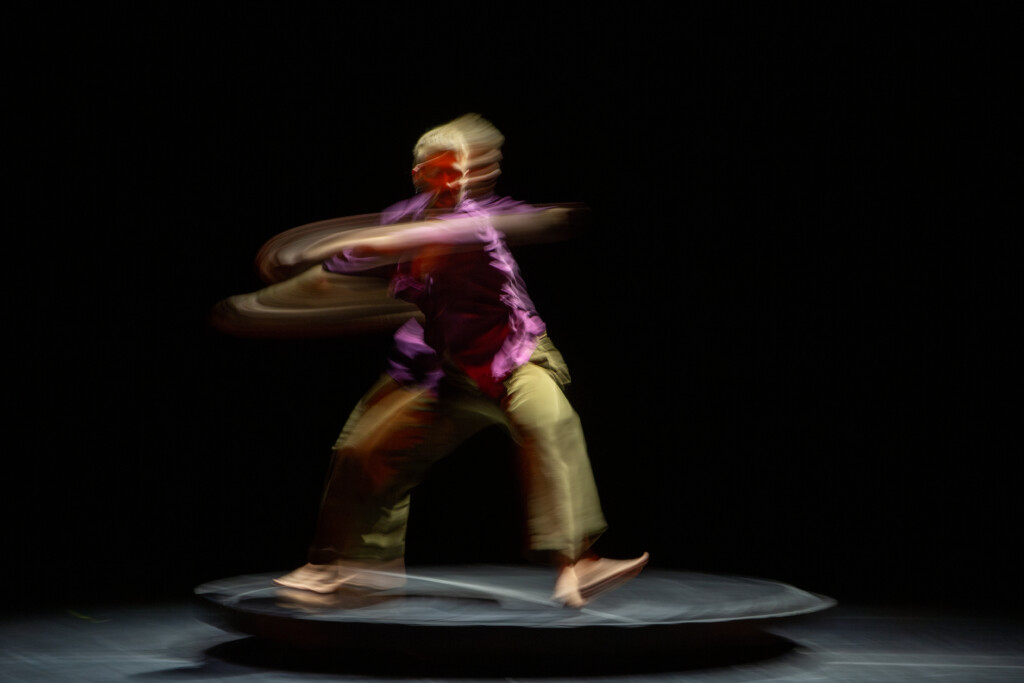
Ririe-Woodbury Dance Company: The Rate We Change by Kellie St. Pierre
Trying to narrow candidates for an annual top ten list in the arts of culture landscape of the state is uniquely complicated, when it comes to considering Utah dance. Regular readers know The Utah Review considers dance as the supreme empress of performing arts in The Beehive State. Last winter, Ririe-Woodbury Dance Company performed the exhilaratingly athletic and keenly original The Rate We Change by local artist Kellie St. Pierre, which the choreographer created as part of her master’s degree thesis at the University of Utah. The work featured the company’s six dancers performing on a human-powered rotating platform, accompanied by a well-sculpted minimalistic score by local musician Daniel Clifton. The work was recently honored with the Grand Prize Award at the Palm Desert Choreography Festival.
In an earlier interview with The Utah Review, St. Pierre, who likes to incorporate kinetic set pieces, said “the idea was to build a nonstop work in creating an ever-shifting and rotating environment and how to respond to this, without stopping.” The challenge was to give dancers a new movement vocabulary and skill, according to her, including how to stand, sit and move safely on the rotating platform and find their ideal momentum and comfort levels while performing on it. For her thesis, she set the work on six dancers and then with five dancers for a performance at the American Dance College Association conference.
The setup and premise in the work are pitched to generate countless versions of unique performances, as each cast approaches the piece with its own intellectual curiosity about how they approach the movement and partnering demands by understanding the trust and confidence they build with each other in presenting it. Indeed, as St. Pierre explained, dancers respond to their own sense of humility, as they individually confront their own fears and circumstances in becoming more familiar and comfortable with a continuously rotating platform set. “These dancers have established such a lovely fit in working together and it has been beautiful to watch them as a team helping each other,” she added.

ChitraKaavya Dance: In a forest, a deer…
In a talkback following ChitraKaavya Dance’s production featuring In a forest, a deer…, an Indian-American audience member who was visiting downtown Salt Lake City last Labor Day weekend commented how grateful and surprised she was to walk by the Rose Wagner Center for Performing Arts and discover this performance. Indeed, the local dance company, which specializes in Bharatanatyam, a South Indian classical form, offered an impressive and richly informative choreographic interpretation of a beloved Indian epic narrative that is quadruple the length of the Iliad, for example.
The performance’s most striking feature was the level of dance theatrical skills on display from the dancers, all of whom were in their teens, including one who was just 14. Prepared by Srilatha Singh, a mathematics professor who specializes in three-manifold topology and who was trained in her dance specialization by eminent gurus in her homeland, the dancers definitely understood the cultural import and creative brief arising from the group’s interpretation of the Valmiki Ramayana. The Ramayana relates the story of Rama, a prince in the city of Ayodhya in the Kingdom of Kosala, whose wife, Sita, is abducted by Ravana, the demon-king (Rakshasa) of Lanka.
The production was wholly absorbing, as these dancers, all of whom were born in the 21st century, truly grasped the interpretive fluidity of this major piece of Indian mythology. As evidenced in projected slides and the talkback discussion after the performance, the work was conceived and based on comprehensive research where Singh synthesized elements of sources ranging from as early as eighth century B.C. to contemporary critical cultural analyses. Music was composed by Sindhu Natarajan and lighting by Ashton Pease, by Blackheart Lighting Design.
Singh emphasized that the work did not seek to offend, disparage or diminish the spectrum of spiritual faith to which people have attached to this preeminent epic of Indian mythology. The interpretation for this performance also was formulated to encourage thoughtful conversations not only about India’s social, cultural and political landscapes, but also about our contemporary circumstances. In the legend, Sita is the daughter of the Earth (Bhoomi) and while she is the female archetype, but as patriarchal perspectives evolved from the epic’s earliest manifestations, it was clear how the dynamics of control, boundary limitations were imposed, as they occur in androcentric versions of the story. Thus, Singh and the dancers retell the Ramayan story in which Sita is moved significantly from traditional mainstream canonical interpretations of the mythology.
In other words, just as the myth has been constructed to highlight idealized portrayals of the Hindu male, Sita has been conventionally rendered as a figure to serve the conventional system. The dance work demonstrated effectively that just as male writers and artists had employed the myth and the story of Sita to render woman’s voice impotent, women, just as compellingly, have articulated and magnified their voice. And, in that reinterpretation, Singh and the dancers remind us that women, emboldened and empowered by the retelling of Sita’s story, are inspired not to stand by idly while society as it has been led and influenced by patriarchal forces risks irreversible destruction.

Torrey House Press: Things I Didn’t Do by Karin Anderson
There was only one fiction book published this year by Torrey House Press(which also released an impressive string of new nonfiction that has garnered national attention and celebrated its 15th anniversary this year), but it is an impressive newcomer to the pantheon of outstanding Utah narratives. Karin Anderson’s Things I Didn’t Do, a bona fide saga set in the Book Cliffs of eastern Utah, revolves around Ryder Mikkelson, taking readers from an accident that messed up his leg at the age of seven to thirty-four years later when his twin daughters return from college with news that leads him to finally acknowledge and accept the roots of his identity and the memories of his upbringing.
Anderson’s storytelling reverberates in a counterpoint of plain-spoken truths and sweeping lyricism that puts us in an area that clings to the past. It was once home for miners, trappers and outlaws. There is an abundance of wildlife matched in scale and scope by the emotional, domestic and economic hardships that hit hard in the region’s tiny ranching communities. Anderson’s novel spans four decades, starting in the 1980s and ending shortly after the height of the COVID-19 pandemic in the early 2020s. In the Book Cliffs region in eastern Utah, Mormonism remains an anchor that simultaneously influences and confounds every individual’s pursuit of becoming the perfect family man or matriarch.
Along with their respective families, Ryder, Kent and Ferron live in remnants of the Old West, far enough away from the Mormon hubs of power in Salt Lake City or the central Utah Valley regions to be neglected if not almost wholly ignored. The boys witness disappointment, guilt, depression, addictions and family crises associated with the culture of unattainable perfectionism. The stigma of such shortcomings chastens and diminishes men who were brought up to be confident and strong providers. Meanwhile, women are vulnerable to become embittered and disillusioned by a culture that prioritizes traditional roles of mother and wife without the benefit of a leading voice either in their families or communities.
In the novel, Evaleen Mikkelson, Ryder’s mother, transcends the barriers, toxicities and the limitations of that culture and accomplishes this in a manner that will surprise many readers who cling to specific stereotypes. Evaleen’s faith is simultaneously unconditional and realistic. She is a paragon of virtue, her wisdom ensconced in her genuine practice of not judging irrationally while accepting with resourceful resolve the unflinching realities of life. Coming from a broken home, Evaleen learned to hunt with rifle skills that impress her husband, Alma. Early in the story, it is 1986 and Ryder asks his father why his mother Evaleen won’t hunt, even though she is known for her skills with a hunting rifle. “Look, Ryder. Your mother’s been through a lot. She had it rough as a girl and rough in other ways as a woman,” Alma, the father, says. “But she picked up skills. Like rifle aim. She grew up in a big desert. She knows them west mountain ranges as well as any man.”
With Ryder’s hero journey, Anderson makes handy use of bears as a Jungian archetype. Art also serves a practical function for Ryder, much as the petroglyphs in the Book Cliffs served for the Indigenous communities of many years ago. But, art’s practicality also extends to the emotions of grief, which Ryder expresses when he paints the panels on Ferron’s truck after taking over the business, following his death. Meanwhile, Kent takes the scientific parallel to Ryder’s artistic route, eventually earning his doctorate in geology. The novel’s exploration of place and identity makes for a gripping read.
Ryder’s strong relationship with Sami, his wife who has Diné origins, is possible, thanks to his years of growing up with Evaleen. Kent and Ferron are not as fortunate, as Maura abandons Doug, their father. Ryder comprehends the crucial impact of having a rock solid mother when he sees other boys in school and the community struggling because of drugs, abuse and broken homes. Late in the novel, Anderson summarizes the mature evolution of Ryder and Kent: “Grown Kent is a shapeshifter in Ryder’s eyes: small rat-tail Kenty bangs inside the walls of smirking libtard Professor Mikkelson. Small Ryder inside the tall husband and father doesn’t know what to make of a self-respecting straight guy from Emery County with a rainbow sticker on the back window of his pickup. Just below the gun rack.”
As adults, Ryder and Kent fully understand the differences between their fathers. Ryder, now the father of two daughters and content in his family life with Sami, says, “My dad did right by me. Even when I was a pain in the ass. Our dads weren’t raised to have kids. Scares the shit outta me, thinking how unready they were to be husbands. Fathers. Because—damn. I was too.” Kent adds that Ryder’s dad was “just a nice ignorant country guy…[who] learned as he went,” while his “never learned shit.” Ryder says that surely cannot be the case or otherwise Ferron, who was philosophical and gay, would not have been possible. Kent tells Ryder, “Mom made Ferron…Whatever that was, it’s not going any further. Like I said a long time ago, you’re lucky there’s none of it in you.”
A masterpiece of Utah literature, Anderson’s novel is a literary gem that exemplifies the outstanding vanguard of Torrey House Press authors whose fiction and nonfiction have illuminated the most commendable path of enlightenment in American West storytelling.

On this year’s top ten list is a Utah indie film that has demonstrated the perseverance of its creative team to market and promote it on their own. A first-generation American, Denny is hustling to grab the brass ring on the carousel of the American Dream. In 2007, lonely and dissatisfied with the dead end of lower income working life, he steals and resells bicycles and occasionally breaks into cars. While Denny is a petty thief, he also is a loving and faithful son to his Japanese mother, especially when they spend time together reading letters from their relatives in Asia. Whatever joys they have in their lives are modest but still heart warming, even when they are spending time at a park. His mother’s biggest concern is Denny pays the electric bill on time.
This is the starting premise of Mouse, an award-winning independent film produced and shot in Salt Lake City, which is about to expand its festival circuit screening tour. Directed by Kenny Riches, who also stars as Denny, this understated yet richly textured narrative also features his real-life mother, Hiroko Riches, as Nobuko, Denny’s mother. Mouse, Riches’ fourth feature-length film, took two top honors at this year’s Brooklyn Film Festival, winning Best Narrative Feature and the prestigious Grand Chameleon Award. It also received a Best Film jury prize at Film Fest Knox in Tennessee. The film also has screened at the Philadelphia Asian American Film Festival and San Diego Asian American Film Festival.
As The Utah Review noted earlier this year, the film takes place in 2007, years before anyone could have credibly imagined the intensely polarizing American sociopolitical climate of today, and the sensations of loneliness, claustrophobia and shattered dreams experienced in Mouse seem even harsher and more dire today. In an interview with The Utah Review, Riches, who saw his second feature The Strongest Man premiere at Sundance in 2015, said Mouse had its genesis during the pandemic. A starting point came after chatting by phone with a filmmaker friend living in Rhode Island whom he has never met in person and who does not have an online presence. “It made me think about how you could communicate this way and feel a close presence to someone and you might never know that they could be catfishing,” he said.
The characters in Mouse are on the fringes in society for various reasons and are feeling insecure, anxious or do not have a grounded sense of self-esteem. Riches, who was born in Toyota City, Japan, said that growing up in Salt Lake City, he chased trouble and represented a microcosm of what we witness in Denny’s character. Riches added that he eventually told his mother about what he did as a kid.
Riches also is a partner in Dualist, a production company. Dave Moppert, one of the producers of Mouse, first collaborated with Riches on the 2012 indie film Must Come Down, with Riches directing and Moppert as assistant director. That film, described as a “hysterical commiseration,” follows Ashley and Holly, both twenty-somethings, who are still in arrested development but are trying to navigate their quartet-life crises. The late actor David Fetzer, who was among the most impressive in his career, played one of the leads. Later, Riches was one of the co-founders of The Davey Foundation, a grant-giving organization for filmmakers founded in memory of Fetzer. Also, Andrew Rease Shaw, an Utah-based musician and artist who serves on the foundation’s board of directors, composed the score for Mouse.
In Brooklyn, where the film had its festival premiere, Moppert said that his ears were burning as he listened to the audience react with the right emotions at the right times in the story. Riches added that he was a little surprised that the film took two high-profile honors, but we also “heard a lot of high praise and there were interesting questions in the talkback.” As for his mother, Riches said she normally doesn’t like any attention so she skipped the premiere.

National Council on Education for the Ceramic Arts (NCECA): 2025 conference exhibitions in Salt Lake City
Last spring, more than 6,000 attendees registered for the convention of the National Council on Education for the Ceramic Arts (NCECA) and several major exhibitions representing the expansive creative possibilities of ceramics were installed in Salt Lake City as well as in numerous other Wasatch Front locations, which were documented thoroughly by the Artists of Utah’s 15 Bytes digital magazine.
The Utah Review covered several shows. For the first time in the organization’s history, NCECA’s three cornerstone exhibitions were in a single museum: Utah Museum of Contemporary Art (UMOCA), which was the host of the 2025 NCECA Annual: True and Real, the 2025 NCECA Juried Student Exhibition, and the Multicultural Fellowship Exhibition.
Collectively, the three shows were among the most impressive showing of contemporary American ceramics art ever presented in Salt Lake City. True and Real featured the work of 40 artists, including invited artists Simone Leigh, Syd Carpenter, Roberto Lugo, Tip Toland, and Steven Young Lee. Curated by Judith S. Schwartz, this showcase examined the relationship between material, process, and personal truth in contemporary ceramic art. In terms of experimental approaches for using ceramics as a medium for narrative, the 2025 NCECA Juried Student Exhibition, co-juried by Adrienne Eliades and Nicole Seisler, highlighted the next generation of ceramic artists. Just as enterprising is the Multicultural Fellowship Exhibition, juried by Jennifer Ling Datchuk, which featured diverse voices shaping the future of the medium.
For museum visitors, whatever conventional perceptions one may have had about ceramics, the panoply of art curated in these NCECA exhibitions testify to ceramics’ versatility in capturing emotion, narrative and spiritual intelligence “Whether plotted in detail or improvisationally, this interplay of materials, process, and experimentation,” Joshua Green, NCECA’s executive director, added. “the pursuit almost always strives to bring inner truths and realizations into the light of public experience.”
“Like NCECA, we are deeply committed to supporting and investing in our community of artists, makers, educators, and students,” Jared Steffensen, curator of UMOCA exhibitions, said. “The selections for these exhibitions reflect the depth and breadth of contemporary ceramic art and underscore the material’s ability to convey meaning in profound ways.”
Regarding NCECA, for example,there was no better opportunity for Material Gallery to host its first show featuring 3-D art forms than in Form (in)Formation. Organized by Hideo Mabuchi, a Stanford University physicist who studies quantum optics and is a ceramic artist, the show featured the work of nine artists who also shared the foundational elements from their respective processes of how they decided the form, creation and presentation of their work. As The Utah Review noted: “The eclectic body of work curated by Mabuchi delivers a fascinating return on the premises of its creative brief. Mabuchi explained the provenance of the exhibition’s theme that as “the footprint of exploration, form physicalizes the ways we search for knowing, feeling, and connection. Our functional, sculptural, and installation works are presented alongside sources, snapshots, and sidelines of the creative strivings behind them.”
Notable were the plentiful examples of works that engage and reflect the practicalities of science, including ecology, marine biology, the impact of human presence on animals and birds, and even the philosophical approach to the scientific inquisitiveness of artists, in general. In some instances, function, which has such strong salience and valence in ceramics, is considered. There were examples of traditional ceramic craft in which the artists are working with wild clay and natural materials that differ from what they have previously used in their pieces. Forms inspired by nature and culture are combined in a unique counterpoint. How structure and assembly are achieved is just as compelling to observe. The spirit of problem-solving ran deep throughout this collection of artwork, as artists contended with the realities and reconcile techniques to create work that carries artistic value which extends beyond aesthetically musings to have concrete meaning on multidisciplinary platforms.

Jorge Rojas: Coyotek
The layout of the space in the Gittins Gallery at the University of the Utah was perfect for Jorge Rojas’ Coyotek exhibition which mows down the physical and cognitive borders we conventionally imagine. Despite efforts to the contrary to dampen or counter the kinetics of the relationship between the U.S. and Mexico, the fact is that the mythology of the coyote is not exclusively a border phenomenon, but one that has permeated so obsessively that it has been inextricably embedded into the respective American and Mexican consciousness. It is now so fixed that its potential socioeconomic and political impacts will always transcend any efforts to stifle it.
Rojas coined the unique portmanteau of Coyotek to combine coyote and technology, as it reflects the matters of borders, immigration policy, new media and digital communication. The exhibition synthesized a body of work he has been developing over the last two decades, represented in photography, performance videos, and a newly commissioned site-specific corn mandala, along with installations created over the period and several new works shown for the first time. Coyotek was the second iteration of the traveling exhibition. The first was organized and presented earlier this year at the El Paso Museum of Art in Texas. The show was organized in partnership with ProArtes México.
Rojas was born in Mexico and at the age of six, his mother brought him to the U.S. along with his siblings, but they also moved back and forth between both countries. He grew up in Provo and went to art school in Mexico. Rojas went to art school in Mexico and would bounce around between Salt Lake City, New York City and Seattle. “So, I always have had this sense of belonging and not belonging,” Rojas explained in an earlier published interview with The Utah Review. “As a person who has existed in both countries with a perspective on the respective cultures as an outsider who does not necessarily belong in one or the other, I learned to appreciate this sense by developing a critical eye to both.”
Where Rojas’ work took on its most significant strengths was the tacitly acknowledged unbreakable pact between the material and immaterial realms of the twin diasporas at the focus of this exhibition. In Chac Mool, a performance video created for Utah Sites: Performance Art in Utah Landscapes, Utah Division of Arts and Museums, Rojas reflects broadly upon the historical realities of Indigenous migrations across the Americas. Chac Mools are Mesoamerican sculptures, most prominently featured as a reclining figure leaning on its elbows and supporting a bowl, which many believe symbolized slain warriors carrying sacrificial offerings, such as tortillas, tobacco, and incense made to the gods. In this video, Rojas acknowledges Aztlan, the mythical Aztec homeland, which some historians have postulated could have been Antelope Island on the Great Salt Lake in Utah, near where Rojas documented this performance. Aztec legend is not detailed about Aztlan’s location, except to note that it was north of Mexico on a small island in a lake.
Rojas took full advantage of the Gittins Gallery space, but the impact was greatest in the section of the gallery that featured the commissioned coyote corn mandala in front of the photographic installation, Oh My God, Where Do I Come From. The visual impact was like standing in a chapel. Rojas has arranged the photographs in counterpoint form, as they depict iconographic relics and objects in Mexican Catholic churches as well as pre-Columbian artifacts. The array of these images alerted us to the complexities of the Indigenous cultural realities that were as evident in colonial periods as they are in contemporary times. In the ancient Americas, the ideals of spiritual tributes and sacrificial offerings were universally natural and embedded so it would have made sense that these obligations were reflected in iconographic artifacts, which would have resonated in continuity with those being created during the colonial periods.
Furthermore, this was brilliantly anchored in the coyote corn mandala installation, the most stunning and most complex of the nine Rojas has made to date. It took five days, with the assistance of five student assistants, to complete the image, which draws inspiration from the Ahuitzotl Shield (Chimalli), a rare Aztec featherwork shield housed at the Weltmuseum Wien in Vienna. Dating to around 1500, the shield features a blue coyote and flowing from its mouth is the atl tlachinolli, or “water and fire,” a Nahuatl symbol of sacred war and the cosmic balance of destruction and renewal. With its radiant feathers and gold inlays, the shield was likely ceremonial, embodying divine power and the sacred force of speech and prophecy. The design at the periphery follows Xicalcoliuhqui, or step-fret motif.
A visual masterpiece of the utmost handcrafting, the mandala’s symbolism emanated throughout the installation space. Made entirely of corn kernels placed by hand, the mandala epitomized an extraordinary exercise of patience. In the one for Coyotek, Rojas also has added text for the first time in two messages: “Abolish ICE” and “Free Palestine.” In creating a chapel-like effect in the middle of the exhibition, the placement of the mandala made sense in front of the juxtaposed photographic collection. The mandala also deepened our understanding of how Rojas has developed his artistic language over the last 20 years. Rojas had found a way to bring forward an ancient practice into the contemporary era without compromising the essential cultural integrity of its original intent and value. It has been an ongoing process and the Coyotek show was the most synthesized representation of Rojas’ overarching artistic philosophy in this regard.

801 Salon: To Be a God, Little Moon, University of Utah School of Dance, UtahPresents’ Stage Door Series
Since it was established in 2021 by Roxanne Gray, 801 Salon has been a paragon of multidisciplinary collaboration in the arts. More than 40 events with an aggregate total of more than 350 local artists have been staged and last month 801 Salon produced its largest show to date, directed by Ty Davis, in collaboration with the indie folk rock band Little Moon, from Springville, Utah, and 16 performers from the University of Utah School of Dance, as part of UtahPresents’ Stage Door Series.
Innovative and experimental in its conceptualization, To Be a God was a unique articulation of dance theater integrated with a new album of songs by the award-winning Utah band, which were being recorded live for the first time during the performance. The brainchild of lead vocalist, singer-songwriter Emma Hardyman, Little Moon has gained an Impeccable reputation and its visibility has expanded significantly since the band won NPR’s Tiny Desk Contest in 2023. The band had its first international tour this year, with stops in the U.K. and the European Union.
Little Moon’s music resides on the cusps of magic and fantasy but, more importantly, it opens a spiritually enriching metaphysical realm that simultaneously grounds the listener while encouraging the individual’s journey of finding their own resonating space in the cosmos. Occasionally, the music expands into the territory of anthems. The choreography paralleled the oscillating experiences of starting in darkness and eventually being bathed in reassuring light. Joined by a top-notch lineup of musicians, Hardyman impressed audience members with her distinctive vocal techniques— truly an outstanding troubadour of spirituality in the 21st century.
The experience was extraordinary for both dancers and the band musicians. The songs were new and were recorded live during the performance. As for Gray and the other dancers, the opportunity to set movement to live music and especially to new compositions was embraced with its full range of emotional possibilities. The new album, which will be Little Moon’s third, will drop sometime in 2026. In addition to the live recording during the production, which sold out all of its performances including a dress rehearsal, the band has recorded the songs in studio.
Indeed, as Gray said in an interview with The Utah Review, it was a “dream project“ one-and-a-half years in the making. This collaboration was among the most innovative The Utah Review has observed in Salt Lake City. The band wrote the album songs with the show concept in mind, which emphasized the harmony achieved in this collaboration. More than 50 dancers auditioned for the 16 slots that were available. Vienna Boyes, a locally based artist, musician and filmmaker, documented the process leading up to the production, as part of a forthcoming short documentary.

Stephanie García and Peter Hay: From the Borderlands to the Roots
As guest writer Matthew Ivan Bennett noted in The Utah Review, in the opening of From the Borderlands to the Roots—an ambitious, cohesive, and moving fusion of dance and visual art by Stephanie García and Peter Hay—we see nothing but projected closeups of eyes, gently shut, a curl of lashes inviting us to wonder about the thoughts and feelings beyond them. We heard a welter of music. Tones that are almost chanting. Flute-like insinuations. Bird-like invitations.
The projection screen is a tall plastic drape, at first conjuring the idea of a construction site, but as figures approach from behind the drape, we see what it is: a veil. An amniotic barrier between us and them. A wall. These figures, call them seekers in silhouette, are pressing hopeful faces and hands to the veil. They are waiting to be born into new lives. The passage through the veil is slow and tentative, requiring the choreography of fear and grace, but gradually they pass under and around. Crawling. Squeezing. Then, as the eyes-in-closeup distort, our seekers are drawn and repelled by the veil’s power in so many waves.
It’s a striking start to the evening, featuring performances that are nothing less than plyometric. The dancers’ stomps could be felt through the floor like mini-earthquakes as the composition flipped out of tension and into harmony.
This piece by Punto de Inflexión, part of the ten-day Corriente Alterna festival, with PROArtes México, and presented in part by Repertory Dance Theatre’s (RDT) Link Series, marked one of the most ingenious uses of the Black Box space in downtown Salt Lake City’s Rose Wagner Center for Performing Arts. Coming into the room, you could be forgiven for finding the setup simple. There were two long rows of seating, arranged to face each other rather than the theatre’s back wall. Between the rows of seats lay a wide black runway. There was the tall plastic drape that later became the veil. Opposite the veil, was another lower drape, bunched against the retracted stadium seats like a covered arch, and it also lends the impression of visiting a construction site. But Punto de Inflexión’s use of the space was anything but simple. The installation by Peter Hays created a deep playing space for the dancers that abolishes any sense of us and them. Incidentally, García was named earlier this year as one of the Guggenheim Fellows in the 100th class.
García’s choreography, too, abolished the sense of separation. Not so much because the dancers came close and sat amongst the audience at some points, but because the overall composition was rhythmically varied such that we never saw the performers as this or that. Obviously, the piece was a visual paean to immigrants, but it didn’t just tell a story of struggle. It told stories of celebration, of overcoming, of failing down again, of getting up again.
The program note from Punto de Inflexión described the piece as “a reflection of the impact of migrating (whether it is legal or undocumented, within the same country or abroad), and what immigrants have to let go of when going somewhere new. This work is an homage to the cultural heritage of those who make this country function and are undervalued and almost invisible.” In the spring of 2025, the timing of this piece could not have been better. For centuries of American life, immigrants have been used as bogeymen by politicians, despite the fact that economists “generally agree that the effects of immigration on the U.S. economy are broadly positive” (see the University of Pennsylvania’s The Effects of Immigration on the United States Economy).
But don’t make the mistake of thinking that From the Borderlands to the Roots was a liberal polemic. On the contrary, its power lay in its refusal to be merely political. Borderlands may be about struggle, but it also insisted, over and over, on being about celebration. Each darker harrowing sequence was followed by eruptions of joy blending folk and art pop, Latinx traditional dance with the feeling that we’ve dropped into a thumping night club. The music by Ryan Ross—featuring vocals by Nora Price, Juan Pablo Villa, Nortec and Rodrigo Gallardo + Fernando Milagros—was a Trickster character unto itself, always morphing, always escaping sentiment and hurtling us into upbeat, genre-bending, aural adventure.
The lights too were evocative for a theater space that tends to be too bright regardless of how one designs. Partly, it’s the open stage plan that helps here, but the design by Ashton Pease—of Blackheart Lighting Design —certainly added to the cohesion. Each sequence felt uniquely illuminated and Pease gets lots of precision of out their choices.
The highlight of Borderlands begins with a sequence that could be called The Labeled Man. Performers lay out multicolored Post-It notes in a great square around the stage. Meanwhile, we heard excerpts of stand-up comedy about Latinx stereotypes. In the middle of this paper-made square was a man dressed in a white plastic jumpsuit. As the sequence built steam, the dancers put labels on the man. Yellow and green and pink Post-Its fluttered as he stumbled from the onslaught. Soon, he’s covered, no longer himself but choked in labels. This horror gave way to an equally horrible game of tug-of- war. The plastic sheeting came down and got twisted into ropes through an orbit of dancers. But it was not a tug-of-war with two sides. It’s a face-off in which someone is always caught in the middle. Jerked. Thrown. Used. It’s a bold yet careful visual metaphor that left you tearful.
This entry into the Utah arts scene was full of tension, controlled wildness, and heart. The performances by Leslie Jara, Keily Tafiti, Zhenya Ragulin, Fasto Rivera, and Stephanie García were passionate and defiantly inexact while still showcasing their exactness. If you ever get a chance to see a piece by Punto de Inflexión, don’t pass it up.
THE UTAH REVIEW’S TOP MOMENT OF THE UTAH ENLIGHTENMENT IN 2025

Norbert De La Cruz III. Photo: Sharon Kain.
Repertory Dance Theatre: Ovation
Sixty years ago, inspired by the vision of Virginia Tanner, one of Utah’s greatest historical figures in dance, the Rockefeller Foundation granted the funding to establish America’s first successful modern dance repertory company, right in Salt Lake City. Joining institutions such as Ririe-Woodbury Dance and Ballet West, the founding artists of Repertory Dance Theatre became cultural ambassadors for the American West in helping to cement Utah’s place as one of the nation’s most important centers for dance.
In between pieces in Repertory Dance Theatre (RDT)’s sensational Ovation production last month, Nicholas Cendese, a former RDT dancer who is now executive/artistic co-director for the company, talked briefly about the company’s 60th anniversary as an occasion to celebrate its “luminous pinnacle.” Indeed, this phrase encapsulated the astonishing quintet of commissioned works, including two gorgeous world premieres, which comprised an extraordinary choreographic production of thanksgiving. Ovation produced an endless string of beautiful emotions, many inducing goosebump effects and tears in more than a few instances.
For the company and the audience, profound emotions flowed from the restaging of Jacque Lynn Bell’s Ryoanji, which featured 43 dancers, including students from the University of Utah’s Tanner Dance Program, seven RDT alumni and Linda C. Smith, RDT cofounder and artistic director emerita. A moving tribute to Virginia Tanner, the Utah dance pioneer who envisioned the founding of RDT, as well as the company’s relationship to the Children’s Dance Theatre, Ryoanji referred to the famous rock garden in Kyoto at a Zen Buddhist temple. The effect of the piece was like a ritualistic procession weaving its way through the sanctuary, with music composed by Mark Kolt and created by Tristan Moore. The youngest performer was an infant who is the newest member in the family of Virginia Tanner. Only the third time this piece was performed, the staging for this particular Ovation show heightened the awareness of the multigenerational legacy that led to RDT’s founding 60 years ago and how it has been sustained.
Three commissioned pieces produced outstanding examples of mining choreomusical elements from classical musical scores not originally written for dance. Two were Oktet: In Situ (2023) by Katarzyna Skarpetowska and Solfège (2023) by choreographer Yusha-Marie Sorzano. For the third, the dancers hit their luminous pinnacle in the world premiere of Scherzo Fantastique by Norbert De La Cruz III, a resplendent, passionate interpretation of the eponymous score by Czech composer Josef Suk. De La Cruz’s choreography put the dancers through many complex passages, which he did exquisitely in replicating Suk’s relentless shifts in rhythmic meters. One of the most striking moments occurred when the dancers replicated a passage in the middle of the piece, as a melody was being passed around while the beat was separated out into four and six parts. It was amazing how the dancers created such a burst of youthful emotional exuberance verging on the edge of becoming a runaway train, but then pulled it back in the occasional pensive, even melancholic moments of the music. As the closer to a show that already had achieved blockbuster status, Scherzo Fantastique was a gobsmacking perfect nightcap.
Sassy, youthful jubilation came through in Cendese’s newest piece, a hoot and a holler, Come Rain or Come Shine, set to five songs from Judy Garland’s final studio album. The dancers reveled in the spontaneous pop magic, including Caleb Daly who strutted and slayed to the opening verse in Lucky Day (“sitting on top of this great big wonderful world”), and real-life couple Jake Lewis and Alexander Pham in More Than You Know, an authentically poignant performance. Likewise, Caitlyn Richter who was joined by the company tugged at our heartstrings, dancing to the Broadway blockbuster You’ll Never Walk Alone. Cendese gave all eight dancers a heartwarming canvas for their personalities to shimmer and sparkle on stage.