
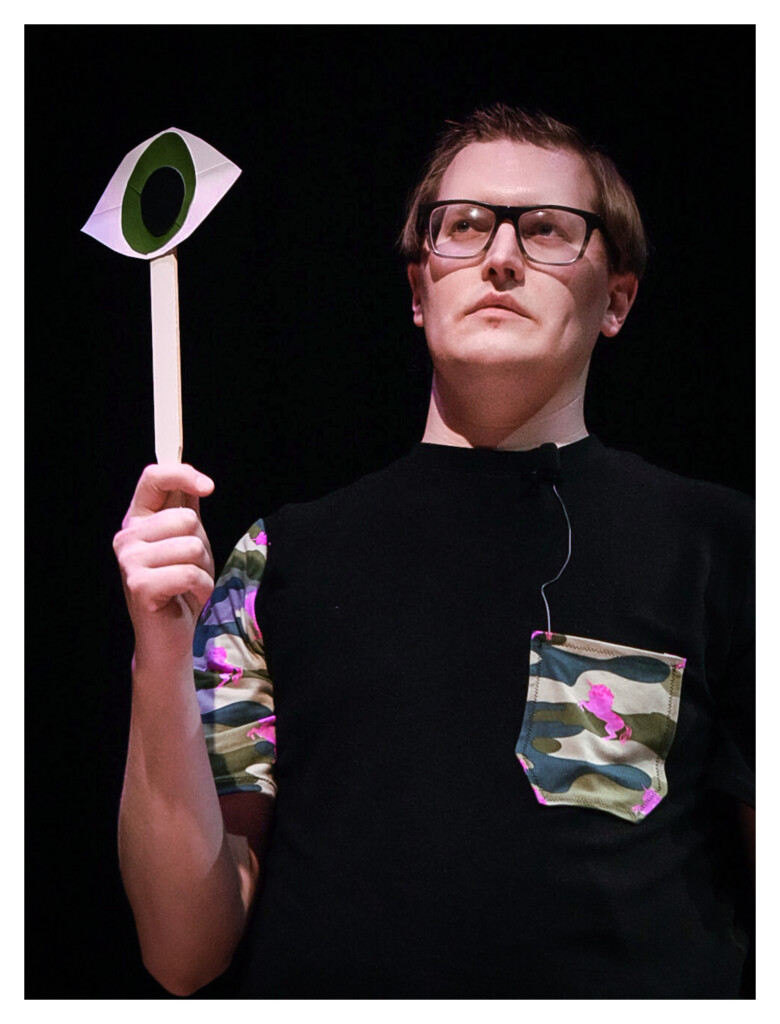
The 12th Great Salt Lake Fringe (GSLF) is in the books. Once again, the venue of the Alliance Theater, connected to the Utah Arts Alliance, at Trolley Square, was ideal for this event, along with the MadKing Fellowship Theater at The Gateway and Lightree Studios. This year’s edition with 28 shows was the strongest in quality and writing for the event’s 12-year history.
Total attendance was consistent with 2025 numbers. A total of more than $21,000 was paid out to the artists for 25 shows, up more than 6% from last year. This was a notable year given the larger-than-number average of first-time performers and students who staged their own shows. The Variants by Randall Huskinson, drew more than 350 people in total over its six performances. Directed by Teresa Sanderson, the work was a Curious Modern Plays production, in association with Meanwhile Park and with support from Salt Lake Acting Company (SLAC).
Awards include the following:
Best of F – The Emperor’s New…Everything | Salt Lake Children’s Theatre
Best of FF – To Be Frank… | Salt Lake Community College
Best of FFF – It Could Be Any One of Us | Jack Bell & Max Rhineer
Outstanding Ensemble – This is Jane | Opera Contempo
Outstanding Solo Show – Sugar Mud | Meat Bar
Outstanding Original Script – Helen | Annabelle Willes
Mx. Congeniality – The Variants | Curious Modern Plays
Fringe Pick – Under Observations | Shaped for Sportive Tricks Theater Co.
Fringe Pick – in my room | laura elise chapman
Spirit of Fringe – J’myle Koretz | Twink or Swim
Friend of Fringe – Happy Birthday Mr. President. | Trust Fall
Face of Fringe – Char & Camas
Top Volunteer – Becky
The Utah Review also highlights reviews from six shows presented over the second weekend of GSLF. For reviews of the first weekend roundup, see this link.

THE UNSEEN
It is always refreshing to see dance at the GSLF. The Creators Dance Project, with Ashlie Carlile as artistic director, presented a dozen short original dance pieces coalesced around the theme of The Unseen, one well suited to the ephemeral dynamics of dance movement in performance. The emotional spectrum was comprehensively represented, starting with a stirring excerpt from Bodies of Water, featuring a piano version of Jupiter From Holst’s The Planets and inspired by a poem composed by Fleur Van Woerkom. Contemporary dance is such a versatile creative portal: short works touched various,on themes of when we hold back words that should be spoken; the multiplex of identities we carry in ourselves; the complicated challenge of holding connections that should endure, even when there are reasons to break them, and the residue of memories and challenging experiences that instill compassion and empathy at the right moment. There also was Comic Relief, inspired by the opening movement of Mozart’s Eine Kleine Nachtmusik. Ambitious undertakings in Standardized Testing and Trigger put the appropriate crowning touch on the show theme.

DAISY VOO’S JUGGLING DEBUT & MEAT BAR’S SUGAR MUD
GSLF’s one-person shows were excellent with solid variety. Giving great street theater and busker vibes, Daisy Voo’s Juggling Debut demonstrated how skillfully an entertainer can work the audience into the show. The debut is a deliberate misnomer for a performer whose portfolio and honors are extensive. It was a clever mix of self-professed mediocre magic which had its proper comedic effect and impressive juggling skills. The more challenging the juggling routines became, the more impressive he executed them. There is a charming wabi-sabi dynamic in the show which is matched by his understated mannerisms.
The absurdism of Meat Bar’s Sugar Mud (comedian M. Beasley) was brilliantly leveraged in one of the most impressive GSLF experiences ever in terms of audience participation. As we are sucked up literally into the tornado upon which this show emerges, our guide is an ancient crone. Every tableau in the show, which also entails some interaction with one or more audience members, is surrealistically crazier than the one before it. But it is a brilliant deceit because Sugar Mud disarms the usual question about otherness because our encounter with the crone more importantly teaches us something about ourselves. Read Jorge Luis Borges’ short story The Ethnographer and you’ll appreciate why Sugar Mud was so damn smart on the money.

Photo: Charles Vaccaro.
POLAROIDS FROM THE APOCALYPSE
An outstanding one-act piece for chamber theater, Polaroids from the Apocalypse by Sara Alanis Morales is a wise science fiction tale of social conscience with an elegantly ironic message about family togetherness. Directed by Vicki Pugmire and presented by PYGmalion Productions, this show has plenty of crisply crafted writing with characters drawn in substantial depth. It happens on a day in 2095 which everyone on Earth has known for 38 years, when human civilization will be wiped out by a cataclysmic solar storm.
Rushing through the final hours, the mother (McKalle Dahl) has given the family members instant cameras to snap Polaroids for the time capsule she is assembling. The father (Shea Potter) is desperate to finish reading Victor Hugo’s Les Misérables, which he has struggled to get through for many years. Olivia, who is 17 (Stevie Anson), is angry that she will never experience the transition to adulthood and would rather be left alone to pout and stay bitter. Leo (Patrick Dahl) is the youngest family member and surprisingly seems to be the most prepared for the catastrophic end.
The play reminds us that perhaps the creepiest thing we can do in family interactions is to formalize the most routine aspects of our Iives, which includes the feverish pace to document every precious moment with each other. We can be tempted by such an idealized version that we actually exhaust the joy without realizing that its powerful appeal is based more on loss, fear and competition than anything else. Family life and love should never become an item to check off a list. Maybe the best thing to do when you know the end is so near is to have nothing to do except to enjoy each other’s company. There is no one to account to or a schedule to adhere to or a trending slogan or hashtag to follow. Morales’ play beautifully communicates this.
THIS IS JANE
It was delightful to see Opera Contempo return to the Fringe stage for the first time since 2022. Judging from the three scenes of the second act from a new opera This is Jane by composer Angela Elizabeth Slater and librettist Kendra Preston Leonard, the prospects for a future full production of the completed opera should be very promising. The music and singing effectively augmented a well-written libretto which was thoroughly researched and references substantial archives.
The opera takes us back to the late 1960s, when the Jane Collective was formed. The organization aided more than 11,000 women to secure safe abortion before the U.S. Supreme Court decided the landmark case Roe v. Wade in 1973. The story of the Collective has been featured in documentary form (The Janes, HBO, 2022) and feature-length narrative film, Call Jane (directed by Phyllis Nagy, 2022). And, as the U.S. Supreme Court decided the Dobbs v. Jackson Women’s Health Organization case in 2022 which overturned the landmark 1973 decision, This is Jane emerges as more than a return to history. The characters remind us that the healthcare consequences they encountered six decades ago are just as urgent and relevant today.
The eventual full opera will have even a larger cast than what was presented in the excerpts, including male singers. The excerpts stood out for bringing in edifying ethical questions. Historically, opera has been at its best when it is adventurous but in recent years a growing number of contemporary opera examples has left the comfortable shelter and reinvigorated an art form that often had rung out as hollow in its gilded narratives. This is Jane effectively makes this connection, with a riveting story set not in the epic past but rather encapsulating an issue that is as consequential now as it has ever been.

SHAKESPEARE’S KING JOHN—A SOLO PERFORMANCE
Produced by The Giddy Round, the one-person Shakespeare’s King John – A Solo Performance offered the best acting at this year’s Fringe. Directed by Macedonian director Damjan Dimovski, the show features a wide-ranging cast of characters, which actor Matthew Windham switched up impressively, never letting the overall show’s captivating tone sag. Windham was intense, paying full attention to the fact that the original is truly an actor’s play. King John is not apolitical in any sense. Commending the stage with passion through every minute, he never mutes or modulate the play’s inherent dramatic value.
The sharp contemporary connections are evident everywhere: King John’s fall is inevitable once he claims too much power for himself. Looking for moral absolutism in the political game is a futile exercise, especially as the play focuses on earthly power and political realities removed entirely from the myth of Divine providential authority. Windham subtly ratchets up the cynical gibes that allow us to consider the relevance of a 13th century figure in today’s political environment.