

In one of the many classroom scenes, vintage 2018, in Kimberly Belflower’s play John Proctor Is the Villain, Nell (Rocky Anicette), who just recently transferred from a school in Atlanta to one in a small Georgia town, is talking to Mason (Gage Martinez), the class jokester who really wants to play basketball but ends up joining the new feminist club for extra credit. The initially unlikely matchup has evolved, as both students are working on a creative class project sparked by their reading of Arthur Miller’s The Crucible.
Nell recites some words of Nigerian author Chimamanda Ngozi Adichie, which begin, “We teach girls to shrink themselves, to make themselves smaller. We say to girls, ‘You can have ambition, but not too much. You should aim to be successful, but not too successful. Otherwise you will threaten the man.’” Those words came from Adichie’s TedTalk titled, We Should All Be Feminists, which later became part of Beyoncé’s 2013 hit ***Flawless. Immediately, Mason realizes how familiar the words sound, but he can’t put his finger on it, until Nell tells him that it’s a Beyoncé song. Indeed, it’s also an eye-opener for the audience.

There are many elucidating pop references in Belflower’s play and the current Utah professional theater premiere production of it by Pioneer Theatre Company (PTC) is as a supreme opener for this company’s 65th anniversary season as any one could have imagined. Directed by Karen Azenberg, this production gallops along beautifully and the pacing on opening night was already crisp and absorbing. The ensemble chemistry in the cast from top to bottom was polished from the first moments.
Once again, Azenberg’s eye for curating plays that epitomize PTC’s artistic branding has come through with exceptional results, thanks to her impeccable network of contacts in American theater. After Belflower finished grad school less than a decade ago, she already had started thinking about penning John Proctor, after reading The Witches by Stacy Schiff, a book which cleared up many historical misconceptions that have been galvanized by the likes of, for example, Miller’s The Crucible, a play forever on many high school reading lists. In a 2021 interview, Belflower recalled, “Lots has been written about Arthur Miller and his life and the way that he treated women and, like, even that aside, taking a real look at John Proctor’s role in The Crucible…I felt crazy. I thought, God, what else did I miss? Geez.’ I was talking to my dad and said out loud: ‘And that’s crazy, because John Proctor is the villain.’ I heard myself say that and I was like: ‘Oh.’”
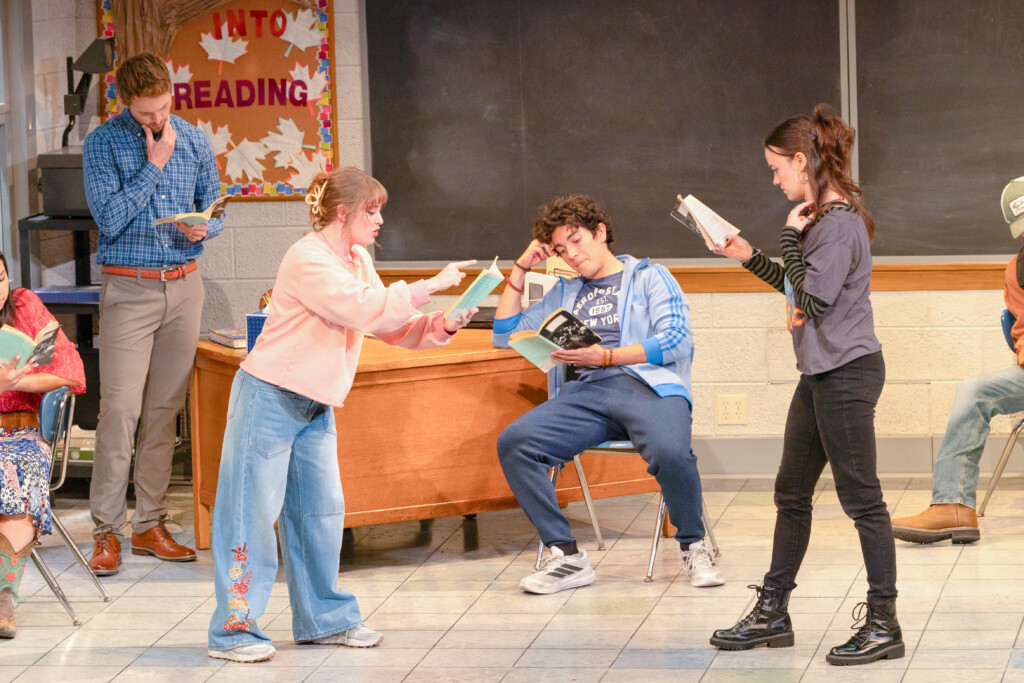
Photo: BW Productions
Belflower’s play was originally produced by Washington, D.C.’s Studio Theatre four years ago and from then on, it skyrocketed. It quickly became one of the most sought plays to stage (a student production was mounted in late 2023 by Utah Tech University in St. George). It became a Broadway hit, eventually earning seven Tony nominations in 2025 and was named by Entertainment Weekly as one of the top 3 Broadway shows that year. It won two Outer Critics Circle Awards, including Outstanding New Broadway Play.
John Proctor immediately draws the audience into the classroom set on stage, reminding many of what it felt like being in a high school English class studying a play that practically every American student of the last three generations has encountered at some point in their education. In the fictitious Helen County High School in the Georgia boondocks, the witch hunt references center on Shelby Holcomb (with a dynamite performance by Allison Dorsey). She is the subject of many rumors about why she left town temporarily after a scandal, which also entailed Raelynn Nix (phenomenally rendered by Alex Humphreys), her best friend, and Lee Turner (a spot-on portrayal by Carson Stewart), Raelynn’s boyfriend.
Yet another rumor erroneously placed Shelby with the father of a fellow student while it turned out the accurate rumor involved a figure much closer to the students—teacher Carter Smith (played with utmost credibility by Colby Strong, who previously appeared on the PTC stage in Women in Jeopardy!). With Shelby subjected to the dynamics of being blamed as the victim, the #MeToo references anchor the dramatic gravity in the main and secondary narrative arcs occurring here.

Photo: BW Productions
The lucidity in these performances makes it immensely satisfying for the audience. Thus, we can comprehend more empathetically with the impact on student Ivy Watkins (kudos to Adri Cumming for fleshing out the conflicting character, perhaps the most challenging role in this play). While we never see her father on stage, we learn things about him that undeniably sound disturbingly too familiar in the news: a wealthy man who holds a lot of power in this small town and who is regularly accused of sexually harassing women in the workplace.
Strong’s performance as the English teacher evokes the popular engaging and occasionally goofy vibes we believe fit this role. But he also is very good at subtly foreshadowing the moments when news about his own predatory behavior is revealed. Beth Powell (a well-textured interpretation by Skye Alyssa Friedman) is the quintessential straight-A student, but she eventually realizes that her beloved teacher also has inappropriately crossed emotional boundaries. One of Beth’s most important lines is, “I know I’m supposed to believe women like no matter what but, I just, I know him, you know?” Also, the teacher becomes nervous about the presence of Bailey Gallagher, a professional colleague (in a nicely evolved character arc nailed by Maggie Goble, whom many PTC patrons will remember for her performance in Prayer for the French Republic).
The actors are most effective at rounding out the painful lessons of maturity that come with the impactful dramatic coming-of-age experiences which many adults and educational professionals often underestimate and tend to dismiss without realizing the justifiable emotional gravitas of discovery. This plays exquisitely with the bounty of pop music references which juice the momentum. These include Taylor Swift’s Dear John (2010) and Lorde’s Green Light (2017). There also are references to Billie Eilish, Selena Gomez and Harry Styles. As a bonus, the southern accents are credible, thanks to the efforts of Sarah Shippobotham as dialect coach.

In the convenience store scene late in the play, Dorsey and Humphreys, as Shelby and Raelynn, respectively, produce a genuine scene of friends reconciling and reinforcing their bonds. Anicette deepens the character of Nell, the new student in town, especially in being unapologetically authentic, which attracts an unlikely suitor, one that Martinez conveys just as credibly in the character of Mason. In the riff between once-close friends Ivy and Beth, the actors Cumming and Friedman take us back to what such difficult encounters might have felt like in our own high school days. Stewart (who played the lead in last season’s new PTC musical Ten Brave Seconds) adds layers to a character that generally is seen as the most unlikable in the cast. He effectively portrays how one often resorts to defensive, even violent, tactics to cover up their insecurities.
This production is truly triumphant. Last month, an unexpected flood damaged PTC’s main theater at the University of Utah, but in an extraordinary brief flurry of activity that was resolved within less than two days, the show was moved to the Jay W. Lees Courage Theater at the Westminster Performing Arts Center. Although that theater has 663 fewer seats than PTC’s home venue, the more intimate staging of John Proctor at Westminster has enhanced the overall dramatic and electric vibes of this superb production.
With many performances selling out quickly, the run has been extended through Oct. 3. For tickets and more information, see the Pioneer Theatre Company website.