

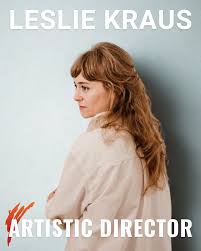
Having mastered the learning curve of how Ririe-Woodbury Dance Company functions and is embedded in Utah’s world-class ecosystem of dance, Leslie Kraus enters her second season as artistic director with her first curated season of productions which will expand upon the possibilities of dance theater and will embolden audiences to intimately connect with evolving ideals of dance as well as the company’s artists in their genuine selves.
Structured in three acts, the season resonates with Kraus’ belief in the company’s historical roots of experimentation and innovation which its founders Shirley Ririe and Joan Woodbury excelled at and won international acclaim for it.
Act I, which opens this week (Sept. 17-19, 7:30 p.m. daily) in the Leona Wagner Black Box Theatre at The Rose in downtown Salt Lake City, will feature works by award-winning New York choreographers Dual Rivet (Chelsea Ainsworth and Jessica Smith) and Kayla Farrish.
Led by Ainsworth and Smith since 2017 and based in New York City, Dual Rivet has created dance for stage as well as film. They have performed and set work at Festival PRISMA (Panama), b12 (Berlin), Centro Cultural Los Talleres (Mexico), Barnard College/Columbia University, Sam Houston State University, Oklahoma International Dance Festival, Austin Dance Festival, Joe’s Pub, West End Theatre, Kittery Maine, Musikfest Pennsylvania, Gibney Dance, Peridance Capezio Center, CreateArt, Arts On Site and many more.
Dual Rivet is on the faculty at The Juilliard School, Gibney, Peridance, SUNY Purchase, Marymount Manhattan College, and STEPS. The company also hosts an annual choreography festival, Made by Women, featuring choreographers and filmmakers from around the world. At this summer’s Dance West in Salt Lake City, the two-week professional dance intensive, Dual Rivet also led a class on contemporary floorwork and partnering techniques, emphasizing strength, adaptability, and trust, which also engaged art forms of capoeira, acrobatics, street dance and contact improvisation.
Dual Rivet’s piece incorporates a clear narrative arc on the theme of how humans act differently in front of a camera or video lens, a relevant update on the classic dynamics of the Hawthorne Effect. Simply, the camera prop becomes an integral element in the mise-en-scène of the choreographic staging.

Completing the twin-bill for Act I will be Evermore by Farrish, who also is based in New York City as a dancer, choreographer, director and photographer. Both Kraus and Farrish were with the Kate Weare Company but during different times. Kraus finally had a chance to work with Farrish during Punchdrunk’s acclaimed production of Sleep No More in New York City.
“I saw very early on what an extraordinary dancer and performer she is,” Kraus said in an interview with The Utah Review, “and then in 2020 during the pandemic lockdown she [Farrish] shared a film that she had made with me. It clicked that if I’m ever in a position to produce her work, I would do so immediately. She is a really beautiful talent and I’m super thrilled, especially now that she has been getting a lot more recognition for her work.”
Farrish’s piece also has an original score, composed by her partner Alex MacKinnon who joined her during the second week of her residency with Ririe-Woodbury. Kraus said that Farrish is “a deep practitioner of improvisation,” explaining that she also is a “deep practitioner of joy.” Kraus noted that “we are dealing with hard subject matter, but at the same time we are taking care of ourselves with this joyful approach that we get to be here with each other and do this miraculous thing.”
“Captivated by the whim, magic, and melancholy of the human experience, I aim to hold up a mirror to the society we form and participate in, to the communities and cultures we identify ourselves with, and lastly to the tremendous and unique experiences that form us as individuals,” Farrish explained in her artistic statement. “Our guts, instincts, weakness, power, voice that we do or don’t find, and our numerous attempts to relate, drive me—I believe in the physicality of what makes us inevitably, catastrophically, heartbreakingly, and wonderfully human.”
Farrish emphasizes that the work should ensure the dancers who perform it can allow their authentic personality to come through. As she articulated in her statement, “With roots as an African-American woman from the south, I have always been aware of the displacement of colored bodies and our continuous seeking for identity and community. Always out of place, and never agreeing to be defined as one thing or one idea, I came closer to my own identity in things that I love.”

Act II brings the world premiere of Kraus’ concluding installment in her trilogy, which will be presented at the Utah Museum of Contemporary Art (UMOCA) (Jan. 27-30, 6:30 p.m. and 8:30 p.m. daily). UMOCA has occasionally been the site for dance performances which intersect with current exhibitions. The most recent example featured the Interdisciplinary Art Collective in a definitive exploration of conceptual art, highlighting Sol LeWitt and Cornelius Cardew. Starting with Lewitt’s Wall Drawing No. 39, which is on loan from the National Gallery of Art in Washington D.C., the IAC presented dance, spoken text and live music in realizing the entire score of Cardew’s landmark 1967 graphic composition, Treatise.
Kraus’ work, set to be accompanied by an original score by Daniel Clifton,, will be the most significant dance experience in which UMOCA has collaborated. The UMOCA exhibition which likely will become the creative canvas for Kraus’ choreographic efforts is Time, Truth, and Other Immeasurables, which just opened Sept. 11 and will continue through mid-2027.
A major show, in part supported by grants by the Andy Warhol Foundation for the Visual Arts and Art Bridges Foundation, is a serendipitous opportunity that fits in the creative bailiwick in this unique artistic collaboration . As the exhibition statement indicates, “Although humans have created frameworks to define [their] experiences, they cannot fully capture how we exist within them. These forces shape our lives yet remain unquantifiable: time, truth, vastness, spirituality, deep time, and history as it unfolds in the moment.”
Additionally, “In an era driven by speed, data, and measurable outcomes, Time, Truth, and Other Immeasurables invites us to embrace the often felt but rarely articulated ethereal. It encourages viewers to reflect on what cannot be quantified, yet profoundly shapes our existence—the unseen, the enduring, the infinite, the immeasurable.”
What a match for dance!
Last season, the first installment, Listening Hour, which was Kraus’ first world premiere in her then-new role as the company artistic director, started with a deep dive into watching not only the body language of the six company dancers’ movement, but also listening to them. It is the appreciation of each artist’s individuality, not the attempt to reshape dancers into cookie-cutter form, which primes the landscape for the collaborative dialogue that generates the most impactful experience between choreographers and dancers set to perform a specific piece. Warren Realrider, a native musician and sound designer with whom Kraus worked in Oklahoma, provided the score for Listening Hour.
The second installment followed last spring, In-Kind Growth, which featured live sound design by Harrison Lind, a local musician-actor, and an avant-garde floral sculpture and costuming by Galore Floral artist Meagan Bertelsen. The second installment flowed from the themes of Listening Hour, by extending an ongoing instinctual exploration of relationships in a chaotic world thrown out of balance by humans who cannot understand or accept how the world has evolved into something that is different. The question raised in the second installment was focused on whether or not we can follow nature’s lead, which accepts the process of adapting to differences, by operating on a systemic level, rather than just primarily on the predominating species’ level.

The season will conclude with Act III (April 22-24, 7:30 p.m. daily, Jeanne Wagner Theatre at The Rose), featuring the nationally celebrated duo Outrun The Bear, presenting their acclaimed work Palace, alongside a world premiere by Bessie Award-winning choreographers Baye & Asa.
Former dancers with Israel’s renowned Kibbutz Contemporary Dance Company, choreographers Megan Doheny and Ilya Nikurov will see their 16-minute work receive its Utah premiere. “Palace is a glimpse into the world of an elegant nightmare. A surrealist-inspired take on partnership, the work uncovers the relationship of a couple, slowly pulling back the layers of the external facade, exposing a world that is filled with insecurity and doubt,” as indicated in the artistic statement for the piece. “Two emotional beings simultaneously intertwining and colliding, traveling deeper and deeper into the dark corners of their internal thought spaces. There, they encounter the places where difficult emotions are buried, where ghosts of the past inform reactions to the present, revealing a world they only want to run from.”
Some have described the work as an artistic fusion, reminding them of Ohad Naharin, one of the formative developers of the Gaga choreographic movement language, and of Pina Bausch, the legendary German choreographer who was a seminal influence in the development of dance theater.
Having met when they were six years old, native New Yorkers Baye & Asa (Amadi ‘Baye’ Washington & Sam ‘Asa’ Pratt), use Hip Hop and African dance languages as the foundation for creating movement art projects. “The physical aggression in our choreography is a symptom of our political rage, and a yearning to personally implicate ourselves,” their artistic statement reads. “We use our choreography to create political metaphors, interrogate systemic inequities, and contemporize ancient allegories; we build theatrical contexts that celebrate, implicate, and condemn the characters onstage.”

The season also will include Synthesis Young Artist Showcase
Dec. 9 – 11 (7:30 p.m. daily at the Black Box Theater in the Mid-Valley Performing Arts Center, Taylorsville). Synthesis is returning for its fourth installment, with nearly 500 students for three days of an annual high school choreographic dance festival. The company will perform each evening, alongside young dancers from across the Wasatch Front.
The Big Kids Show (March 4 -5, Jeanne Wagner Theater at The Rose) will feature choreography and sound score, respectively, by Satu Hummasti and Daniel Clifton, performed by the artists of Ririe-Woodbury.

“I love Leslie’s [Kraus] vision of being a house for experimentation,” Thom Dancy, Rirle-Woodbury’s executive director, said. In addition to reaching the community on a broader scale such as inviting more people into open company classes, he said that the company hopes to launch a small artist-in-residence program in early 2027 to support experimental dance makers in process. This concept is similar to what local theater institutions such as Pioneer Theatre Company, Plan-B Theatre and Salt Lake Acting Company have offered as incubators for workshopping scripts in progress.
For tickets and more information about the season, see the Ririe-Woodbury Dance Company website.