
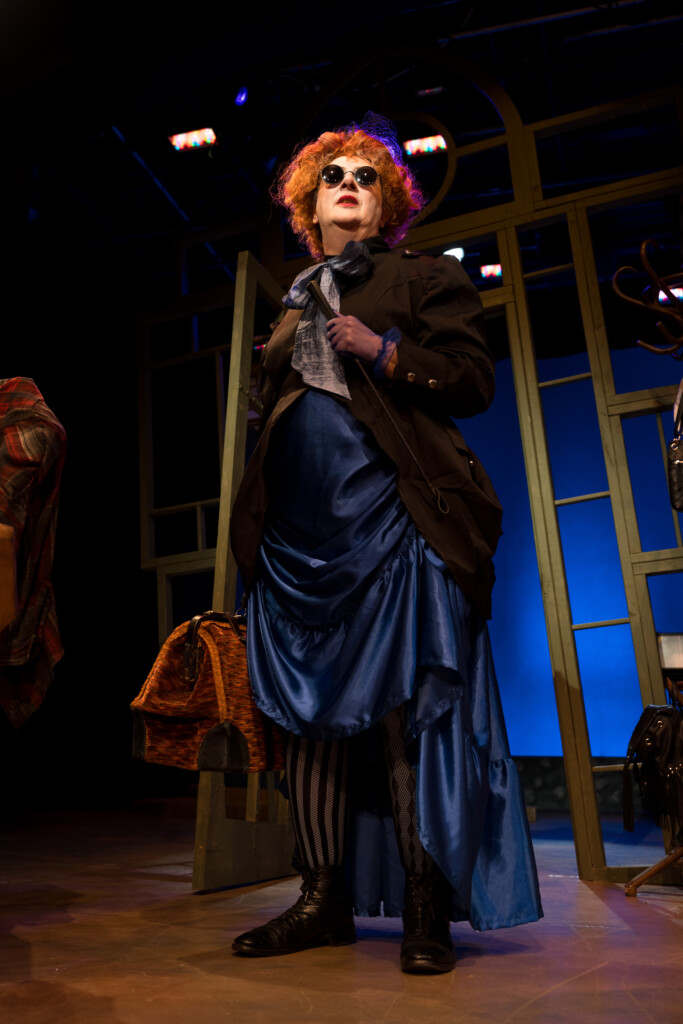
PYGMALION THEATRE COMPANY: WITCH
Playwright Jen Silverman certainly is admired by Salt Lake City theater companies. The most recent example is the outstanding production of Witch (a 2018 play), directed by Morag Shepherd, in a PYGmalion Theatre Company run which continues through Oct. 17.
This is the third Silverman play within the last year to be produced locally and the results are consistently gratifying. In 2025, Voodoo Theatre Company produced The Moors (2017), an intriguing Gothic chamber theater play that resonates very nicely with parallel stories touching on counterpoints of love and power and isolation and identity. To open its season last year, Salt Lake Acting Company presented a superbly acted production of The Roommate (2015), directed by Teresa Sanderson. The actors did a grand job of sorting out the playwright’s objective of reversing the likely premise that once women are past 40, they gradually diminish from the scene and eventually become invisible.
An impressive playwright in her own right who appreciates the disarming and subversive narrative potential, Shepherd kept Witch smart, crackling, and hip, with scene transitions riding along a contemporary song playlist which fell right into place for a period setting in the old English village of Edmonton. In fashioning complicated characters that encourage audiences to handle more than one thought about a person in their minds, Silverman has always deftly handled themes of isolation, paranoia and loneliness well while suggesting larger social epiphanies in her stories.
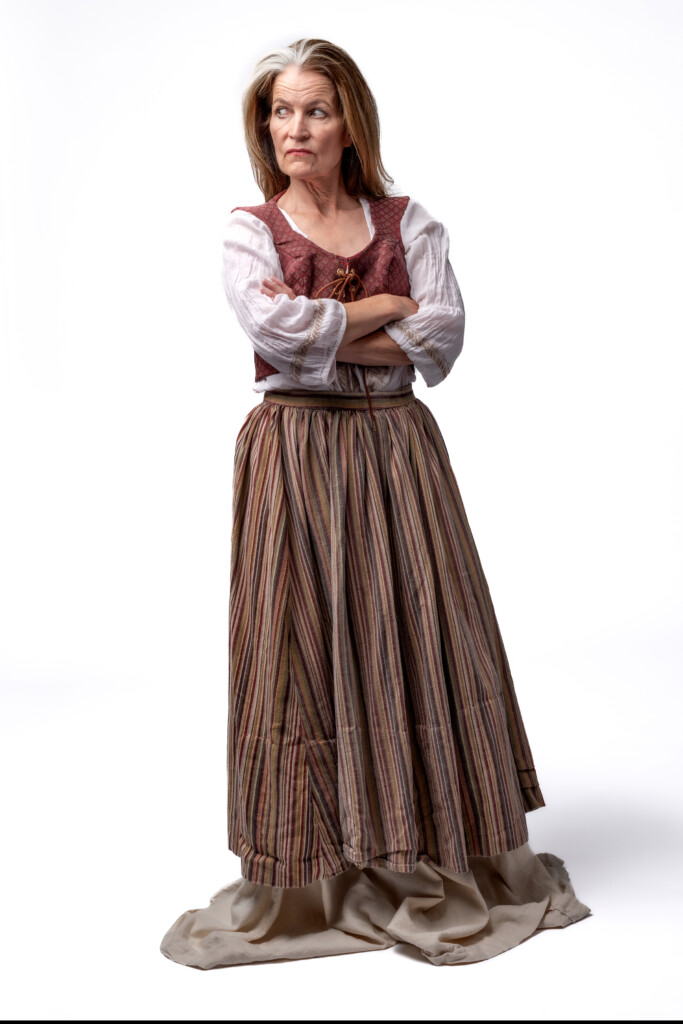
The sextet of actors fulfilled Witch’s creative brief with equally superb performances. Stephanie Howell shines as Elizabeth, cast out by the village which has accused her of being a witch. Her exchanges with the devil, Scratch (McKell Rae), are especially good when she makes it clear to the devil that her soul cannot be that easily bought. The devil is persistent but Elizabeth’s hesitation also gives the time and space for the village soap opera which quickly unfolds.
Barrett Ogden embodies the nobleman Sir Arthur, who is more intrigued that an outsider, Frank (Pedro Flores) will make a more worthy and properly masculine scion than his rightful heir, Cuddy (Amona Faatau), who wants to pursue his career as a dancer. Meanwhile, Winnifred (Juls Marino) proves to be more involved in the narrative tensions than merely being an estate servant and observer.
The production sparkles because everyone involved on or off stage instinctualized the undercurrents that brought this dark comedy to life. Silverman was inspired by an early 17th century play, The Witch of Edmonton, a tragic comedy that was an outlier when it came to telling stories about witches and what people should do if they are approached by a witch. “The Witch of Edmonton is the only one I found that boldly announces to the audience that it is going to do this exact thing, and then does entirely the opposite,” Silverman explained in an interview published elsewhere.

Silverman’s play is in no way faithful to the original which sparked the idea for Witch. The alchemy of predicaments where despair and hope is played out as the question of whether or not one can fall in love emerges from the darker expectations suggested at the outset. Of course, Silverman’s greatest skill is how she casts a distinct tone in each play that differs from her other works. The questions are essentially the same in The Moors, The Roommate and Witch. But Silverman always sets a unique tone even as she relies on her own conventions of dark comedy to explore them. Thus, Shepherd’s distinctive approach nicely elucidates the theatrical epiphanies that take shape in Witch.
Performances continue through Oct. 17. For tickets and more I formation, see the PYGmalion Theatre Company website.
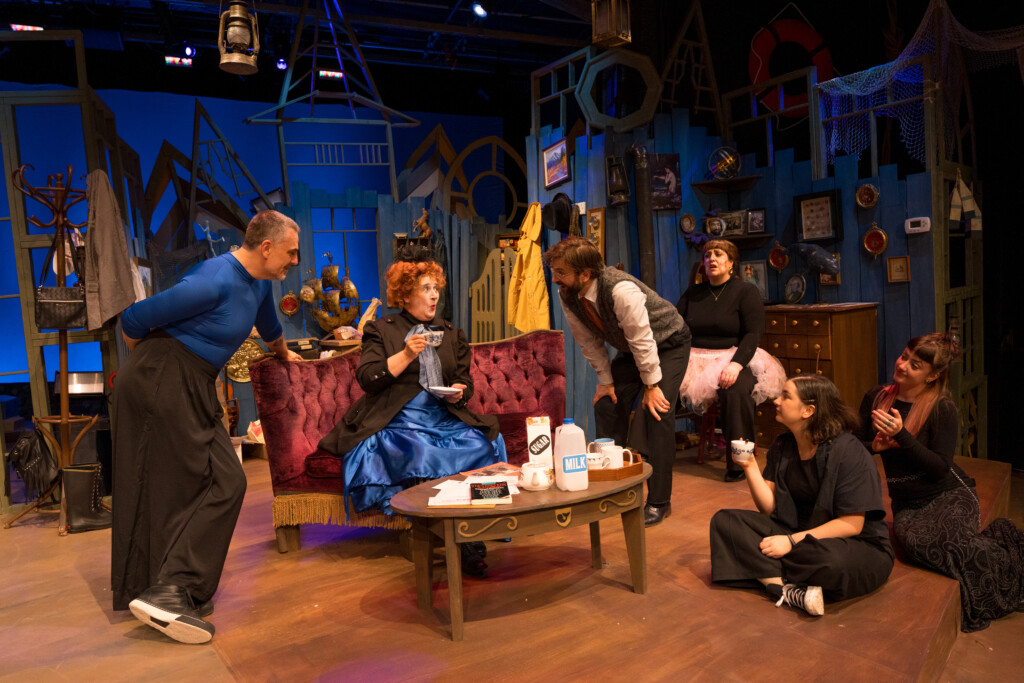
SALT LAKE ACTING COMPANY: VERY LIKE A WHALE
It is curious that a 19th century Utah urban legend about whales being transported by train to be deposited into the Great Salt Lake so they could thrive and propagate has reinvigorated the 21st century imagination among Utahns. The lake’s existential crisis is now being discussed continuously, especially as the crucial threshold for timely action is so uncomfortably close. The symbolic imagery of the whale, once preposterous because of the nature of its hoax origins, is galvanizing emotional sentiments about how a calamitous environmental disaster could be prevented.
This appears to be the impetus in the world premiere of Troy Deutsch’s Very Like A Whale, which is currently in a Salt Lake Acting Company (SLAC) run through Oct. 25. In a co-world premiere with Cadence Theatre Company in Richmond, Virginia, the SLAC production is offered in collaboration with Flying Bobcat Theatrical Laboratory and is directed by Alexandra Harbold.
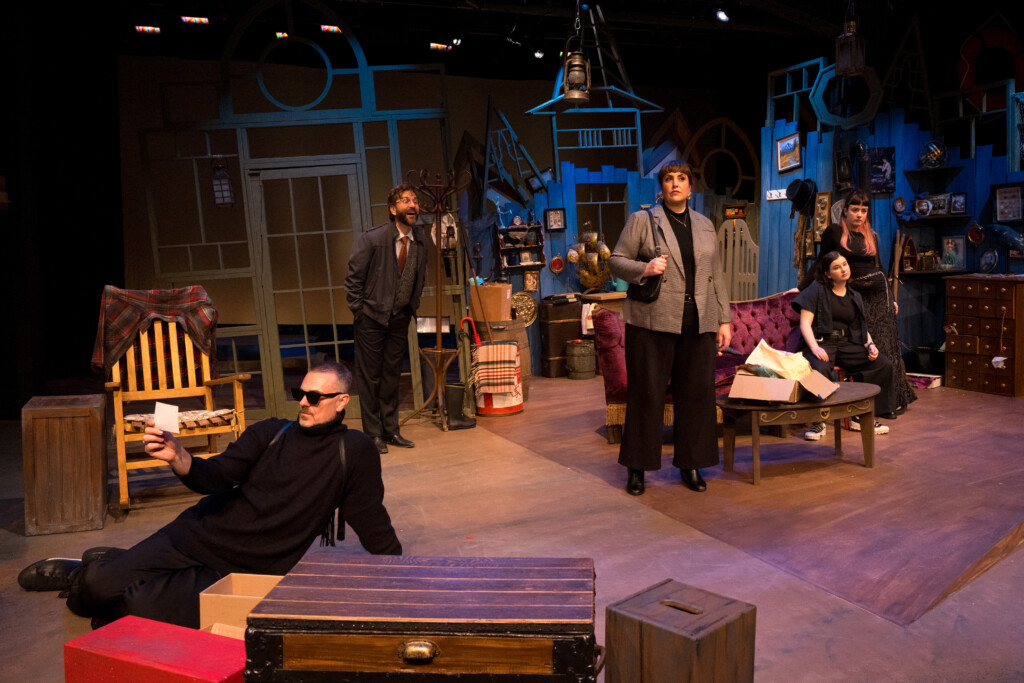
The cast is stellar, notably in the performances of Olivia Custodio, as Megan, the acerbic matriarch of the very eccentric Sharp family; Robert Scott Smith as Greg, her brother whose flamboyance is catapulted by his obsession with modern dance, and Sarah Shippobotham as Miss Penelope Dickinson, the eccentric steward representative for ensuring the well-being of the mysterious whales continues. Of course, the elderly and even more odd neighborhood observers who seem to be the most grounded in the story are rendered effectively by Yolanda Stange and Ben Young. Rounding out the Sharp family ensemble are Chester, Megan’s husband (M. Scott McLean); Max, the lesbian daughter (Devoree Ellis) and their partner, Sophie (Mack Barr).

The actors extract a lot from a script that doesn’t always effectively connect the magic of legend and lore to the sobering obligations of practical stewardship and spiritual guardianship required to rescue the lake. Very Like A Whale occasionally touches on the obligations of personal sacrifice in order to preserve something from being lost forever. But these elements also are subsumed too often into comedic eccentric conventions.
The Great Salt Lake whale legend has existed since at least 1888. It has become a popular community touchstone. At the same time that Very Like A Whale opened at SLAC, Repertory Dance Theatre (RDT) gave Penny Saunders’ Legend Has It, part of RDT’s new Living Landscapes initiative, its world premiere. Saunders created a choreographic counterpoint about the whimsical and darker implications of urban legends and myths.
The script from which Saunders choreographed the work resounds with the zeitgeist where the public is acutely aware of the Great Salt Lake’s urgent existential crisis. Deutsch also is inspired by that same zeitgeist.
The link to these examples is channeled via the public’s enchantment with Out of the Blue, the whimsical 23-foot-tall whale sculpture which breaches the roundabout in Salt Lake City’s Ninth and Ninth neighborhood. That same weekend, Whale Fest celebrated the new look for the sculpture, Open Your Eyes by artist Jiyoun Lee-Lodge.
Is the whale legend as effectively instructive a sociopolitical motivator as it could possibly become? Thoroughly entertaining, Very Like a Whale hints at that periodically, but the connection sometimes is interrupted.
Indigenous peoples view the lake as sacred kinfolk. Anyone who has ever visited the state park on Antelope Island has seen buffalo, an animal which has thrived there because of the lake’s presence. The most important question is “Who is the lake to us?”— raised in a recent op-ed at the Salt Lake Tribune by Cristina Mormorunni, who is Red River Métis and co-founder and executive director of INDIGENOUS LED, which is in formal partnership with A’nuche, a Ute Mountain Ute community non-profit.
For tickets and more information, see the Salt Lake Acting Company website.
WESTMINSTER UNIVERSITY’S DANCE, THEATRE, MUSIC, ART PROGRAMS: CHANCE OPERATIONS
Earlier this month, four Westminster University programs in the arts embarked on a wonderful dive in their interdisciplinary Chance Operations festival which explored the legacies of composer John Cage; his life partner, choreographer Merce Cunningham, and contemporary artist Robert Rauschenberg.
The events celebrated the ideals of adventurous risks taken even when critics and colleagues in the artistic communities are prone to dismiss or ridicule them. It has been 35 years since Cage died and his artistic impact has survived the cultural lag of the passage of time. The Intermountain West is one of the best places to appreciate these legacies. Cage emerged as part of an experimental music movement that, not surprisingly, began on the U.S. West Coast more than a century ago but gained momentum post-World War II when he set forth his revolutionary musical philosophy, encased in his sensibilities of Zen Buddhism.
Cage’s music has transcended the initial reactions of ridiculousness or absurdity. The Chance Operations festival, to reiterate a point The Utah Review has made previously, strengthened the respect and integrity for the genius of experimental composers who challenge musicians to follow their instincts and to live, express and work as freely as possible as artists, regardless of the medium or discipline.
The festival’s title is related to a Cage program note he wrote in connection to 27’10.554″ for a percussionist (1956), which was Cage’s last work in The Ten Thousand Things project. As Cage explains, “the notation is in space, with one page equaling one minute. The work may be performed as a recording or with the use of a recording. The compositional means included chance operations and the use of the imperfections found in the paper upon which the work was written.”
Two events that The Utah Review attended stood out as anchors for Chance Operations, both which conveyed an artistic elegance that easily would neutralize the words of critics or those skeptical or intimidated by the idea of such programming.
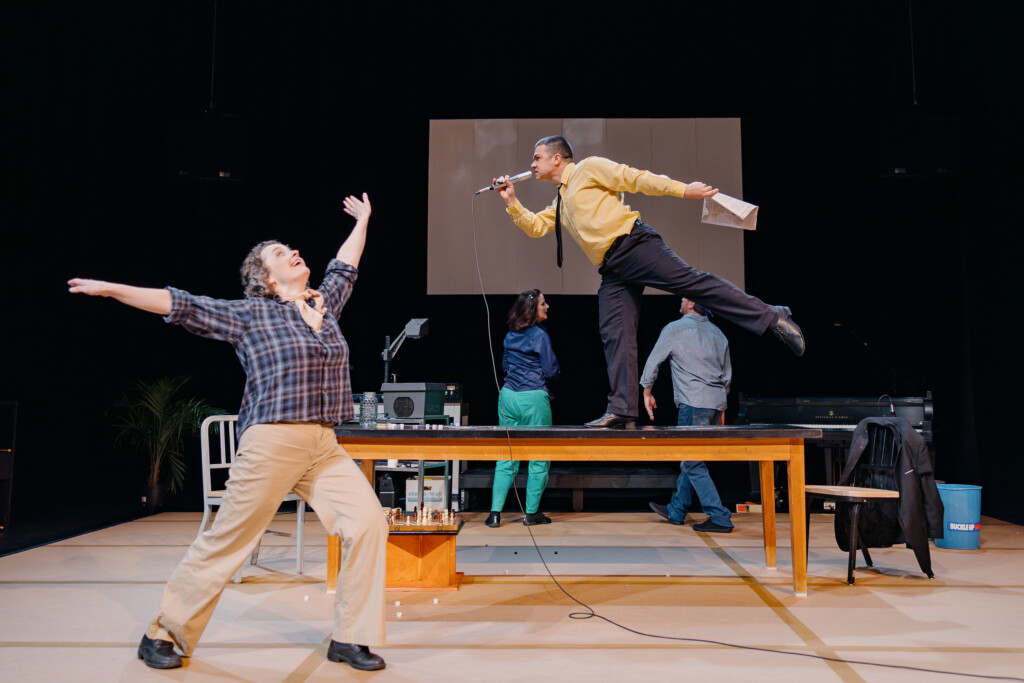
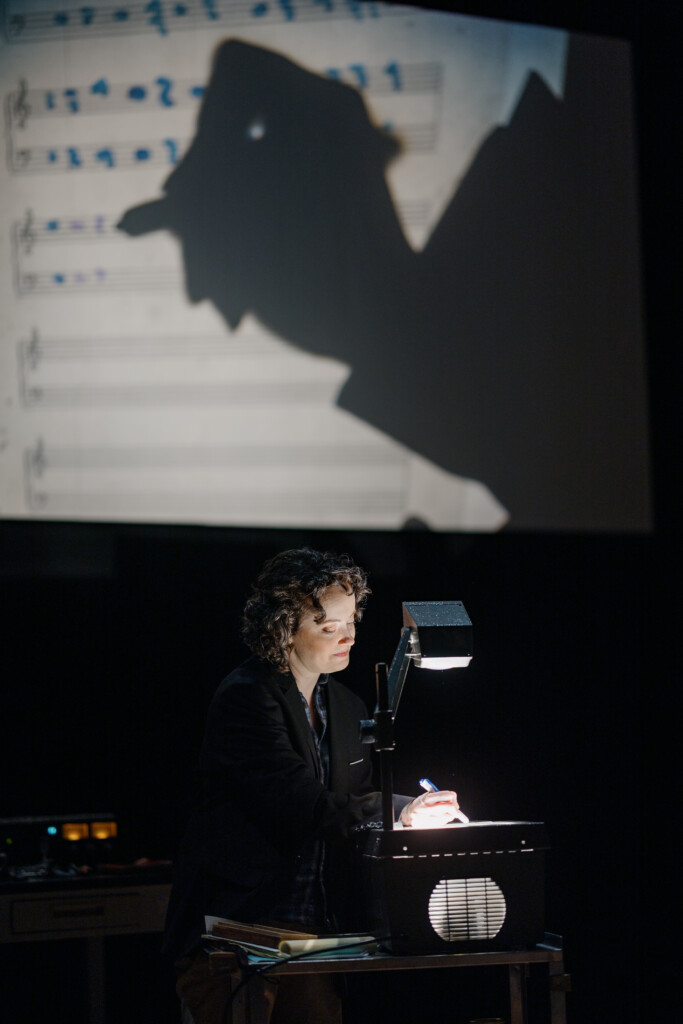
One was John Cage 101, an enlightening theatrical exploration of the composer’s life with the additional contexts of Cunningham and Rauschenberg as creators. Presented by Available Light Theatre, a company-in-residence in the university’s performing arts programs, the well-researched production was developed and directed by Matthew Slaybaugh with movement by Meghan Durham Wall, who is chair of Westminster’s dance program.
This was an effusive appreciation of Cage, with performers (Acacia Leigh Duncan, Meghan Durham Wall, Drew Eberly and Ian Short) responsible for handling a spectrum of sound design and noisemakers, including prepared piano, claves, vintage meat grinder, tin flute, wood waterfall, Caxixi shaker, egg shaker, train whistle, radio, tambourine, service bell and sheet metal, among others.
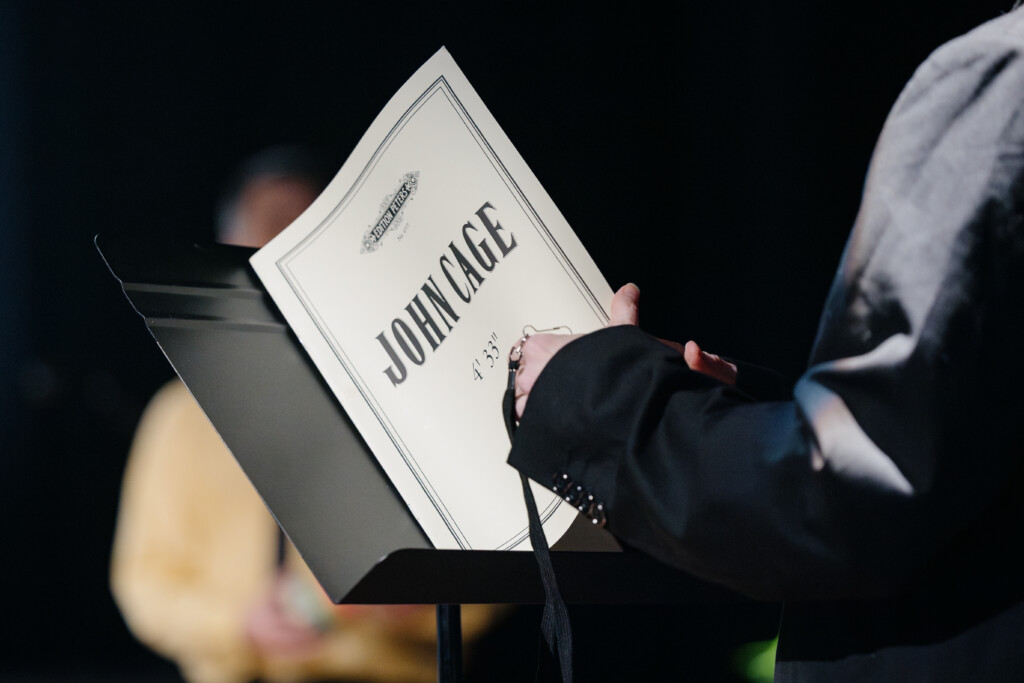
Just as satisfying was MusiCircus, an all-Cage concert, featuring Indigo Cook, Brandon Derfler, Kimi Kawashima, Hilary Koolhoven and Devin Maxwell. Of course, there was the original 4’33” (1952), with Cook, Kawashima and Maxwell each performing a short movement but holding their respective woodblocks in silence.
With the exception of Child of Tree (1975), featuring Cook on a set of percussion instruments and amplified cactus, and One4 (1990), with Maxwell on drum set, the remainder of the works came from Cage’s earlier periods. Soprano Koolhoven gave an elegant melodic reading to Experiences No. 2 (1948), with text by e.e.cummings which became the basis for a short choreographic piece by Cunningham.
Kawashima offered an impressive set of excerpts from Cage’s Sonatas and Interludes for Prepared Piano (1946-1948). The 20 pieces Cage wrote for this set are the magnum opus for prepared piano. Cage’s score is meticulous about how bolts, screws, rubber, and plastic should be inserted to alter the piano strings that produce 45 of the 88 notes on the keyboard. This work fuses Cage’s appreciation for improvisatory approaches and the very simple sonata form that Scarlatti promulgated,
The set of sonatas and interludes signified Cage’s interests in capturing ancient Hindu aesthetic theory through sounds representing emotions (very useful when Cunningham asked Cage to write music to accompany his choreography). East meets West in this fascinating series.
The two percussion pieces echoed the festival’s Chance Operations theme. Cook definitively realized the composed improvisation of eight minutes in Child of Tree. Cage explained that the performer must “clarify the time structure by means of the instruments,” but even as the performer designs the piece, there is always the element of chance “because the improvisation can’t be based on taste and memory since one doesn’t know the instruments.”
The late Cage work, One4, was written as part of his Number Pieces opus and Maxwell demonstrated why this particular work stands out in this set. This is like no other drum set piece which we might expect to hear, far different from the performances of a master drummer such as Buddy Rich. Comprising 14 distinct events of controlled sonic densities, the piece emphasizes two specific sound types Cage wanted. They should either be long (for instance, tremolos where the attacks are barely audible) or short to the point of being terse (that is, no resonance or completely stopped). In this Cage work, attacking a cymbal with a single hit must not be allowed to ring.
Derfler opened the program with In A Landscape (1948), a solo piano work that immediately evoked the likes of Erik Satie’s translucent Gymnopédies. Composed for woodblocks, Amores, III (1943) is the third section of a four-movement work for prepared piano and percussion.
Closing out the concert was Imaginary Landscapes No. 1 (1939) featuring Derfler on piano, Cook on cymbal and Maxwell on electronics. At 27, Cage produced one of the earliest examples of electro-acoustic music for live performance, which emulated the aesthetics of French composer Edgard Varèse that emphasized music as an organized and organic set of noises. It was a perfect punctuation point on an enthralling sampler of Cage’s catalogue.