
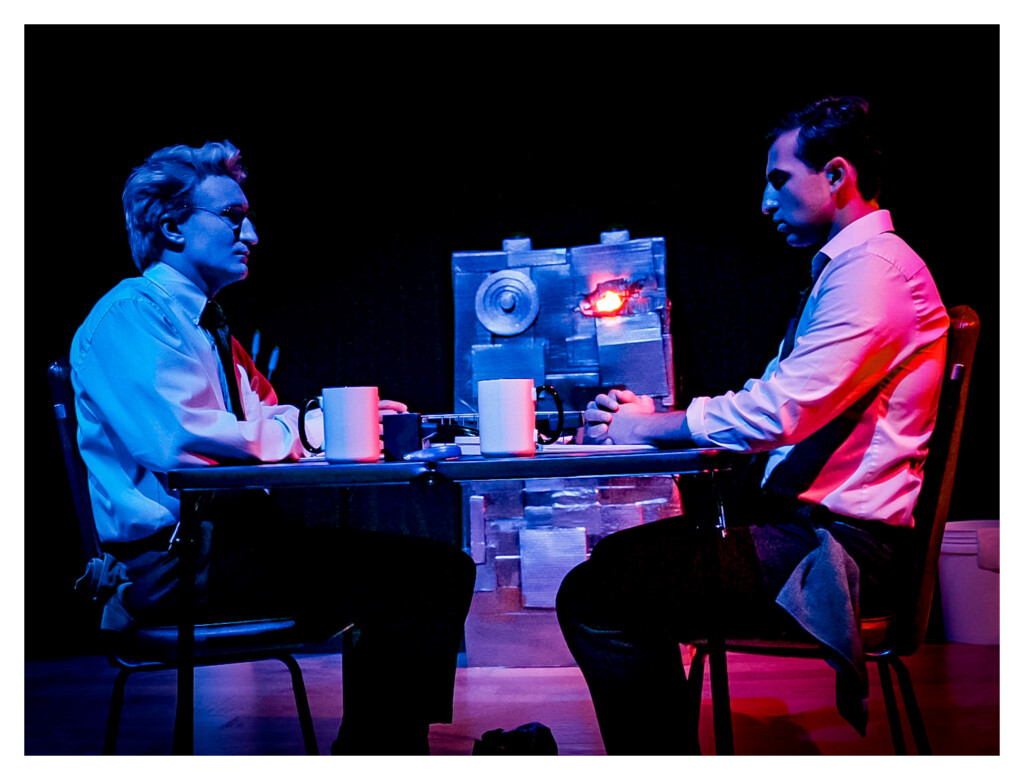
The first weekend of the Great Salt Lake Fringe (GSLF) finished on a strong note, with sales approaching $20,000, up more than 20% from the same point in 2025. Audience numbers also have increased to 1,500, up 50% from last year’s first weekend.
Shows resume for the second weekend, July 30-Aug. 2. Four venues are available: the main hall and the Sister Dottie S. Dixon Memorial Black Box at the Alliance Theater, connected to the Utah Arts Alliance, at Trolley Square, as well as the MadKing Fellowship Theater at The Gateway. The newest venue is Lightree Studios (740 W. 1700 South). Tickets are available individually, as a three-pack or a ten-pack at the GSLF website.
The following are reviews for six shows presented during the first weekend. For previews, see The Utah Review’s earlier coverage here and here.

Great Salt Lake Fringe 2026. Photo: Charles Vaccaro.
AN UNDISCOVERED ROOM
In total darkness or in a very large room very quietly, attune to the souls of rooms and objects, the emanations left by time. I have made myself different eyes,/ to see down the infinite alleyways the universe dissolves/ into, at each ecstatic footfall. Whatever it will be,/ it will be new, filled/ with its own mystifying absurdities,/ and likely beyond me./ This body may not be built/for it.
Having presented some of the most memorable performances at GSLF in other years, Interdisciplinary Arts Collective, formed in 2017 and directed by Indigo Cook, returned this year with An Undiscovered Room. The audience maneuvered through a maze in the performing arts space with sections segmented by poles and handmade curtains from upcycled materials. Designed by Cook and Michela Dwyer , the show’s primary four elements were sound, light, texture and bodies, featuring dancers, musicians, poets and actors. There was live music and sound effects, with dancers performing alone or with the others with periodic recitations of poems and prosaic text by writers including Gwendolyn Brooks, Donna Tartt, Brian Eno, Ted Chiang, Kai Carlson-Wee and others.

A fascinating conceptual performance piece, the show was created in a five-day intensive workshop. With the theory of psychometry of space in mind, these elements precisely primed the audience to immerse themselves into a deep introspective environment where clairsentient and clairaudient dynamics allow us to clear our minds for our stronger intuitive senses. It was a calming 40-minute experience.

An Undiscovered Room will also be presented in the fall at The Carolina Theatre of Durham for the Durham Fringe Festival in North Carolina.
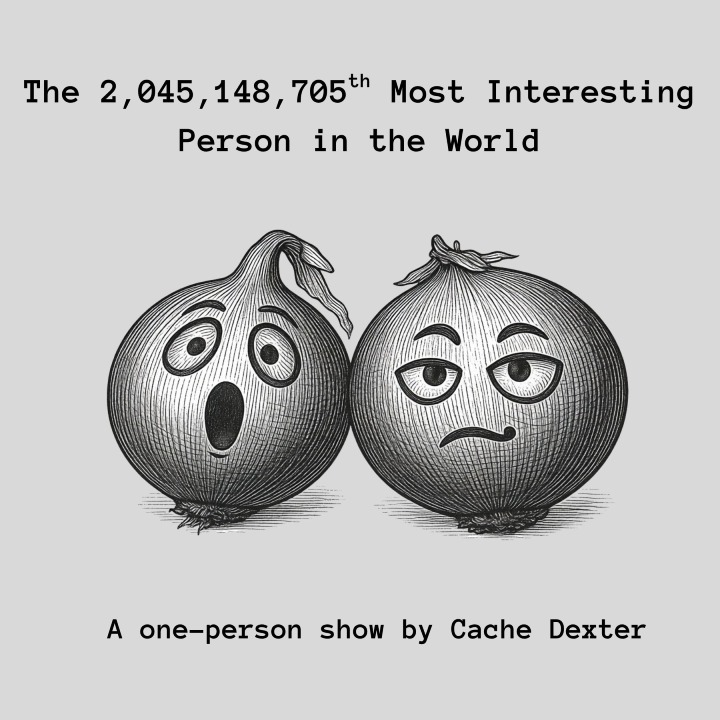
THE 2,045,148,705th MOST INTERESTING PERSON IN THE WORLD
In 2025, a monologue show, Second Grade Problems, by Cache Dexter, won a Fringe Pick award as picked by the GSLF staff. This year, Dexter returned with The 2,045,148,705th Most Interesting Person in the World, which likely will set him up for a second consecutive GSLF award. As Dexter explained, the person one spot ahead of me is named Baby Satan, an ordinary accountant in Ohio.
When one thinks about his show afterward, its sly, clever virtues of anti-comedy hit spot on in pondering its takeaway. He espouses the possibilities about being a night-shift taxi driver whose fares are classical mythological beings and his Onion Buddies enterprise (in which every audience member receives a yellow Spanish onion), along with the virtues of the Pythagorean Theorem. He is determined to move up one notch on the list while he updates us with dispatches in manila envelopes he receives offstage.
Considering that more than 8.3 billion people live on Earth, Dexter—who describes himself on his website as diurnal, bipedal and heterotrophic—already does pretty well on the most interesting list, considering he ranks easily within the top 25% of the human population.
Like the late Andy Kaufman and others who made their name on the Adult Swim cable television series, Dexter succeeds at giving us an intentionally confusing sense that his show is void of substance when actually it is anything but substance-less. It’s quite the subversive satire on the narcissistic digital obsessions of the attention economy. His website is just as consistent in message.
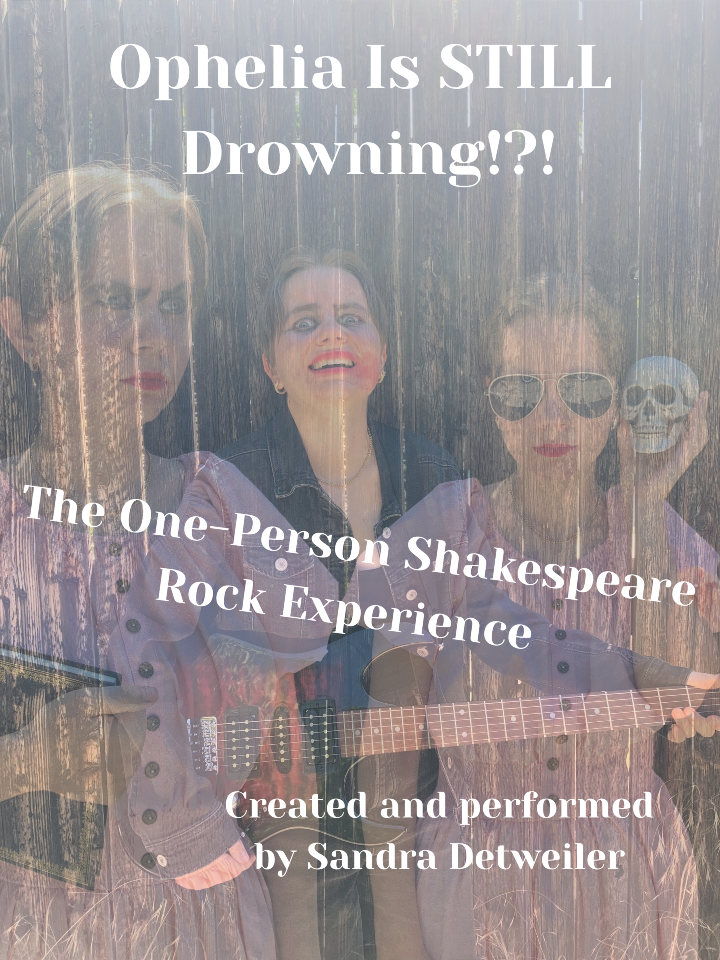
OPHELIA IS STILL DROWNING!?!
A monologue, Ophelia is STILL Drowning!?! by Sandra Detweiler riffs on one of Shakespeare’s most familiar characters but whose stage presence in Hamlet is limited when considering the some of the most consequential events in this play affect her the most but it is evident that she did not have the more active role in key moments of the plot.
Shakespearean-themed Fringe shows are almost always a staple for this festival but Detwiler’s one-person show invigorates our appetite to continue digging into The Bard’s works for contemplating sociocultural and sociopolitical questions about women in larger society. Faithful to the plot (which she summarizes nicely in this Instagram reel), Detwiler incorporates smartphone chats and music breaks with rock songs. She manages her theatrical duties well, playing not only Ophelia but also Hamlet, Horatio, Laertes, Polonius, Claudius and Gertrude. She accomplishes her creative brief with solid results, by credibly shifting the dearth of Ophelia’s perspective in the script to a plausible case of her becoming an influential driver for the events which actually affected her in the original.

UNDER OBSERVATION
Under Observation (July 25–Aug. 2) is one of the most intriguing avant-garde works this year, an approach that is most welcome at GSLF. Shaped for Sportive Tricks Theater Company presented a queer thriller dance theater piece written by Tony Trunnell and which is partly inspired by Stravinsky’s The Rite of Spring.
Trunnell, an ambulatory wheelchair user, plays Isaac, a recently disabled botanist who is working furiously to save the dwarf mistletoe from extinction, despite its classification as a destructive parasite affecting Douglas fir trees. He comes so close to achieving his objective but dealing with an increasingly impatient corporate CEO, a boyfriend whose love is more frequently doubted for its sincerity and insomnia punctuated by surreal dreams collectively overwhelm him.
None of the other characters appear on stage. Two dancers perform during the dream sequences, with excerpts from a historical recording of Stravinsky’s ballet conducted by Leonard Bernstein and performed by the London Symphony Orchestra. Ethan Green and Sophi Star, who also choreographed the movement, performed these interludes. All of these elements in part represent Trunnell’s lived experiences, with this play having its roots seven years ago in his small hometown of Arco, Idaho.
It’s a riveting piece. Trunnell’s performance is excellent. The premise is well conceived. His character is on the verge of achieving a stable livelihood, with a major scientific achievement on hand and the support of what he assumed was a sincerely loving life partner. As for the ugly parasite of the dwarf mistletoe, it does have a scientifically acknowledged role in managing a forest ecosystem, including providing food for birds and small mammals, habitats for owls and acting as a valuable disturbance agent.

TWINK OR SWIM
Living in Seattle and performing stand-up comedy in venues from San Francisco to Vancouver, J’myle Koretz, a Salt Lake City native, brought Twink or Swim, quite an illuminating show about how one young gay Navy enlistee managed to have plenty of funny experiences during his military service which started when Don’t Ask, Don’t Tell was still in force. The one significant note is that Koretz should not restrain himself from revving up the saucy hilarity of it. Juicier details are always welcome.
Three years before he graduated from West High School in Salt Lake City, Koretz came out. With a high school diploma in hand, he briefly worked on a couple of presidential campaigns for the Democrats before enlisting in 2004. For a young gay man, he couldn’t have asked for a more opportune assignment. He served four years in the Pacific aboard the USS Patriot, an Avenger-class minesweeper, which took him to more than 30 countries. What emerges are some good tales about camaraderie and places safe enough for socializing without worrying about being reported. Certainly the inevitable repeal of Don’t Ask Don’t Tell, which started under the Clinton Administration in the 1990s, was the vital relief many gay military members deserved. Knowing how to leverage an undeniably imperfect but still pragmatic compromise, Koretz shows us that a gay man could still experience the bonds which come with a shared sense of survival.

Photo: Charles Vaccaro.
THE VARIANTS
With a marvelous quartet of actors who know how to deliver devilishly good one-liners on cue, Randall Huskinson’s The Variants, directed by Teresa Sanderson, is on the path to becoming one of this year’s most popular GSLF shows. Yet it is still a work in progress and one must consider that when assessing its artistic potential.
Also, Fringe audiences are seeing an excerpted version of the full script, which will receive its reading on Oct. 19 as part of Salt Lake Acting Company’s New Play Sounding Series. It is a rough diamond but there is still plenty of work to finish polishing it for a full-fledged production world premiere at some future point.
A Curious Modern Plays production, this dark comedy opens in the midst of the pandemic lockdown, as four members of the Pierce family gather on Zoom for their weekly chat. With news that a COVID-19 vaccine will soon be available, Diane (Annette Wright), the mother, is excited for her upcoming 70th birthday and the opportunity to see her adult children together in Palm Springs for the first time in three years. However, Blair (Allen Smith), her eldest son, throws a monkey wrench into the plans because he refuses to be vaccinated.

Furthermore, he no longer looks forward to their weekly Zoom chats because he is tired of hearing the constant heat of critical judgment from his two siblings, Reggie (Kirt Bateman) and Julie (Eva TerraNova). Reggie, the younger brother, is gay and has held back some details about his life, including the fact that a relationship with his partner is crumbling. As a scientist, Julie can’t understand why her oldest sibling continues to believe non-scientific hoaxes and conspiracy theories about the pandemic. Blair, who works in the hospitality industry in Anaheim, home to Disneyland, is extremely frustrated how the pandemic has reduced his business to a trickle.
The script gives Wright’s character the lion’s share of the best lines, which the veteran actor revels in, thanks to her distinction as a performer on many Utah theatrical stages. Incidentally, she also was Huskinson’s high school drama teacher. Despite Diane’s assertions that Blair might have an addiction to pornography, she unconditionally loves her children. What is most curious in this abridged version is that the mother seems to be most urgently concerned about the blots and blemishes in her firstborn’s life. It will be intriguing to see the character contexts in the larger script, especially with the revelations Reggie shares with his older brother in a phone call.
There also is a curious tenor to the scorn that the two younger siblings have for Blair. One could assume this was not exclusively affected just by Blair’s obstinate refusal to accept the realities of the pandemic and his family’s request for being vaccinated.
The task of writing in the genre of dark comedy is complicated, as The Utah Review has periodically commented on elsewhere. Humor is an effective defense mechanism to a certain degree. When dealing with the more uncomfortable dramatic elements in the narrative, the writer must be meticulous to avoid crossing the boundaries into melodrama, where the rhythms of the play’s story can risk becoming tedious and self-indulgent. There are some of those moments, at least in this abridged version.
To reiterate a point this critic has made before: No question, art should never shy away from vigorously challenging the audience to be uncomfortable, even as the play generously serves up well-written lines of dark comedy within the context of its inherently tacit political undercurrents. But clearly there are passages which should be tightened significantly and the balance between comedy and drama honed.

Photo: Charles Vaccaro.
I am reminded of a quote from F. Scott Fitzgerald’s The Great Gatsby by Nick Carraway: “Reserving judgments is a matter of infinite hope. I am still a little afraid of missing something if I forget that, as my father snobbishly suggested, and I snobbishly repeat, a sense of the fundamental decencies is parcelled out unequally at birth. And, after boasting this way of my tolerance, I come to the admission that it has a limit.”
The last sentence in this quote is important. To get to the climactic reunion, expressions of judgment are inevitable. In The Great Gatsby, Nick continues musing about his father’s advice, “[W]e’ve always been unusually communicative in a reserved way, and I understood that he meant a great deal more than that.”
Ultimately, The Variants is about family communication dynamics of judgment, and the pandemic experience provides handy theatrical scaffolding. Diane is on the verge of being heartbroken by the possibility that she will not get to see her firstborn at the birthday reunion. In chastising Blair relentlessly, his brother and sister are fed up with his protests and refusals. And, there is The Variants’ most dramatic phone call scene, when Reggie shocks Blair with his own revelation.
Family communication is no longer a convenient gesture for the sake of one’s protection of identity. It’s a rocky, even tumultuous, ride in the play. But with a good deal more polish, the destination signaling infinite hope the play arrives at has the potential of an illuminating epiphany bridging audiences, regardless of their political proclivities.