
Sometimes, great novels make great plays and films. More often than not, novels definitely less than great make far better plays and films. That is certainly the case with Leopold von Sacher-Masoch’s 1870 novel, Venus im Pelz (Venus in Fur), an autobiographical treatment which literally put the M—masochism—in S&M. David Ives’ theatrical adaptation, which later became a Roman Polanski film that won best director’s honors in France’s 39th César Awards, is downright brilliant. Ives’ script is a seductive quilt of enticing counterpoints — erudite and campy, with more than a soupçon of ridiculousness and bananas-like vibes; clever and unashamedly risqué. No question that Ives improved upon the prose of the original, which the playwright once described “as Teutonically leaden as velvet sandbags.”
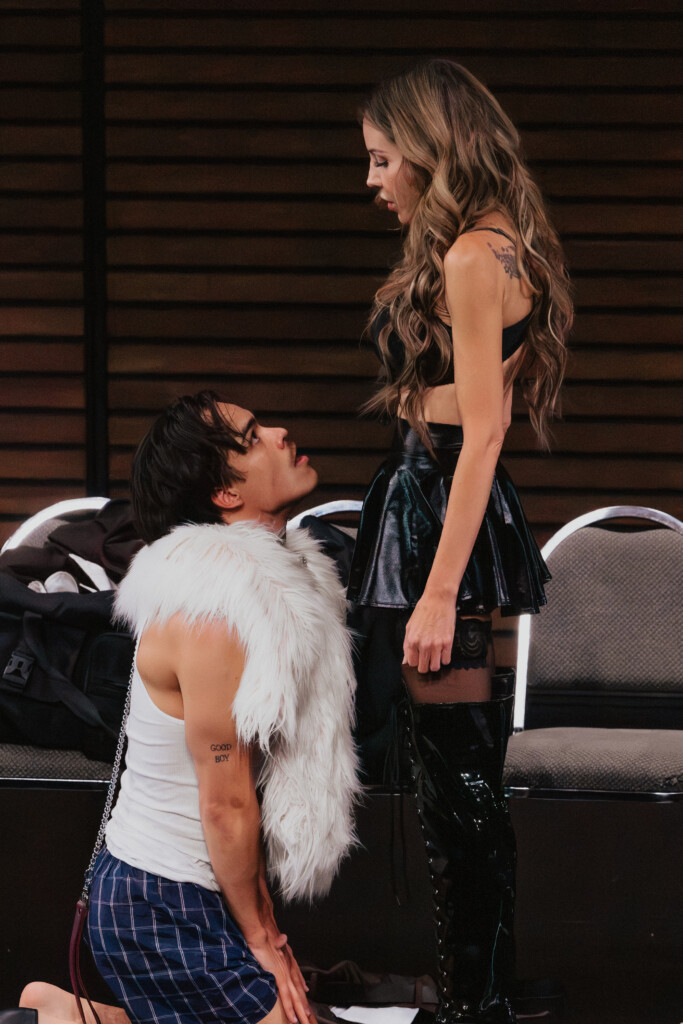
With good reason, this two-hander Ives play has landed at the doorsteps of Voodoo Theatre Company, which has recently produced a string of very good productions featuring provocative intelligent scripts. Directed by Patrick Kibble, the production mostly succeeds, with outstanding performances by actors Jaden D. Richards and Deena Marie Manzanares.

Consisting of a single extended scene, the play demands exceptional stamina, along with the syncing up of the rhythm of eroticism which entails a deep cerebral focus and ultimately heightens the sense of body pleasures being played on stage. Notably, in the first 50 minutes of Venus in Fur, Richards and Manzanares succeed tremendously in working up these rhythms to their proper gripping pace. In a specific performance, however, some of this was lost in the natural ebb-and-flow pacing in the back half of the play which would have put the fine point on the resonating cohesion Ives deftly worked into his script. This critic saw a matinee performance on the day following opening night so perhaps the actors might have been mindful of their stamina reserves ahead of an evening performance that same day.
Nevertheless, the actors consistently communicated how the dialogue Ives scripted for their respective characters electrified them just as the playwright was motivated by the dramaturgical possibilities he found in the novel. “I mean, because the relationship between Severin and Vanda, the two lovers of the plot, seemed to dramatize itself without the intervention of a playwright’s hands,” he explained in a 2011 interview with Broadway.com. “Venus in Fur sparks with the friction of two buttoned-up people in an erotic power play who challenge, resist and disagree with each other even while bound by mutual sexual attraction. That sure sounded dramatic to me.”

It’s an ingeniously written two-hander. Desperate for a creative coup, Thomas, a playwright and director, has hit a dead-end in finding an actor to play Vanda, the female lead in his adaptation of Venus in Fur. Just as desperate and certainly not giving a good first impression that she is the ideal choice for the part, Vanda (coincidentally bearing the same name as the lead in Thomas’ script) is blatantly crude as she strides into Thomas’ office. Despite this, Vanda knows the material inside and out, which lures an ever increasingly curious Thomas deeper into her territory. Reading passages as they begin working through the script, Richards and Manzanares effectively guide us, as boundaries between the play they are reading and the utter realities of the setting evaporate.
It is here where the actors excel in building tension into this unfolding game of submission and domination where only one person can credibly win. Manzanares is a smooth shape-shifter. When reading the lines of Thomas’ script, she is convincing as a prim, buttoned-up virgin of the 19th century. But reading the signs of how her reading has piqued Thomas’ attention, she unapologetically criticizes him on the influences of sexism that permeate his work. When Thomas lashes out, she resists and holds her ground, a good foreshadowing of her emergence as a formidable dominatrix. Just as fascinating to observe, Richards matches Manzanares in this power game of sexual ping-pong between Vanda-Dunayev and Thomas-Kushemski.
Audiences might be surprised to know that Ives’ first crack at adapting the novel originally was set for four actors, with respective pairs playing the story characters in the play and Thomas and Vanda as director and actor, respectively, with each dressed in costumes appropriate to their era. For Ives, the creative brief involved keeping the story of Dunayev and Kushemski intact while making the whole thing resonate for 21st century audiences. As he explained in the aforementioned interview, the revision came quickly: “Since their plight wouldn’t let me go, I felt certain that I was bound (so to speak) to go back to it. And then one day I did, though I don’t know what spurred me to take the route I took, which was to strip away everything but my two lovers and create a frame story set today in an audition room where a playwright seeks an actress to play Vanda in his adaptation of, what else, Venus in Fur.”

Bravo to Voodoo Theatre Company for bringing Venus in Fur to Utah, where public propriety prefers to frame sexuality in angelic, celestial and heavenly terms. However, the play’s most instructive takeaway is there is a natural demoniac trait of sexuality in all of us, even as many try to suppress it, lie about it or cosplay as prim, proper members of society rashly judging others who are honest, confident and comfortable in the comprehensible kinks, fetishes and sexual turnons we discover as our identities mature and flourish.
Vanda knows the full-throttle power of sex. As Thomas’ compulsions are teased out in her presence, he realizes how difficult it is to resist the voluptuous rapture of indulging, at the risk of living the rest of his life in a hopelessly humdrum state of existence.
The run continues this weekend through July 26 at the Studio 5400 theatre in the Mid-Valley Performing Arts Center in Taylorsville. For tickets and more information, see the Voodoo Theatre Company website.