
EDITOR’S NOTE: This is the eighth in an ongoing series of features highlighting authors and new books published by Torrey House Press in Utah.
Four recent short book releases by Torrey House Press comprise a comprehensive soulful journey of summer reading. Whether in the form of poetry, short story, creative nonfiction or essay, each book focuses on common themes of natural history, our human connection to it and the unifying objectives of not only preserving and restoring our natural environments but also ensuring legacies of human wisdom and stewardship can thrive anew. Each book makes for a convenient traveling companion. In fact, all four are so compact that they fit together in any bag and their weight is hardly noticeable.
Each of the four books is reviewed:

BEYOND THE GLITTERING WORLD: An Anthology of Indigenous Feminisms and Futurisms
Beyond the Glittering World features prose, poetry and lyrics from 19 writers as curated by three editors. It is a tantalizing anthology that primes the intellectual demand for bringing more speculative fiction and creative nonfiction in Indigenous American voices with distinctive influences from respective realms of traditional knowledge and language which is being rejuvenated. Some stories in the anthology’s fascinating sampling touch on the genres of Indigenous futurism and science fiction.
What intrigues most in these specific pieces is the range of possibilities in a future that does not have to be dystopian and, in fact, it revitalizes the primacy of a natural history where Indigenous wisdom and taxonomies become prominent once again. The non-Indigenous reader realizes that Indigenous peoples already had experienced their apocalypse with the arrival and abuse by colonialists. The anthology, wholly comprising the voices of indigenous women, is a resilient testimony of restoration and reclamation.

The trio of editors have varied backgrounds. A Utah resident, Stacie Shannon Denetsosie, a Navajo Nation citizen with two clans Todích’íí’nii (Bitterwater Clan) and Naakaii (Mexican Clan), is an award-winning author. Kinsale Drake, who is Diné, is an award-winning poet who also directs programming for NDN Girls Book Club, which distributes free books to Indigenous youth and communities. With a doctorate in oceanography, Darcie Little Badger, Lipan Apache, is an award-winning writer of science fiction, fantasy, horror and comics. The anthology is one of the 2026 American Book Award winners presented by the Before Columbus Foundation.
In the foreword, Natalie Diaz talks about the cohesive theme of the glittering world:
The glittering world is a world we know and also a world we have never met, but have been told about that lies behind us beneath us and in front of us. The Mojave glittering or sparkling world is a time when the world was still wet after a flood or deluge, or after the original waters we came from had receded. It was from this wet and soft land that we were formed from its mud clay and elements across our many different Native stories.
Many current topics are covered in the contributions. Dilasulo Walks by A.J. Eversole touches inventively on the recent emphasis on protecting the cultural integrity and the repatriating of indigenous artworks and objects. In the story, a pair of Cherokee moccasins at the Dallas Museum of Art finally assumes a sentient form and discovers a new Chickasaw installation. There is a lament: “My greatest tragedy was that I had never been worn. The idea that I would never fulfill my creator’s reason for making me was something I worked hard not to think about.” Dilasulo ultimately feels joy for the artist who has liberated her people’s art which had been trapped in obscurity after the apocalypse they suffered.

With song lyrics as a key narrative element, Sandstone Ballad by Danielle Shandiin Emerson is vividly written. To Roadside, a statue’s resemblance to her dead mother is so striking that she is sure the statue “would start singing in the same husky saccharine voice [her] mother loved showing off at downtown bars.”
The survival of native languages anchors Trisha Moquino’s futuristic short story, set in 2114 where many adobe homes withstood the heat of global warming. “Our languages are in demand now because of the Indigenous knowledge they hold,” she writes. “You can’t talk to land, clouds, plants and flowers through English anymore. They won’t listen.”
In Chelsea T. Hicks’ futuristic The Oklahoma Ocean, generations of fracking have made the state’s natural aquifers so salinated that the last governor “rebranded it as an ocean.” The unprecedented changes in climate set the wheel in motion for the tribes to take back control of the land. Set in the 22nd century, Sky Woman Rising: A Memoir by Moniquill Blackgoose sets up a similar starting premise to frame the narrative, as numerous tribes set aside differences to become the Dawnland Confederation, in the aftermath of cataclysmic war and climate change.
The futuristic premise in Stacie Shannon Denetsosie’s No Wrong Roads Home is so credible and prescient to be a realistic possibility. In the midst of World War III, a strange virus emerged and the Diné term for it translates to “body stiffness.” It was a “war hungry” American president who was “quick to declare war on any country that offended him after losing so many troops to pointless wars.” The casualties in the latest war were so catastrophic that the U.S. started drafting boys as young as twelve who were injected with the viral vector. The media called it a “superhero vaccine,” which rapidly accelerated the process for adult muscle growth. “All natives have lived in a dystopia since colonization,” Denetsosie writes. “We’re the rebel band with burning sage and bandannas over our mouths.”

Another outstanding contribution animates the enthralling Beyond the Glittering World by Shaina A. Nez. The setting is a creative writing workshop and involves an enigmatic student who wears black sunglasses all of the time. While other students embrace the literary challenge of Indigenous futurism, Black Shades resists fiercely, offering zero positive feedback. Meanwhile, she files a complaint against the Native teacher concerning the grade she received. The complaint is supported by one of the teacher’s White colleagues.
Referencing Leslie Marmon Silko’s Storyteller, the Native teacher realizes that while one is careful not to violate Indigenous ethics of story work, evils can lurk anywhere. Black Shades disputes the two stories the teacher assigned to the students. Her objective was complete disruption and repudiation.
As the teacher explained about the stories, “They warned me and saved me from a witch in the colonizer. What I knew now was that a witch can be anywhere, take any form and that our spirits must remain protected at all cost for the sake of our communities and teachings.” The story closed on the teacher’s message to her students that encapsulates every other contribution in the anthology: “Representation matters I told the students on the last day of class and we should be honoring ourselves with love, compassion, and empathy anytime we put words down on a page.”

THE DIVINATION OF SALMON
In recent years, the impact of changing climate conditions on the Alaskan salmon industry has been the subject of research at, to name a few examples, the National Oceanic and Atmospheric Administration, U.S. Fish & Wildlife Service, the U.S. Department of Agriculture and the University of Alaska at Fairbanks, along with reports on PBS NewsHour, Bloomberg, CBC and The Nation. The impressive collection of poems in Vivian Faith Prescott’s The Divination of Salmon draws in the reader to feel the emotional and cultural consequences of a crisis which has upended the livelihood of Indigenous communities that rely on subsistence fishing.
Prescott brings us the poetic muse of Salmon Woman, who occupies and transitions back and forth as Indigenous storyteller, scientist and cultural steward. It is a compelling creative turn which encases empirically-based realities in this Indigenous muse who wears the durable armor of Native wisdom that has always understood life in the Alaskan environment. An extensively published author with family roots in Indigenous clans in Scandinavia as well as Glacier Bay, she lives and writes as a climate witness in Lingit Aaní at her family’s fishcamp, Mickey’s Fishcamp, on the land of the Shtax’héenKwáan.
Prescott’s poetic voice is undiluted, with the precision of language evident on each of the 90 printed pages of poetry. Some poems were published separately, including a few that were collected for a Green Linden Press chapbook Fat For Our Stories. The economy of this unique format makes the full weight of Salmon Woman’s narrative readily digestible for the reader. Prescott’s gift is her mastery of concentrating the most consequential details without losing any edifying value while showing the reader the enormous emotional manifestations which Salmon Woman observes.
The title theme comes in the prosaic offering Ichthyomancy: “the divination of fish— we watched the ocean for jumps and ripples and flashes of light.” The signals are explained in their aggregate: “Now we offer memories, learn how to interpret omens of a good fishing season or an unknown voyage/this latest storm/this fat slice of fish sizzling in the pan/this warming sea.”
The poetic procession of Salmon Woman’s shifting into different roles, shapes and spaces helps the reader appreciate the multilayered contexts involved. In She Left Her Deer Skin Shoes on the Shore, for example:
Salmon Woman’s hair is the seagrass, the Willow on the shoreline bent from her ribs. We learned salmon and human and creation and grief and story are all connected.
she becomes salmon
Salmon Woman’s ancient mother weeps for her and the mother’s tears become rivers, become islets where trees grow, and birds sing like sorrow.
When Salmon Woman monitors the impacts of the Alaska climate, the poem catalogs them in stark terms: one million metric tons of seafood, significant adaptation costs, greater snow and ice melt, shrinking snow season, Alaska is warming twice as fast as global average and people in rural Alaska will be disproportionately affected.

The poetic imagery Prescott brings to mind resonates in striking breadth and depth of sociological perspective in comprehensible ways for those of us living in the Lower 48.
In Terrestrial Projections, she writes,
Instead, I imagine the artist
near this rock-faced shoreline,
seaweed perfuming the air,
balanced on canoe,
holding a small bowl
with mineral pigments—
she paints a red ochre canoe,
rayed ovals,
a rising sun,
and the salmon leaping the falls.
In Salmon Teachings, the 14,000-year-old canon of knowledge sustained by “descendants of trappers, prospectors, commercial fishermen and the clans of people who’ve been here” is recounted: “We learned to smell /changes in weather listen to the current of air, /recognize rain, and salmon jumps and rolls,/know the flow of river and swirl of the narrow/ Inside Passage. We know what stirs up silt,/ what blooms algae, what day to fish the fish.”
Sonnet For our Salmon illuminates the heritage of smoking fish for preserving and storing for the winter food supply: “Go beyond spruce and cottonwood, beyond cut and dried, and smoked, and enter our bellies, beneath our skinfolds. Salmon., be fat for us, be fat for our stories.”
Salmon Woman’s fascinating poetic journey serves more thn literary appreciation. It rises upon well-documented research evidence and oral histories about women, especially those who have worked in Alaskan commercial and subsistence fisheries. Of note is the NOAA’s Women in Alaska Fisheries set of 22 oral histories. These factors of family, kinship, shared community resources and intergenerational transfers of Indigenous wisdom and knowledge animate Prescott’s superbly crafted poetic chronicles.

ASTONISHED BY BEAUTY: a field guide to the practice of paying attention
A naturalist and conservation biologist, Thomas Lowe Fleischner excels at crafting sentences that are perfect and concise. Noting that we are now experiencing the “greatest dearth of natural history,” he laments, “Humans have come to see the world as a funhouse built of human mirrors, where we see narcissistic distortions of ourselves.” Chronicling his experience in the slickrock region of southern Utah’s desert, he cherishes, “There is no greater alchemy on earth than a simple addition of water to dry country.” In his introduction, he explains, “Natural history reanimates the world by adding sensory details and living, vibrancy and making real what is at stake when we talk about something like ‘sustainability.’”
A master of word economy, he has produced Astonished by Beauty, a small book packed with magnificent Lincolnesque lyricism that translates the cerebral, erudite roots of his scientific experience into a personable persuasive call to practice natural history. “Natural history is a verb, not a noun— a practice, something we do,” he writes. “And attention, as the Buddhist psychologist John Tarrant has pointed out, is the most basic form of love.”
It is a smoothly flowing, eminently readable book, perfect for taking outdoors as a general field guide to the practice of paying attention. As lofty as the principles might appear in the introduction, Fleischner casts off the cloak of his comprehensive research to talk to us in a friendly, approachable style.
He sets the book’s tone from the first beat. Driving down an Arizona desert highway on a hot summer afternoon after leaving the office, he stops at a dusty trailhead parking lot and ventures down a short canyon. Almost immediately, he encounters literally thousands of butterflies. “This unanticipated burst of life, oblivious to human concerns, transforms this arid landscape from a sere backdrop to a multicolored tapestry of delight,” he recalls. “And it helps me transcend the narrowly focused confines of my busy mind into the rich realm of the unexpectable: the wide, wild world that circles, embraces and enlivens human psyche.”
He lays out the creative brief in a few introductory pages. He explains how natural history is “the oldest human endeavor,” quoting Barry Lopez who wrote that “for 40,000 years at least…it is as old as the history of coherent narrative, old as the history of the interaction of people with landscape.” He reminds us of the necessity of natural history, always articulated in plainspoken terms. In barely a single paragraph, he reminds us that the first U.S. conservation policy focused on regulating hunting seasons because of observed decreases in the game population. He adds, “Without detailed natural history information, a species cannot be nominated for protection under the U.S. Endangered Species Act. Every conservation issue involves an interaction between the realms of science, values and policy.”
The book is in two main sections. A Geography of Astonishment is a brisk, well-detailed miniature catalog of his natural history practices. The second section, Elements of The Practice, constitutes a field guide suitable for everyone. He closes with a short epilogue how simple, always available, this practice of natural history is for everyone, regardless of wherever they live.
Fleischner’s geographic catalog takes the reader to many places: the sea ice near Nuvuk, the northernmost point of Alaska, in the Arctic springtime; a summer-long field exploration of Alaska and the Canadian Northwest; northern Pacific shores and the Oregon Cascades; eastern Sierra Nevada range and Death Valley.
A resident of Prescott, Arizona, he has been ardent in emphasizing the rich biodiversity values of the Mogollon Highlands Ecoregion in the American Southwest. The desert ecosystem was the site of his first quantitative ecological field study many years ago, but, he recalls, “what comes alive most viscerally in my memory is that very first savoring of the desert sensuous night air.” Reiterating the elucidating objective of practicing natural history, Fleischner mentioned a friend who was preparing to move to Arizona from New England and who thought that the desert was nothing more than 5,000 square miles of kitty litter.

The most illuminating portion of Fleischner’s account of “a geography of astonishment” arrives in discussing the region, which he thinks of as “the connecting land.” In just 70 words, he summarizes the connecting points with British Columbia, the high rib of the Sierra Madre, southern Mexico, the Sonoran Desert, red rock Canyonlands, the Great Plains and the coastal Carolinas. He concludes the Mogollon Highlands Ecoregion is a “mosaic of remarkable topographic geologic, and thus biological diversity.”
Combined with his experiences in Mexico’s Tiburón Island, the traditional homeland to the Seri, or Comcaac, people, Fleischner fundamentally redefines wealth in the practice of natural history. In the context of the rapidly flaming multifaceted debate over water rights in the American West as long-term drought continues in an ever hotter, drier climate, the following passage really leaps off the page,
This Indigenous view— that a healthy riparian ecosystem essentially represents heaven on earth— conflicts traumatically with our standard treatment of desert wetlands during the past century. Rather than seeing wetlands as ideal and inviolable, Euro-American settlers of the southwest treated water as a tool, and wetness as irrelevant at best…
Ultimately, in short, heaven, too often, turned into ecological hell.
In the second section, which comprises one-third of this elegantly compact book, Fleischner takes us quickly through some principles. The section Solitude and Sangha is noteworthy. Sangha is “the Buddhist notion for a supportive community of practice,” he writes. However, he emphasizes that both solitary and communal practices are essential because both offer unique emotionally potent epiphanies for the individual to discover. Indeed, this makes sense, if in order to practice natural history, as Fleischner has articulately laid out, we recognize that “we are wired not just for destruction, but for healing, grace and compassion.”
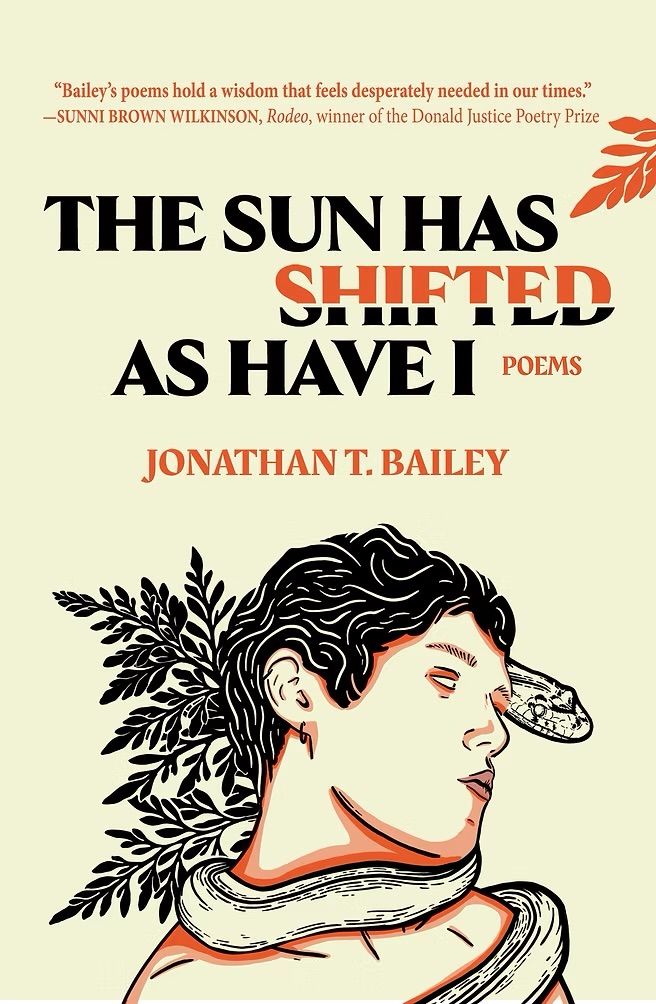
THE SUN HAS SHIFTED AS HAVE I
Exploring desolation and renewal, Jonathan T. Bailey’s outstanding collection of poems The Sun Has Shifted As Have I is a notable example of precisely what Thomas Lowe Fleischner’s Astonished by Beauty offers readers who aspire to practice natural history as a way to make their own narratives coherent and cohesive.
Bailey is a master of brevity in this poetic set of emotional revelations. His precision of language reverberates with the respect one encounters when reading works of poets such as William Carlos Williams, Emily Dickinson, Dorothy Parker and others. An award-winning writer, artist and conservation photographer, Bailey also wrote a literary memoir When I Was Red Clay: A Journey of Identity, Healing, and Wonder (about growing up as a young gay man in a rural LDS community), and co-author of The Greater San Rafael Swell.
Allow these poems to steep in your mind. Reread them aloud even. Bailey’s language is instinctual and every word in each poem carries profound emotional weight and meaning. This is a Utah Enlightenment poetic jewel.
His author’s note at the beginning is a clear example of what we humans can gather from our practice of natural history. As opposed to the human larynx, the major sound-producing organ in birds is the syrinx. Bailey explains, “Unlike the larynx, the syrinx features specialized muscles and membranes that allow some birds to control each side independent of the other. By singing multiple notes simultaneously, these birds have gained the ability to do something remarkable: harmonize with themselves.”

Because Bailey’s poetic brevity instinctively is aware of sounds and silences in nature and the surrounding environment of his existence, the alchemy of their musicality is evident. A resolute reclamation of personal agency and identity, I Am A Queer Person Who Survived Loving has the feel of French art songs which Debussy or Ravel could have written, capturing the shifting poetic imagery of nature as it also occurs in Bailey’s verse: [A]nd proud resident of this soil and sumac thrust above it,/ where cherry trees immigrated to this continent/ to open rush pink on the banks of a river/seven thousand miles from where it would bear leaves—/I have learned time and again to exist as a question.
The simple splendor of Plants, Hyphae and Other Ego Killers would be the envy of other poets who aspire to master Bailey’s word economy: We move on to greater things/the way an ordinary flower/offers its whole world to the potato beetle,/generous or just thankful/to be pretty. With just ten words of exquisite understated emotional potency, Wind Rivers reminds of the concise poetry that Henrik Ibsen occasionally crafted and which Edvard Grieg cast as songs.
One thinks of the radiant reflective rhythms and tones of songs about an individual’s authentic glory in Bailey’s La Milagrosa, including the verse which gives the collection its title: It is morning,/glorious morning./The sun has shifted, as have I,/beneath a cottonwood, /here, watching,/where above,/so above,/honeybees dangle/in a spool of yellow light/and water rushes from granite/as if to reach me/where I tremble.
Ma Rounds Her Cheeks in Front of a Mirror, a Dress Over Her Deseret Industry Jeans, Waltz For Aaron and Two Hundred North bring readers through a portal into Bailey’s intimate narratives.
Bailey’s skillful word economy is evidenced in every poem while leading readers to a lucid string of well-curated illuminating and edifying metaphors. In View from Multus, there is the wide-open sky’s multitudinous nature. In The Gulf of California, there is sun-tanning along the ocean shoreline. The Recently Emerged Hawkmoth at the Gay Bar brings to mind the fast-flying, darting aerobatic nature of the hawk moth. About individual resistance and resilience, Calcareous husk/ kerosene lantern/ nacre and void riffs elegantly on the counterpoint of the external hard cover protection and the capacity of our pearl interiors to absorb even the most incredible impacts of our life experiences.
Its brevity is priceless and timeless: an extraordinary addition to the canon of Intermountain West poetry.