

A celebration of commissioned works, including two world premieres, is set for this week’s blockbuster Ovation production by Repertory Dance Theatre (RDT).
As part of its 60th anniversary season, the five works for Ovation constitute one of RDT’s most technically and stamina demanding programs in recent seasons. Just as dynamic as the company’s mission to preserve 125 years of modern and contemporary works in its repertoire, commissions have been just as essential for RDT’s creative lifeblood in documenting the evolving frontiers of dance languages and movement vocabularies.
Two scheduled works are recent commissions that have become popular in the company repertoire. World premieres will feature Come Rain or Come Shine by Nicholas Cendese, a former RDT dancer who is now executive/artistic co-director for the company and Scherzo Fantastique by Norbert de La Cruz III, an internationally known choreographer who is setting work on RDT dancers for the first time.
The company also is restaging Jacque Lynn Bell’s Ryoanji, which features 43 dancers, including students from the University of Utah’s Tanner Dance Program and seven RDT alumni. The seven former RDT dancers who will join Ryoanji include Mimi Skola Silverstein (1981-1986), Angie Banchero-Kelleher (1985-1992 & 1998-2006), Tina Misaka (1986-1998), Brent Schneider (1989-1994), Chara Huckins (1995-2012), Nathan Shaw (2006-2012) and Efren Corado Garcia (2013-2019).
The first half alone could stand as a blockbuster show for emotion, jubilation and the collective power of dancers uniting as a cosmopolitan community. The opener is Oktet: In Situ (2022) by Katarzyna Skarpetowska, a richly layered work blending rhythm, form, and emotional depth. She set it to a recording of a string quartet adaptation of Bach’s Goldberg Variations, in an arrangement by French composer François Meïmoun.
In an August, 2023, interview with The Utah Review, Skarpetowska said that she has created such works specifically for dance companies that are challenged to sustain and reinforce their core as an artistic community during events that complicate such an objective. For RDT, Oktet: In Situ reflects how the eight principal dancers of the company have processed and rejuvenated the community core, as they periodically confront events that challenge sustaining their unified spirit.

Skarpetowska, who has worked extensively with Lar Lubovitch (a choreographer whose works are part of the RDT catalog), says she was impressed by how the dancers “rallied around each other and pulled together, and I wanted to celebrate their energy and individuality in building their own community.” She also worked with RDT in 2021 as répétiteur, when the company performed several of Lubovitch’s works. As for her selections of music by Bach, Skarpetowska says that he is a “great dance partner” and his works lend themselves to how she likes to structure her choreography.
One of the most emotionally intense commissions in recent years is Solfege (2023) by choreographer Yusha-Marie Sorzano, this being her first commission with the company. In an earlier interview with The Utah Review, Sorzano (note: her first name is pronounced “Ooo-sha”), who took dance lessons in ballet and jazz at a magnet school during her childhood, said that she has found her assertiveness as a creator, by not thinking about one genre or by limiting herself to a specific movement language or vocabulary. “It is about weaving all types of vocabulary together to create emotional arcs that reflect the true heart and soul of an artist,” she added.
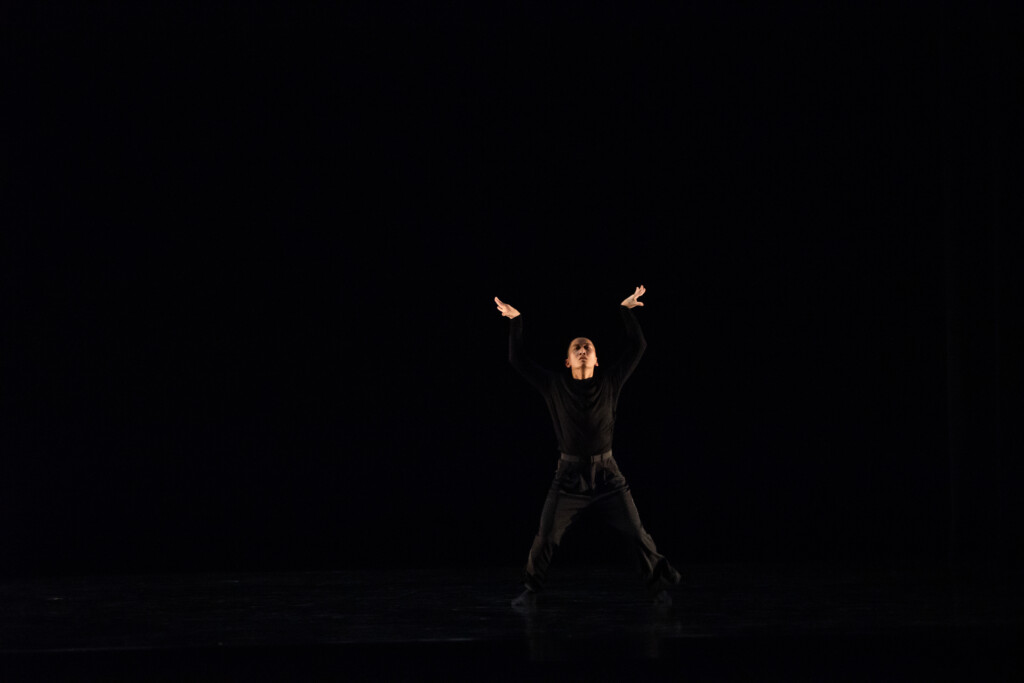
This is what made Solfège ideal for RDT and its revival for the Ovation show. Originally from the Republic of Trinidad and Tobago, Sorzano said that in the case of Solfège, she knew from the point of conceiving the piece what music she wanted to use, which is different from what she has typically experienced in the creative process. The musical source is Symphonic Poem of 3 Notes, a 2011 work that the Teatro Real Opera in Madrid commissioned from Chinese composer Tan Dun to commemorate tenor Placido Domingo’s 70th birthday at the time. Tan, in a program note, explained that when one raps the tenor’s first name, three solfège pitches (LA – SI – DO) build and anchor the work’s integrative theme, which signifies, to quote the composer, “the start of a new life, like a dream it unfolds with the sounds of birds, wind and rain.”
The music includes symphonic rapping, hip-hop phrases, sounds made with stones, industrial brake drums and car wheels, along with chanting and stomping before the solfège notes return to their natural origins for a new cycle to begin. Deeming it a brilliant composition, Sorzano explained that her instincts guided her to envision how dance could replicate the complex world Tan envisioned in this music. Coming into the studio to work for the first time with the RDT dancers, Sorzano decided not to have any specific movement phases and fragments prepared ahead of time because she wanted to involve the dancers as much as possible in building a world that would celebrate the music that accompanies it.
Once everyone figured out how to count the ever shifting meters in the music, Sorzano said it quickly took shape in setting movement to represent what these sounds resembled. For example, she looked to other visual references as a guide, including Guillermo del Toro’s spectacular film Pan’s Labyrinth (2006). Tan’s score lends itself to all sorts of fantastical imagery. There also are temple bells to herald the start of the day, the sounds of strings emulating birds taking off into the morning sky, and the shouts of the three solfège notes which have a purifying effect on a body, which rids itself of stress, aches and pains.
With Solfège, “you cannot go wrong with this music, because it really is perfectly made for dancers and they get it,” Sorzano said in that same Utah Review interview. As for her first time working with RDT dancers, she added, “Each day, I was very happy going to work and having that same feeling coming home. All of them are kind human beings who made me feel deeply safe.” Sorzano added this is significant to her personally, “because I make my best works when I am vulnerable and the RDT dancers were willing to go for and try anything that we talked about in the studio. Their enthusiasm and eagerness were evident from day one.”
During its East Coast tour last year, RDT also performed the work at the Whitney Museum of American Art in New York City, as part of the museum’s Edges of Ailey installation. The Utah Review tapped Solfège as one of the Top Ten Moments of the Utah Enlightenment in 2024.
With its superb cinematic effect that the dancers replicate so skillfully in their interpretation and an ending that is stupendous in its emotional impact, Solfège will be a riveting, enthralling close to the first half.
The second half promises to be euphoric and gleeful. Giving dancers a chance to play off their unique personalities, Cendese set Come Rain or Come Shine to songs recorded on The Garland Touch album, which was the last studio production release by Judy Garland. Cendese said the piece was “born out of everything we knew how this show was going to be like, especially with three gorgeous works that use classical music.” He added, “it made sense to add something with a pop song feel that gives the dancers a respite from the grueling emotional demands encompassed in the other works.”
Scherzo Fantastique by Norbert De La Cruz III exemplifies how a tightly knit network of dancers can forge artistic relationships and pave a path for a commission. “Out of the blue, Linda Smith [RDT cofounder and artistic director emerita] reached out to me after Jake Lewis [one of the company’s current dancers who had participated in an Ailey School program] championed my name,” De La Cruz said in an interview with The Utah Review. With that, Cendese and Lynne Larson, executive/artistic co-directors, set the process in motion for bringing De La Cruz to Salt Lake City.
“My dances, like me, are hybrid creatures: part classical, part improvisational, and personal. I was trained in Western ballet in Los Angeles and New York City,” De La Cruz, who was born in the Philippines and raised in California, explains in his artistic statement. “Yet, these canonical movements map differently on my body, a body that has been underrepresented in the canon. I make modifications, bend rules, and break them, as I search for movement that feels authentic, and I innovate inside the dominant paradigm. This is a gift that immigrant voices give to the field. We revamp the rules and interrogate the forms, in order to bring together multiple histories on our bodies.”
He counts among his mentors distinguished dance teachers such as Risa Steinberg and Aszure Barton. Among the paragons for cultivating and nurturing his creative language, De La Cruz cites historic legends such José Limón and Martha Graham and contemporary titans such as Crystal Pite, as well as major contemporary ballet choreographers such as William Forsythe and Alejandro Cerrudo.

De La Cruz capitalizes on the dancers’ amazing capacity to use their body as an instrument or vessel to make the most of the memory of many physical and movement languages they retain as performers in a repertory dance company. One personally surprising aspect as De La Cruz began working with RDT was discovering how the company has connected so naturally to the ambience of classical music within the realm of the dance languages and vocabularies they encounter in their work.
The idea for his piece was sparked when he thought about the possibilities of turning the mundane actions of standing and sitting in his office chair into a dance that finds light and hope amidst darker moments of grief and loss. Hence, the dancers for this Scherzo Fantastique use chairs as props.
His choice of music came quickly to mind, which also became the title of his commissioned choreography: from Josef Suk, whose career spanned the late 19th century and the first part of the 20th century. Suk studied under the great Antonín Dvořák’s and, in fact. married Dvořák’s daughter, Otilie Suková. Although Suk composed Scherzo Fantastique a year before the deaths of Dvořák and his wife occurred within a 14-month span, the piece received its Prague premiere in 1905 and took on a bittersweet context. The musical colors are exuberant and whimsical and the score bristles with a distinct Czech energy that would have made Dvořák eminently proud of his favorite student.
De La Cruz said the RDT dancers are impressive in their artistic maturity. “They are faithful to not taking their work so seriously that they have to sidestep finding their own joys for dance,” he explained, adding that this piece reinforces that sense of play for the dancers. “I had such a great time with them in the studio,” he said, “observing their self awareness, their genuine love for the company and their abilities as team players and problem solvers.”
De La Cruz’s choreographic career began under the mentorship of Tom Mossbrucker and Jean-Philippe Malaty at Aspen Santa Fe Ballet, where he received the Jerome Robbins Foundation’s NEW Essential Works Grant for his ballet Square None (2012). He has since been commissioned by companies including Ballet X, Richmond Ballet, Dallas Black Dance Theatre, Grand Rapids Ballet, Nashville Ballet, and Hubbard Street 2. A recipient of the Princess Grace Foundation-USA Choreography Fellowship (2012), he has also been recognized by the Alvin Ailey New Directions Choreography Lab, Joffrey Academy of Dance’s Winning Works, and the National Choreographic Initiative. His work has been presented at prestigious venues such as the Winspear Opera House for TITAS Command Gala and through collaborations with the New York Choreographic Institute and Dance Lab New York.
Performances for Ovation take place daily, Nov. 20-22, at 7:30 p.m. in the Jeanné Wagner Theatre in the Rose Wagner Center for Performing Arts. For tickets and more information, see the Repertory Dance Theatre website.