
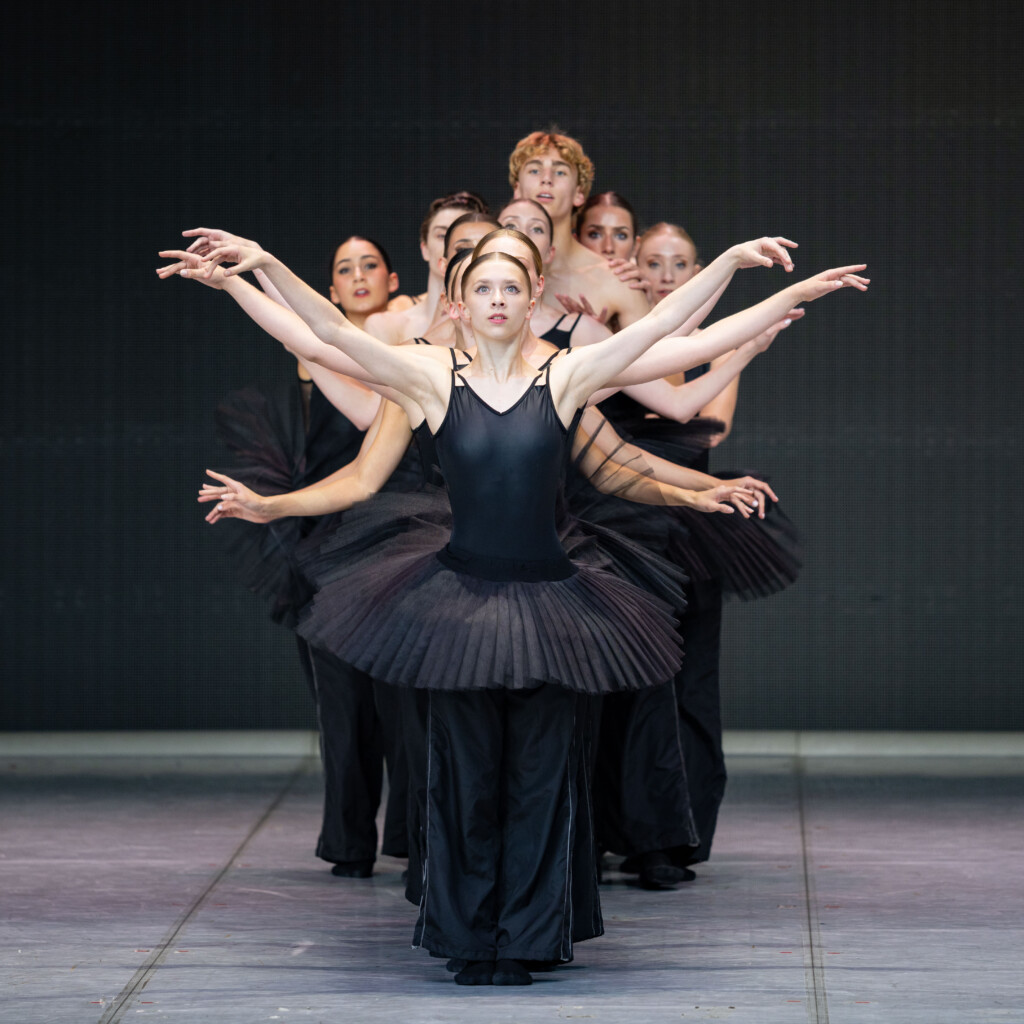
With four world premieres and two company premieres to boot, the resplendent heritage of Ballet West radiated with exciting results in the culminating performance of the inaugural Ballet West Summit Festival: Where Art Meets Elevation on July 17 at the Canyons Village Amphitheatre in Park City.
The results confirm that this festival should become a Ballet West summer tradition. In the five days of the choreographic workshop presented by Ballet West Academy in partnership with artÉmotion, the young dancers learned their respective assigned world premieres which were created by four internationally renowned choreographers. Their performances clearly telegraphed their potential for professional careers.

Photo by Lauren Wattenburg
Complex, intricate, graceful and athletic in sum, the dances required stamina and intense focus, as each choreographer clearly played not only to the artistic strengths of the group assigned to them but also their individual personalities. The audience had a great look at the conceivable future look of the Ballet West corps, which certainly will reinforce and expand the legacy of a performing arts institution that is sustaining the height of its artistic impact.
As Allison DeBona, cofounder of artÉmotion and one of the principal organizers of the Summit festival, noted in the preview published at The Utah Review, she deferred to the instincts of the guest choreographers to allow their natural diversity to shine through the repertoire they set upon the young dancers. This was evident at every turn.

Photo by Lauren Wattenburg
The young dancers responded beautifully to the astute fusion of classical elements with Brazilian rhythmic pulses in The Unknown Wave by Ingrid Silva, a Rio de Janeiro native who also is an internationally recognized Theater of Harlem principal dancer and choreographer. The dancers effectively intuited the thematic undercurrents in Silva’s work which explores the relationships we have with the natural world, namely, bodies of water. The commission included an original score, Becoming, by Leandro Albuquerque, a composer with whom Silva has collaborated on other works as well.
The second world premiere, As We Are, by Garrett Smith, was a riveting, exceptionally smart display of youth excellence on the ballet stage. Smith, a Riverton, Utah native who started as a choreographer with the Houston Ballet, has since created and staged his choreography with some of the most elite dance institutions in the world.

Photo by Lauren Wattenburg
This was a brilliantly conceived piece manifesting fascinating parallels from the musical source material, which included excerpts from some of Mendelssohn’s symphonic repertoire, most notably the Choral (Lobgesang) and Reformation symphonies. The young dancers connected with and saw themselves in the historical contexts of that composer, who was the epitome of a young musical genius, but who also experienced the challenges of becoming socially integrated into a community. The challenges of dual identities always come up against expectations of conversion, assimilation and the desire to harmonize one’s own sense of cultural and personal hybrid character.
The third world premiere Les Quatre Amours, by Rex Tilton, with music by Camille Saint-Saëns, was graceful, elegant and stately—definitively the most classical of the world premieres in character. For the young dancers, it gave them a compelling and demanding sense of what performing a work such as Michael Smuin’s Quattro a Verdi might be like (which was earlier performed by some of Ballet West’s principal artists). The music is pleasing enough but the young dancers elevated the expressive punch in these baroque-like dance forms which Tilton effectively elevated.

Photo by Lauren Wattenburg
The final world premiere was a stunning and ingenious outlet for expanding the young dancers’ appreciation of the possibilities of diversity and representation in the ballet world. Phil Chan’s An American in Bali percolated for its cross-cultural union by developing an authentically sensitive respect for the musical and movement languages of the East. Chan, author, cofounder of the organization Final Bow for Yellowface, president of the Gold Standard Arts Foundation and resident choreographer at Oakland Ballet, chose a perfect musical source: Colin McPhee. Fascinated by the gamelan, McPhee, born in 1900, studied with Edgard Varèse and was the first Western composer to pursue an ethnomusicological study of Bali. McPhee’s music stands out for its naturally indigenous and minimalistic interpretation of the folk music of the East. Indeed, McPhee’s music would have been an extraordinary experience to what would have been familiar to the Western ear in the middle of the 20th century. Likewise, Chan gave the young dancers a simultaneously vibrant, ebullient and subtle ballet experience in how one can avoid an impressionistic idealization of an exotic idiom by distinguishing themselves with keeping the essence and integrity of an Eastern cultural language in the world of ballet.

Photo by Lauren Wattenburg
Interspersed with the world premieres from the workshop dancers were three pieces, performed variously by four Ballet West principal artists. Smuin’s Quattro a Verdi, a 1979 work that received its Ballet West premiere at this Summit performance, featured the four principal artists: Katlyn Addison, Jenna Rae Herrera, Adrian Fry and David Huffmire. Rigorously echoing the movement language of greats such as Marius Petipa, this work asks the dancers to marshall maximum levels of stamina and technical acuity. Simply, the quartet aced the artistic test with honors.
Two duets followed later in the program. Katlyn Addison and Adrian Fry performed Christopher Wheeldon’s After the Rain (Pas de Deux)(2005),a stupendous short master class of intimate, fragile, delicate character on the ballet stage. Set to Arvo Pärt’s Spiegel im Spiegel, one of the Estonian composer’s best-known works, the duet had received its Utah premiere by Ballet West in April at the Capitol Theatre. Jenna Rae Herrera and David Huffmire gave Gerard Arpino’s L’Air d’Esprit its exuberant Ballet West premiere.

Like every piece programmed for this production, this turned out to be a serendipitously poetic companion which delighted the outdoor audience. This 1978 work featured some of the less-familiar music from Giselle, which was composed by Adolphe Adam. Very much a traditional pas de deux in its conception, the work was intended to pay tribute to Olga Spessivtzeva, one of Nijinski’s ballet partners before the onset of the Bolshevik Revolution.
The Summit performance capped an incredibly innovative cultural festival for Ballet West, which included a free, public screening of two ballet documentaries, sponsored by Park City Film, and a dinner, From Root to Relevé, at Ballerina Farm in the Kamas valley, which was founded by former dancer Hannah Neeleman. With proof of concept accomplished, one is hopeful that an even larger festival is in store for the summer of 2027.

1 thought on “Ballet West at the Summit radiated with exciting results in new Park City festival”