
The Utah Review offers reviews of several recent excellent downtown Salt Lake City performing arts events.
ChitraKaavya Dance: In a forest, a deer…
In a talkback following ChitraKaavya Dance’s production featuring In a forest, a deer…, an Indian-American audience member who was visiting downtown Salt Lake City on the most recent Labor Day weekend commented how grateful and surprised she was to walk by the Rose Wagner Center for Performing Arts and discover this performance. Indeed, the local dance company, which specializes in Bharatanatyam, a South Indian classical form, offered an impressive and richly informative choreographic interpretation of a beloved Indian epic narrative that is quadruple the length of the Iliad, for example.
The performance’s most striking feature was the level of dance theatrical skills on display from the dancers, all of whom were in their teens, including one who was just 14. Prepared by Srilatha Singh, a mathematics professor who specializes in three-manifold topology and who was trained in her dance specialization by eminent gurus in her homeland, the dancers definitely understood the cultural import and creative brief arising from the group’s interpretation of the Valmiki Ramayana. The Ramayana relates the story of Rama, a prince in the city of Ayodhya in the Kingdom of Kosala, whose wife, Sita, is abducted by Ravana, the demon-king (Rakshasa) of Lanka.
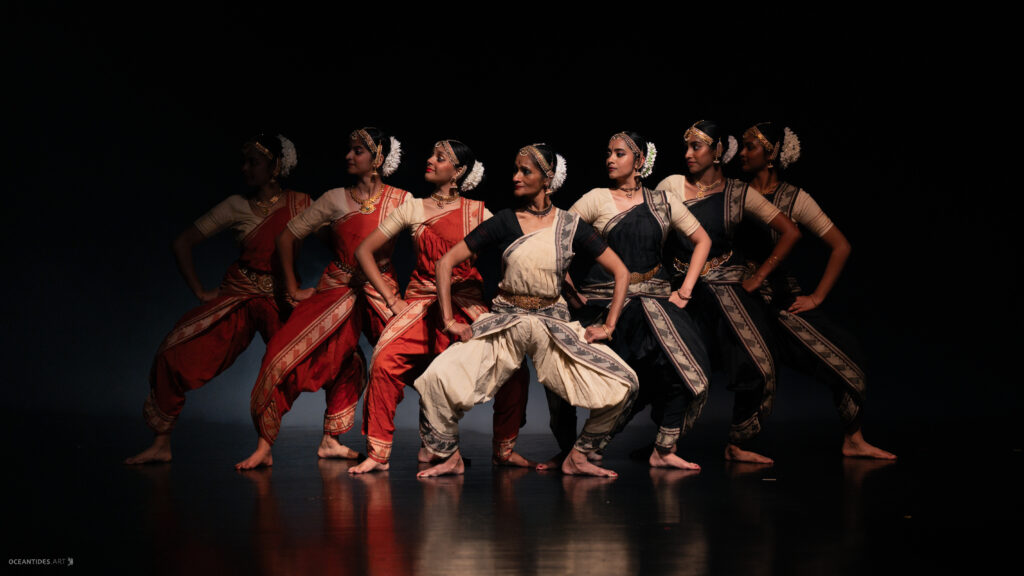
The production was wholly absorbing, as these dancers, all of whom were born in the 21st century, truly grasped the interpretive fluidity of this major piece of Indian mythology. As evidenced in projected slides and the talkback discussion after the performance, the work was conceived and based on comprehensive research where Singh synthesized elements of sources ranging from as early as eighth century B.C. to contemporary critical cultural analyses. Music was composed by Sindhu Natarajan and lighting by Ashton Pease, by Blackheart Lighting Design.
Singh emphasized that the work did not seek to offend, disparage or diminish the spectrum of spiritual faith to which people have attached to this preeminent epic of Indian mythology. The interpretation for this performance also was formulated to encourage thoughtful conversations not only about India’s social, cultural and political landscapes, but also about our contemporary circumstances. In the legend, Sita is the daughter of the Earth (Bhoomi) and while she is the female archetype, but as patriarchal perspectives evolved from the epic’s earliest manifestations, it was clear how the dynamics of control, boundary limitations were imposed, as they occur in androcentric versions of the story. Thus, Singh and the dancers retell the Ramayan story in which Sita is moved significantly from traditional mainstream canonical interpretations of the mythology.
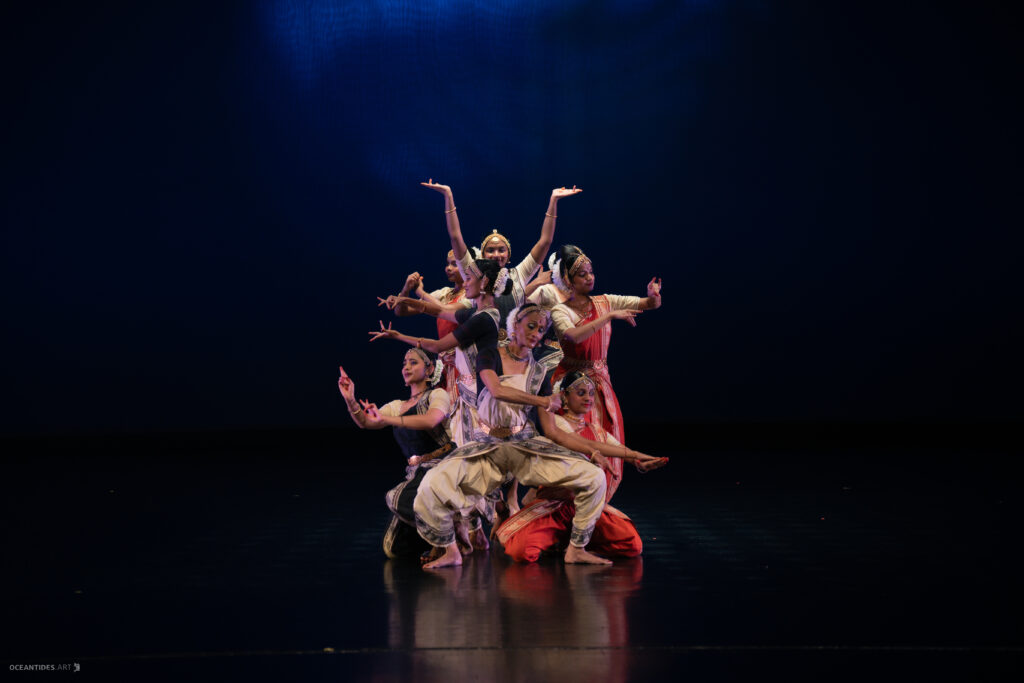
In other words, just as the myth has been constructed to highlight idealized portrayals of the Hindu male, Sita has been conventionally rendered as a figure to serve the conventional system. The dance work demonstrated effectively that just as male writers and artists had employed the myth and the story of Sita to render woman’s voice impotent, women, just as compellingly, have articulated and magnified their voice. And, in that reinterpretation, Singh and the dancers remind us that women, emboldened and empowered by the retelling of Sita’s story, are inspired not to stand by idly while society as it has been led and influenced by patriarchal forces risks irreversible destruction.
Intemezzo Chamber Music Series: September concerts in the Grand America Hotel Courtyard
Coming off a fantastic summer season of performances, the Intermezzo Chamber Music Series has been offering outdoor evening concerts in the Grand America Hotel courtyard throughout September.
The first two Sunday evening concerts, marked by perfect weather and temperatures, have been outstanding, as both offered different thematic takes on a common sentiment. The Sept. 7 opener, The Last Goodbye, featured a first-class, beautifully balanced reading of Schubert’s Trio No. 2 in E-flat Major, D. 929, with a powerhouse instrumental lineup, comprising violinist William Hagen, cellist Lauren Posey and pianist Vedrana Subotic, who also is the series’ artistic director. Composed in late 1827, less than a year before Schubert died at the age of 31, the work is famous for numerous reasons. For example, the second movement has been used in various pop culture and film settings (Stanley Kubrick’s Barry Lyndon, from the 1970s).
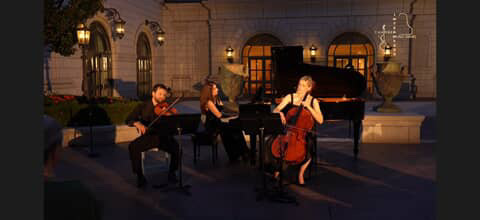
Playing this Schubert trio outdoors is a feat, given the complexities hidden throughout all four movements, but the musicians made light work of this. Indeed, this particular trio is perfect for an outdoor evening concert. Thanks to Hagen, Posey and Subotic, listening to this trio felt like being carried along by the slight breeze on this September evening, feeling immensely gratified by enjoying the package of compositional gifts this incredible composer put into this work.
Hagen and Subotic opened the concert with two splendid arrangements for violin and piano, including a ravishing reading of Leopold Auer’s arrangement of Lensky’s Aria from Tchaikovsky’s Eugene Onegin. The other was just as intoxicating: Mischa Elman’s reconstitution of one of Schubert’s most recognizable lieders, Serenade, D. 889.
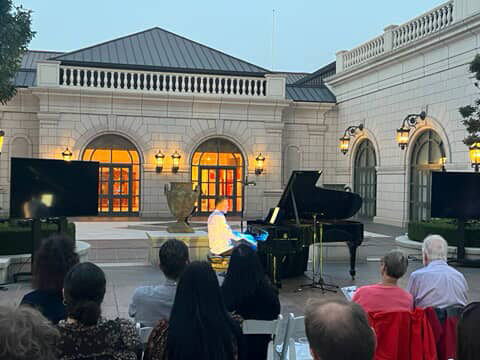
Meanwhile, Exit Music was the theme for the Sept. 14 concert, featuring pianist Sergei Kvitko, an award-winning, internationally acclaimed pianist, composer, recording engineer and producer. The creative brief compels the question: “If you knew that world would end in one hour, what would be your playlist?” And, it was tantalizing to listen to Kvitko’s selections and hear him briefly justify why he selected particular pairs of music.
It was surprising to see that not one of the 14 selections was music originally composed for piano so the program was just as much as a celebration of what makes a good transcription of music that not only covers classical but also other genres. Kvitko’s arrangements of music by Messiaen, Schumann and Mahler were gorgeous. There also was David Biedenbender’s rhapsodic Falling Light, based on Björk‘s overture from her 2000 film Dancer in the Dark, made in Iceland as a musical psychological crime drama. He also performed Christopher O’Riley’s arrangement of Radiohead’s Exit Music (for a film). Just as splendid, the closing arrangement was a premiere, by Utah composer Igor Iachimciuc who produced a fantasia based on the gospel warhorse Take My Hand, Precious Lord.
The series continues Sept. 21 (7 p.m.) with a performance of one of Schubert’s seminal song cycles, Die Schöne Müllerin (The Beautiful Miller Maid). Tenor Brian Stucki will perform, accompanied by Subotic on piano. Based on Wilhelm Müller’s collection of 25 poems narrating the story of a young man’s tragic love for the beautiful maid he encounters at a mill, this Schubert song cycle is the signature Romanticist expression of an entire life of emotions, love and loss.
The September concert series will conclude Saturday, Sept. 27, at 7 p.m., featuring the Waterford Chamber Orchestra and soloists, conducted by Kathy Morris.
Tickets can be purchased here or at the door prior to each concert.