

Capping a blockbuster 60th anniversary season, Repertory Dance Theatre’s Anthology takes on the challenge of curating a handful of works from a catalog approaching 450 in number to emphasize the historical significance of modern dance that is more than 125 years old.
With 40% percent of works of historical significance that have been restaged on the company, Linda C. Smith, cofounder and director emerita, stated it succinctly: “RDT has been an oasis of dance, and it provides a point of connection. We look at our dance history with love and reverence, while we look to the future with a sense of artistic purpose and determination inspired by historic treasures.”
The quartet of works for Anthology span nearly a century, including the company premiere of a Martha Graham work from 1947 which was adapted into a suite in 2016. The works include José Limón’s Concerto Grosso (1945), the first major acquisition by RDT in 1967, as well as Soaring (1920) a work that Doris Humphrey created with Ruth St. Denis during her tenure with the Denishawn Company. The production will run April 23-25, daily at 7:30 p.m., in the Jeanné Wagner Theatre at the Rose Wagner Center for Performing Arts.

According to Smith, Soaring became one of the best loved Denishawn dances. “It was one of the earliest ‘music visualization’ pieces [set to Schumann’s ‘Aufschung’ Fantasiestücke, Op. 12] and utilized a large scarf in an original way that emphasized the dancer’s bodies and the constantly changing forms accentuated and visualized the composer’s music. A program note in the 1920’s described the work as a …’lyric idea of wind, wave, and cloud in fleeing forms of a great veil.’”
The suite for Dark Meadow was created 70 years after Graham premiered the work, with music by Carlos Chavez. “Both the unison dancing and the partnering have been recognized as some of Graham’s most architectural, ritualistic and profound creations,” Smith explained. “They are clearly inspired by Graham’s love of the rituals of the natives of the American Southwest and Mexico, which she observed as a young woman.” In her original program note, Graham wrote, “Dark Meadow is a re-enactment of the mysteries which attend the eternal adventure of seeking.” As Smith explains in an artistic statement, “I will always cherish taking a class from Martha Graham and remember her whispering, ‘Travel across the floor as you were listening to the secret that the beating of your heart is telling you.’”

Photo: Matthew Atanian.
There is no more appropriate piece to end this 60th anniversary season finale than with Dance for Walt Whitman by Helen Tamiris, a 1961 work based on Whitman’s Leaves of Grass, with music from Rounds for String Orchestra by David Diamond. Fifteen dancers from the University of Utah School of Dance and a member of Tanner Dance Children’s Dance Theatre will join the eight RDT dancers for this performance.
Whitman’s poetry was a central muse for Tamiris’ choreography over several decades, which emphasizes the iconic American character of her cultural language. With a grant from the Rockefeller Foundation in honor of Virginia Tanner, Tamiris came to Utah to stage the premiere in 1961, five years before RDT was established with a Rockefeller Foundation grant.

Smith and Joan Woodbury, a cofounder of Ririe-Woodbury Dance Company, performed in the 1961 premiere of Tamiris’s piece. In 1992, Smith set out to reconstruct the work for a new performance, but was temporarily stuck when she heard that a rehearsal film from the original production was damaged and no longer available. However, Woodbury told Smith that she had given her copy of the film to the University of Utah’s media department. But there was no record that the film had been saved in a digital format. The staff offered several boxes of unmarked films for Smith to go through and she rented a projector to screen the videos at home and eventually found it. “There are people who do not seem to appreciate how important it is to preserve the artistic treasures of the past,” she said. “I like to quote the videographer, Ken Burns, who said, ‘You can’t know where you are going until you know where you have been.’” While the work has been restaged previously, Anthology audiences will see the reconstruction of the 1961 original. Daniel Nagrin, who assisted Helen Tamiris during the original choreography, provided additional coaching and historic perspective. The Tamiris Foundation funded the creation of the labanotation score.
“Tamiris changed my life,” Smith said. Tamiris also was known for choreographing Broadway musicals, including Annie Get Your Gun, Showboat, and Touch and Go for which she received a Tony. In 1947 she was commissioned to choreograph Promised Valley, a musical written to celebrate the Utah centennial. She also taught at the legendary Perry-Mansfield Arts Camp in Colorado. Among her students were Academy Award winning actor Dustin Hoffman, shortly before setting the groundwork in 1958 for Dance for Walt Whitman.
For tickets and more information, see the Repertory Dance Theatre website.

FINAL BOWS AS RDT DANCE ARTISTS: URSULA PERRY, CALEB DALY
The emotional punch of Anthology’s historical celebration will even be stronger, as two RDT dancers — Ursula Perry and Caleb Daly — will take their final bows as company artists.
With 13 seasons, Ursula Perry, who was born in Houston and is a University of Utah dance alumna, has the third longest tenure of a dancer at RDT. After finishing her degree in 2002, she was more interested in opportunities to perform new dance pieces elsewhere than Utah, in the mid-2000s. Locally, she had migrated from ballet to contemporary dance and, in fact, danced with RawMoves, a dance program Nicholas Cendese created with choreographer and teacher Natosha Washington. However, a little more than a decade later, she returned to Salt Lake City and auditioned for RDT in 2013. The timing was ideal, as Smith and Cendese, who is now co-executive/artistic director of the company, decided that RDT could effectively manage the energies for commissioning new work while continuing to expand the historical dance repertoire, which was part of its founding mission.
Back at RDT, Perry discovered this was the balance she was looking for as a performer and as part of nurturing her own choreographic interests. Works by historical greats such as Donald McKayle and Jose Limón are among the most memorable.
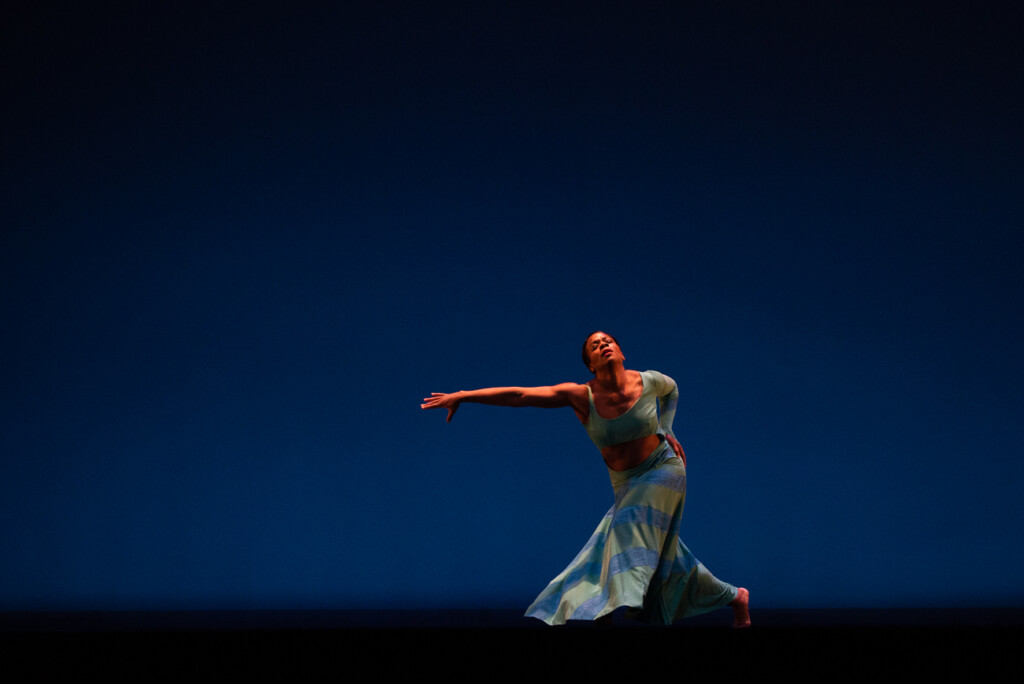
As The Utah Review noted previously, Perry’s solo in McKayle’s 2005 work I’ve Known Rivers was brilliant in every beat of movement and verse. The work augments but, more importantly, magnifies the soulful core of Langston Hughes’ The Negro Speaks of Rivers, the poet’s first work, which he wrote in his late teens, to be published. Hughes connects four rivers — Euphrates, Congo, Nile and Mississippi — in tracing the journey of Africans and African Americans through civilizational history. The poem is quite short but Perry fully elucidated the rising and ebbing emotional textures of the choreography, as it precisely traces the sung rhythm of Hughes’ poetic text.
Another McKayle work is Rainbow ‘Round My Shoulder from more than 60 years ago is as timely as ever. Choreographed for seven men and one woman, the dance is a fully realized narrative of a Southern chain gang, from the male point of view. Choreographed for seven men and one woman. Again, as The Utah Review noted, Perry takes on various dimensions that do not convey a specific female character as much as they represent aspirations of freedom, nurturing, love and compassion. In an interview, Perry said McKayle’s works are so visceral to do, not just for their ancestral roots, but also for how their story-telling takes over.”As a Black woman, these solos became very personal to me.”
As for Limón, Perry is looking forward to performing his Concerto Grosso in her last regular season show. “Learning his technique changed who I am as a mover,” she explained. Among the pieces was Mazurkas, set with Chopin’s music and dedicated to people in various Polish cities and towns.
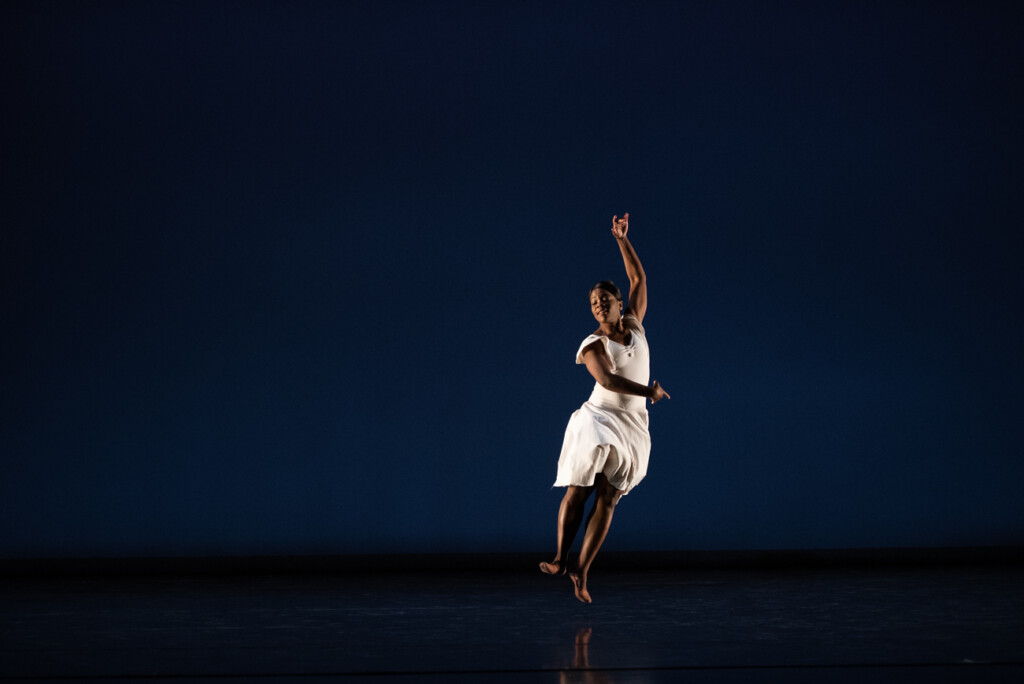
Another source of artistic impact for Perry as a dancer has been the works of internationally acclaimed choreographer Zvi Gotheiner. This includes Dabke as well as his most recent Migrations (2022), which is the 10th Gotheiner work in the RDT catalogue.
Dabke (2012) is a dance composition inspired by the national dance of Syria and Lebanon that also is an integral aspect of Jordanian and Palestinian cultures as well as Israel and other Middle East countries. About Dabke, Perry said, “It was the first work that gave me permission to feel truly on stage as a performer and not just as a performer.” One of the most striking examples was when Doron Perk, who accompanied Gotheiner last fall to restage Migrations on RDT, was constantly revising Perry’s solo in one section of the work, up until the final dress rehearsal before the premiere. “He kept telling me, ‘it still isn’t you,’” she said, “and I thought this man knows me. He would think about it every night and when he finagled it until we both found it right, we realized, ‘doesn’t that make sense.’”
Over the years, choreographers who have worked with dancers in Salt Lake City, especially in RDT and Ririe-Woodbury Dance Company, consider creating new work as a collaborative process with the dancers and they publicly acknowledge that relationship as such. And, just as dancers have allowed their own personalities and vulnerabilities to come into the space, the same has been observed with choreographers. “This allows us to go to places that are unapologetically visceral and raw,” Perry explained, “and to strip every pretense away so we can feel a thing that is so strong and good that it is like tasting something in your mouth that is so right.”

Likewise, as RDT has developed its niche in works embedded in the language of Gaga movement, the dancers can go beyond what they perceive as their physical capacities, by realizing a vast realm where they have the stamina, the heart, the skills and technique to perform at ever more demanding levels, but also without sacrificing their individual identities and personalities. Perry said she appreciated how Noa Zuk — for example, in By The Snake — could unleash carnal elements which permit genuinely human moments in the movement.
Working with Danielle Agami, whose dance composition Theatre has become one of the elite standouts in recent additions to the RDT catalog, Perry recalled how different Agami was in the studio when she returned after the first time in staging the work. Perry explained that Agami’s first time was challenging: “She was very combative and demanding, but I also understood that it was coming because of the expectations she placed on herself.” This was at a time that Agami was setting up her own company [she was traveling back and forth between Israel and Los Angeles where she founded the ate9 dance company].
According to Perry, with so many new things happening at once, she felt the need to prove herself. But, when she returned the second time to restage Theatre (in 2019), it was a “night and day difference,” Perry said. In Theatre, dancers become more naturally aware of their own surroundings and performance spaces along with acknowledging how the emotions and reactions of people in those surroundings become handy sources of inspiration. “The second time, it was anything but robotic,” Perry added.
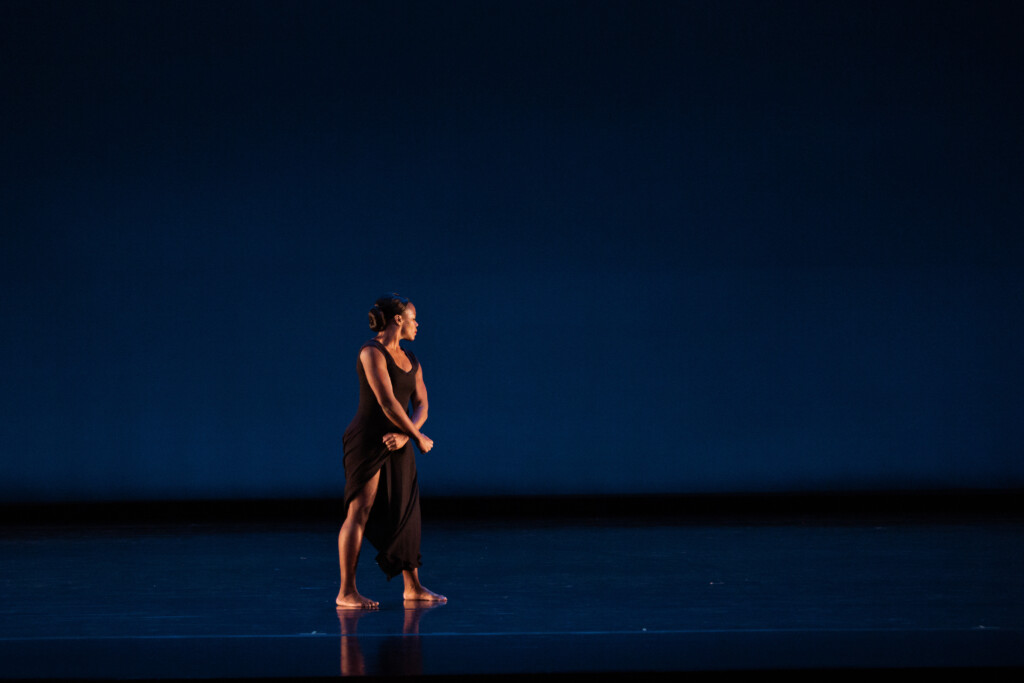
Other unforgettable moments for Perry include Triptych by Cherylyn Lavagnino, with each section inspired by the choreographer’s observations in Mexico, which covered secular as well as religious expressions of community, faith and generosity. Triptych’s striking aspect is how the dancers (particularly in solo and duet forms) flawlessly transformed themselves into figures, which one would find in the narrative panels of a triptych artwork. Likewise, Perry said she will never forget Ihsan Rustem’s Hallelujah Junction and Norbert De La Cruz’s Scherzo Fantastique.
Although Perry is stepping down from RDT, she will be balancing her time as a freelance choreographer and dancer, gardening and continuing to work with Libation SLC, a wine and spirits brokerage specializing in program development, industry training and consumer education. This summer, she will be one of the choreographers for Dance West, the advanced dance festival coordinated by RDT, Ririe-Woodbury Dance Company and the University of Utah School of Dance. She also will be working with choreographer Molly Heller on a new dance work which will be featured later this year in RDT’s Link Series. “I’d also like to explore new programs combining wine and the arts,” she said. “Periodically I have set dance works for high schools and with so many experiences of being a part of dance pieces at RDT, I am beginning to explore how my choreographic voice continues to mature.”
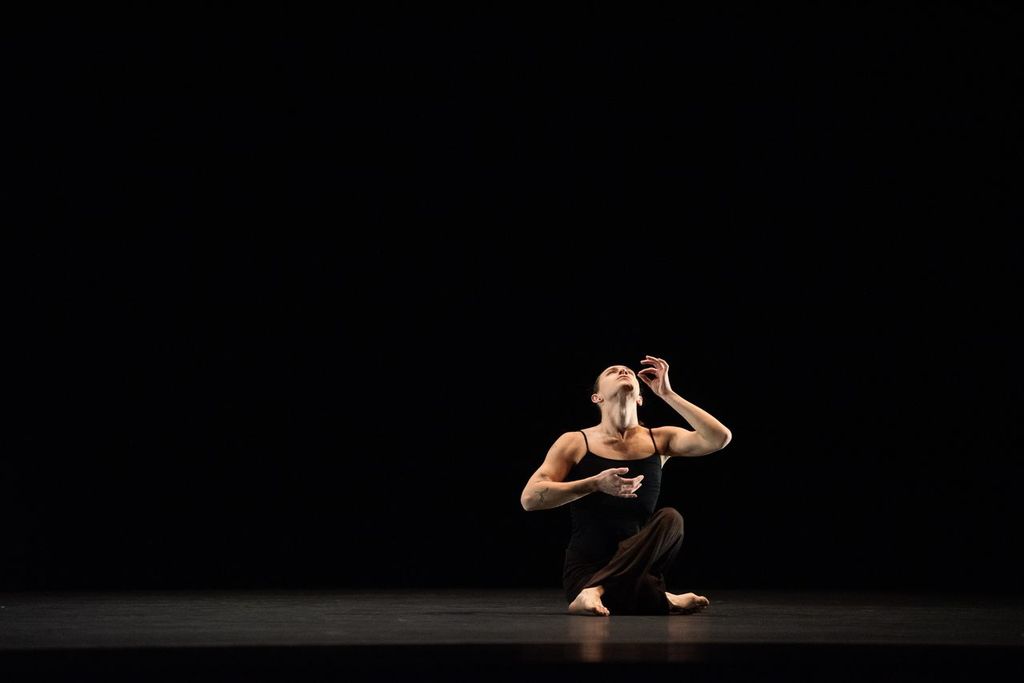
Shortly after Caleb Daly received their bachelor of fine arts degree in dance at the University of Wyoming in 2022, they joined RDT and quickly discovered the expansive range of opportunities as a company dance artist. This was not just learning the demanding repertoire of countless movement languages and styles in the studio, but also the thrill of teaching and demonstrating while on tour in Utah or elsewhere in the country. Many audience members might assume that dancers in a company like RDT primarily just create and perform dance works, but RDT dancers emphasize how some of their greatest impacts happen away from the main performing stage. Coming directly from college, Daly could have been worrying about imposter’s syndrome, but as they explain, “I was selected for a reason and by how welcoming RDT brought me into it, I was able to build my confidence.”
While seniority might matter among dancers in some companies, Daly discovered just as quickly how even newcomers have opportunities to shine in both historical works as well as new commissions. This became immediately evident for Daly as well as Jacob Lewis who also joined the company in 2022. In 2023, Daly shined in Shane Urton’s Sweetspot, a brilliant organic study of sweet spots in dance movement that grew in metaphorical complexity. Urton’s piece was as compelling for its intelligent demonstration about how the physical logic of dance movement is leveraged to be lucid and specific in articulating emotions and themes, as it was designed for its approachable entertaining quality. Last season, in Limón’s The Winged, Daly also stood out as the indomitable, incredible Pegasus.

For the 60th anniversary season opener last fall, Daly’s solo in Gotheiner’s Migrations, epitomized how the work blossomed beyond the realm of abstract symbolism, often taking on theatrical sensations that were as gripping in their individual portrayals as well as the technical movement harmonization in the ensemble. An example of how genuinely RDT takes to heart the objective of letting the dancers’ individual personalities shine through on stage, Come Rain or Come Shine, by Cendese, was set to five songs from Judy Garland’s final studio album. The dancers reveled in the spontaneous pop magic, including Daly who strutted and slayed to the opening verse in Lucky Day (“sitting on top of this great big wonderful world”). For the world premiere of Norbert De La Cruz’s Scherzo Fantastique last November, Daly collaborated with Anastasia Zlobina on costume designs that perfectly complemented the work.
Along with Katarzyna Skarpetowska, Noa Zuk and Yusha-Marie Sorzano, Daly also cherishes the time spent with Gotheiner, who has truly endeared himself to the company’s dancers. “He brought so many things to realize as an artist with Bears Ears, Chairs and Migrations,” Daly added.
As a choreographer, Daly’s works stood out for their inventive resourcefulness and strong production values, including costume design which they will be pursuing in the forthcoming future. For Emerge in 2025, the annual showcase for company dancers to demonstrate their choreographic forte, Daly set skintight for a trio, visually stunning in the fabrics Daly repurposed from other works to create oversized flowing costumes with gigantic trains. This piece, set to music by Photay, clearly resonated in the idea of what really lies underneath our exterior appearances and how and when we decide what to reveal about ourselves. In last January’s Emerge, working with 11 dancers from Weber State University, Daly and Caitlyn Richter set an intriguing piece, No Sense, to music by The Art of Noise, a British group that pioneered the use of sampling in commercial electronic music.

Gratified by the RDT experience which has allowed them to find themselves in the world of dance and beyond, Daly is excited to explore the artistic dimensions of costume design in the performing arts. There has been plenty of inspiration. For instance, Daly looks forward to the puffy tops and flowing dresses that Brenda Van der Wiel has designed for the company’s upcoming performance of Limón’s Concerto Grosso. For last January’s Traverse production by Ririe-Woodbury Dance Company, Daly’s fabric designs accentuated Fausto Rivera’s Sage Green. With such an intimate command developed about the thematic, social and philosophical undercurrents of dance works, Daly is ideally positioned to emphasize that costume designs are not an afterthought to be decided casually, but instead are integral toward amplifying the holistic expressive powers of a dance composition, either in abstract or imagistic forms.