

EDITOR’S NOTE: The Utah Review will publish a daily diary about the Gina Bachauer International Piano Foundation’s International Junior and Young Artists Competitions, which run June 14-27. Follow this link daily through June 20, as we cover both rounds and the final round of the junior artist portion of the competitions. For more details about the 24 pianists in the junior artist category, see our comprehensive profile feature here.
JUNE 20,2026 FINALS
GOLD MEDAL: Jueon Lee (Cash Award of $10,000)
SILVER MEDAL: Menhe Liu (Cash Award of $5,000)
BRONZE MEDAL: Junye Huang (Cash Award of $3,000)
FINALIST PRIZE: Shengkai Wang and Wilson Liu ($2,000 Cash Award (to each of the remaining two finalists)
SASCHA GORODNITZKI FOUNDATION DISCRETIONARY PRIZE: Ruohan Wang (Cash Award of $1,000 at Jury’s discretion to a non-finalist)
PREVIEW
Starting at 7 p.m., each finalist will perform a movement from a concerto with second-piano accompaniment by Alexandra Nguyen, an internationally acclaimed collaborative pianist who is chair of the Collaborative Performance Committee of the Frances Clark Center.
The seven-member jury will then determine the winners:
The five finalists are:
Wilson Liu, 12, U.S.
He will be performing the opening movement from Mozart’s Concerto No. 20 in D Minor, K. 466, which became instantly popular with its 1785 premiere. This work has been integral to the performing careers of numerous composers, including suffer the same fate. Johann Nepomuk Hummel, Ludwig van Beethoven, Clara Schumann, Johannes Brahms and Ferruccio Busoni, among others. Liu’s playing was very polished and controlled.
Shengkai Wang, 13, China
Menhe Liu, 11, China
Performing second and fourth in order, both pianists will be performing the opening Allegro molto moderato from Grieg’s Concerto in A Minor, op. 16. Remember, each pianist selects their own program for the entire competition. This makes it fascinating to draw freshly memorable distinctions between the two performances. With one of the most instantly recognizable openings of any piano concerto in history, this work, inspired in part by Norwegian folk dance music. also features one of the most highly prized cadenzas in the first movement. Various interpretations can range anywhere from outright bravura to a lighter, almost Chopin-like and poetic quality. Wang’s interpretation tended toward the bravura end. Liu’s opening was striking, in particular.
Junye Huang, 14, China
Throughout the junior artists competition, a good number of pianists have offered pieces by Rachmaninoff so it is no surprise that one of the finalists will play the final movement (Allegro scherzando) from the composer’s Concerto No. 2 in C Minor, op. 18. Some interpretations have weighed in deeply with late Romantic sensibilities. Others avoid the rubato flex and adhere strictly to Rachmaninoff’s tempo markings. Rachmaninoff’s own performances of it have been described as fleet and conversational. It will be fascinating to hear which point in the range of interpretive possibilities Huang takes. Huang’s performance sizzled, with sensitive and conscientious playing which synched beautifully with Nguyen’s accompaniment and tended to blend both approaches.
Jueon Lee, 14, South Korea
No question, aspiring competition winners cut their teeth on Chopin’s body of piano works. The opening Allegro maestoso in the composer’s Concerto No. 1 in E Minor, op. 11 blends a Beethoven-like feel with Chopin’s rapidly maturing lyrical compositional voice. He was just 20 when he wrote it. The movement, without a cadenza, nevertheless sounds like one long cadenza, with near-constant virtuosity spanning the length of the movement, which comes in a little under 20 minutes. Lee managed to capture a good deal of Chopin’s youthful poetry.
JUNE 18, 2026
EVENING SESSION
After the four remaining pianists performed this evening, the jury deliberated and selected the five finalists who will play Saturday, June 20, beginning at 7 p.m. Each finalist will perform a movement from a concerto with second-piano accompaniment by Alexandra Nguyen, an internationally acclaimed collaborative pianist who is chair of the Collaborative Performance Committee of the Frances Clark Center.
The five finalists are:
Wilson Liu, 12, U.S.
Shengkai Wang, 13, China
Menhe Liu, 11, China
Junye Huang, 14, China
Jueon Lee, 14, South Korea
Miyabi Haseo opened her program with Bach’s Chromatic Fantasy and Fugue in D Minor, BWV 903, which also was in HyeonSeo Cho’s first round program. This is among the most technically challenging works which have performed to date in this current competition. While the title emphasizes the fantasy’s chromatic nature Bach sustains its tonality with conventional cadences and, most notably, a fixed tonic pedal at the end of the fantasy leads to the fugue, which is much looser than the fugues in the Well-Tempered Clavier and brings back elements of the fantasy. The pianist’s task is substantial for clarifying the incredible harmonic architecture Bach has endowed to this piece. Haseo gave the proper Liszt treatment to the composer’s Concert Paraphrase on Verdi’s Rigoletto. She closed with a brief eight-minute work which Prokofiev composed in his teens: the Sonata No. 3 in A Minor, op. 28 in a single movement. The format brings Scriabin’s similar works to mind but the young Prokofiev had greater ambitions in mind, by following Liszt’s practice of making this brief sonata work both in its conventional form as well as a multi-movement work. Haseo’s program overall was erudite, quite the feat for a 12-year-old pianist.
Charlotte Florence Deng gave the jury and Bachauer audience yet another example from Book II of Bach’s Well-Tempered Clavier: Prelude and Fugue in A Minor, BWV 889. The fugue in this one is a hoot, as Bach lets everything go off on a heady, witty run. And, the spectacle ends abruptly. For the second time today, there were excerpts from Prokofiev’s Ten Pieces from Romeo and Juliet, op. 75. Deng included two heard earlier in Menhe Liu’s program and offered others, including the hymn-like section about the priest and the witty and feisty virtuosic character piece about Mercutio. To end her program, she offered shimmering confections, with Rachmaninoff’s Lilacs, op. 21, no. 5 and Chopin’s Variations brillantes, op. 12 (which also was played earlier by Ruohan Wang). Quite a colorful program, she offered.
Jueon Lee opened with one of Mozart’s most popular pieces for solo piano, Fantasy in D Minor, K. 397. Yet, if has a strange history. He wrote it in 1782 but was never finished. The last ten bars were written by a fan of the composer and the completed score was discovered some 15 years after Mozart’s death. The work is not near as technically demanding as his sonatas but the fact that it is written in a minor key, which we don’t usually associate with Mozart, gives the pianist to flex their muscles in terms of mood and expressiveness. To demonstrate his technical ease especially in achieving the ideal resonance of parallel chords, Lee played Liszt’s Ballade No. 2 in B Minor. Charles-Valentin Alkan was a 19th century piano virtuoso who was a contemporary of Liszt and was friends with Chopin. After two decades of virtual obscurity, Alkan returned to recognition, as his most developed works were presented. Lee’s performance of Scherzo Focoso in B Minor, op. 34 is a classic example of a fiery keyboard workout which requires stamina to endure sweeping and cascading figures like an extra-long rollercoaster ride. A bit of trivia: the last pianist to play a piece by Alkan at a Bachauer competition was fellow South Korean Youl Sun, the 2024 gold medalist in the International Artists Competition.
The last pianist to play before the jury deliberates on selecting the five finalists was Katherine Hibbs. As for Hibbs’ program for Round 2, and keeping in mind that each pianist is free to select whatever repertoire they want to play, she had three works that some of her fellow competitors included on their programs: Chopin’s Ballade No. 2 in F Major, op. 38, the Rachmaninoff transcription of the Scherzo from Mendelssohn’s A Midsummer Night’s Dream and Prokofiev’s Sonata No. 3 in A Minor, op. 28. Her opening selection, Liszt’s Valse oubliée No. 1 in F-sharp Major, was a smart choice. It is a short, strangely cynical, roguelike piece with the cheekiness in its opening and the swings from emotional pressure to a brief rush of exhilaration only to be cut off by an ending that leaves everything in the air. This made the Chopin which followed it that much more dramatic, along with the third piece, Debussy’s Poissons d’or from Images, Book II with its darting and scurrying images of schools of fish in the sea. The brief shimmering emotions in its cadenza lead to an elegant conclusion. Hibbs switches it up again, in Mendelssohn’s buoyant dance for forest fairies before bringing it back to the harsher realities of Prokofiev’s youthful sonata. It bookends the cynicism found in Liszt’s waltz opener. It’s clever programming and the fact that it contains three pieces which already had been played in the competition should be seen solely as coincidence.
Soma see the order in the competition of who plays when as a potential factor in whether or not someone advances. Coincidences do not necessarily translate into statistically significant measures of correlation or as replicable causation. Arguments can cut either way. It was interesting that in 2024, the two last pianists to play their Bachauer semifinals advanced to the finals, along with a third person who played earlier in the day.
AFTERNOON SESSION
After a superb day of Round 2 performances by 12 pianists, the remaining 12 Junior Artists pianists follow suit today. Later this evening, the seven-member jury will name the five finalists who will perform Saturday. One thing is evident: the jury has an incredible abundance of options to consider for finalists. It likely will come down to nuances and subtleties which such an experienced panel of jurors can discern. These pianists, ranging in age from 11 to 14, have produced thrilling programs from start to finish.
Bach has popped up quite frequently in both rounds and Menhe Liu follows dutifully with the popular dances from the French Suite No. 5 in G Major, BWV 816. The six French Suites do not have preludes, unlike the English Suites. Besides the nimble fingerwork, what stands out in this particular suite is the final Gigue, which takes the pianist on a thrilling ride through its harmonic journey. Liu jumps to the 20th century with the first five selections from Prokofiev’s Ten Pieces from Romeo and Juliet, op. 75. This is no mere second-hand score from the great Russian composer: the scenes are reordered and the solo piano version differs considerably from the original orchestral score. Prokofiev performed this collection himself, asserting its value as a solo work. Liu has the proper choreomusic feel in an all-dance program. Appropriately, Liu concluded his program with Rachmaninoff’s well-known transcription of the Scherzo from A Midsummer Night’s Dream
A few pianists in the second round are emphasizing their stamina with one major work, such as MuQi Zhang perfoming Rachmaninoff’s Opus 33 cycle of eight Études-Tableaux, which are among the most robust character studies for piano a composer has penned. Bachauer’s jury and audiences have already heard various etudes by other composers, notably Chopin and Liszt. These Rachmaninoff pieces are most closely connected to the creative brief in Chopin’s Etudes, particularly Opuses 10 and 25, but the Russian composer also extends the technical and expressive possibilities in his unique language with these character studies. Based on the publishing history of these works, one might assume that Rachmaninoff did not intend to have these pieces performed in an intact set. Zhang has apparently set out to prove not only he has the stamina but also the precision in the titanic chords of the music, along with balance and control of rhythm and dynamics in tonal expression.
Chaeryeong Kim had something in mind with henrpgram, which comprised the 12 Etudes in Chopin’s Opus 10. This set was completed when the composer was 23. Not only did he demand the highest standards of technique from the performer but he also cast these studies as unforgettable poems which crystallized his place in the pantheon of master of piano literature. Hearing the cycle in a single performance by Kim reinforces the awe we have for these miniatures. The challenge for the young pianist is to balance technical gymnastics such as extended right-hand arpeggios, minor keys with incredible harmonic complexities, novel features such as the Black Key Etude and the lyrical multilayered requirements with a musicality unparalleled in its charm. It sets up a valuable coming-of-age ritual for young pianists in this competition.
Several pianists have selected program pieces from either book of Bach’s Well-Tempered Clavier and Natalie Wang adds to the slate, with Prelude and Fugue in D Major, BWV 874, from,Book II. The fugue is simple, as he stacks and restacks the theme comprising three short notes that repeat and two longer ones which play yet again with a link in the middle. She followed with the opening Allegro con brio of Beethoven’s Sonata No. 3 in C Major, op. 2, no. 3, clearly the most technically demanding of this specific set. It feels like a concerto, as the principal theme’s figures open up in development and the second theme appears in an unexpected minor mode even as it is in the anticipated key of G. Quite a few junior artists have taken to Ravel’s love of water, as Wang effectively captures in her performance of Jeux d’eau. She closed with a piece first heard yesterday evening in Shengkai Wang’s program: Tarantella from the Venezia e Napoli’s triptych in the second book of Liszt’s Années de pèlerinage. It was as fierce a reading as yesterday’s performance.
Jeffrey Shield apparently is undaunted by the program he selected. On its surface, Chopin’s Barcarolle in F-sharp Major, op. 60, seems fairly innocuous even for a 12-year-old pianist. But one of the composer’s markings — dolce sfogato — in the score amounts to a major test of the pianist’s interpretive expressionistic approach to this piece. André Gide, one of the most eminent Chopin scholars explained it: ‘Sfogato, he wrote; has any other musician ever used this word, would he have ever had the desire, the need, to indicate the airing, the breath of breeze, which, interrupting the rhythm, contrary to all hope, comes freshening and perfuming the middle of his barcarolle?” This particular piece, composed in 1845, was one of the composer’s favorites to perform. Shield raised the ante, with Prokofiev’s Sonata No. 7 in B-flat Major, Op. 87. The last Bachauer’s International Artists competition featured various pianists performing the trio of Prokofiev’s “war sonatas,” one of the greatest sets in 20th century piano literature. The shortest of the great trio, No. 7 is the composer’s best-known piano sonata, with its famous first movement, marked as Allegro inquieto, followed by a cantabile middle movement and the machine stomping of the final movement.
Junye Huang gives the competition its first taste of a composer whose music fits beautifully int the great canon of piano literature: Isaac Albéniz. His Navarra was incomplete when he died and it was completed by one of his students. In recent times, Marc-André Hamelin has offered instead the extensive reworking by American composer William Bolcom, which seems to be more in line with Albéniz’s voice. The piece was intended to be included in Iberia, but Albéniz decided against it, believing it took away from the greater value of Iberia. Huang devoted the remainder of his program to two Liszt pieces. The first was Les cloches de Genève from the first volume of his Années de pèlerinage. Rather than bells, the music is lush romanticism evoking joyful love. For the second time in the competition, we hear the devilish Réminiscences de Don Juan, which Zeming Wu handled effectively in his first round program. These pianists are not shying away from the warhorse beasts in the repertoire.
Ruohan Wang’s program spans nearly the entirety of Romantic music, including short pieces by Mendelssohn, Paderewski and Chopin. Mendelssohn was 24 when he published his first set of Song Without Words. Wang offers E Major, op. 19, no. 1, one of the most heartwarming of the entire lot, and Song Without Words in F-sharp Minor, op. 67, no. 2, one of the most sparkling encores which concert pianists love to play. She follows with jeweled miniatures representing two generations of the Polish piano titans: Chopin’s Variations brillantes, op. 12 and Paderewski’s Au soir from Album de mai, op. 10, no. 1. She closed with two companion pieces Liebesleid (Love’s Joy) and Liebesfreud (Love’s Sorrow), originally written by violinist Fritz Kreisler and transcribed years later by his friend Rachmaninoff. The two men collaborated on numerous recordings and their mutual respect is remembered in these transcriptions.
Closing out the afternoon session, Xuanqi Zheng opened with Haydn’s Sonata in C Major, Hob. XVI:50, which the composer wrote during one of his hugely successful London tours in the 1790s. It is no exaggeration to say that during this period, composers literally were writing dozens upon dozens of piano sonatas. The work showcases the pianist’s dexterity in handling combos of parallel thirds and broken octaves, along with Haydn’s specific performance instructions, notably in the pedal work. Zheng offers a palate cleanser with Chopin’s Mazurka in A Minor, op. 59, no. 1 before the three sections of Ginastera’s Danzas argentinas, op. 2. Based on folk dance themes, the work challenges the pianist for how Ginastera sculpts the dissonance into zesty melodic themes and provocative musical patterns. Great cap on an astonishing session.
JUNE 17, 2026
EVENING SESSION
Frederick Chen’s program brimmed with musical confections of different stripes, starting with two delicate short Mozart pieces: Kleine Gigue in G Major, K. 574 and Adagio in B Minor, K. 540. He followed with four piano miniatures from the massive collection titled Játékok (Games) by Hungarian composer György Kurtág, who turned 100 earlier this year. Kurtág began composing these little pieces in the 1970s and there are more than 400 for either solo piano or four hands, which have been compiled and published in 10 volumes. The pieces are like the composer’s diary, representing his aesthetics, incidental thoughts, tributes to musicians and fellow composers. Each one is idiosyncratic. Take for example, Waltz (Hommage à Shostakovich), which breaks the conventional expectations, as Chen stood up and casually noodled on the keyboard before sitting again and realizing playtime was over. Another paid homage to Bartók. The fourth captured the mood of boredom. After a few minutes of keyboard games handled well, Chen returned to the meat-and-potatoes repertoire many competitors know, as he closed with four pieces from the set of Rachmaninoff’s Preludes, op. 32. It was a marvelous program
Whether on harpsichord or modern piano, Haozhe Yang deftly demonstrated that Bach’s English Suites such as No. 4 in F Major, BWV 809, are sumptuous feasts of keyboard technique. The irony is that the dances are more old French traditions than English. Yang continued with Ondine from Ravel’s Gaspard de la nuit, the second time in the second round this selection has appeared. To us, Ondine sounds complicated in technique. But the smart pianist realizes that only a handful of ideas really drive this piece. The opening melodic phrase is straightforward which is subsequently modulated through several tonalities and is contrasted with some new material. However, the reference to that phrase is always evident. Yang closed with a brilliant gem, the third character sketch of Josef Hofmann’s Charakterskizzen, op. 40– Kaleidoskop, a damn fine musical replication of the kaleidoscope toy.
Before digging into the monumental Sonata in B Minor by Liszt, HyeonSeo Cho played Bach’s Jesu, Joy of Man’s Desiring in an arrangement by Dame Myra Hess. This Liszt work has been heard plenty of times in Bachauer’s International Artists competitions but it is fascinating to see a 14-year-old pianist summon the stamina to handle this audacious half-hour-long sonata. Ever since its creation in the middle of the 19th century, it has been debated vigorously regarding its merit. Liszt dedicated it to Schumann (who unfortunately was committed to an asylum after his attempted suicide by then). Clara called it dreadful. Today, the sonata is prized for its historical significance in the repertoire and the fact that such incredibly well-prepared teen pianists are engaging with it tells us how far the field of piano pedagogy has advanced. The work’s emotional core is deep and broad and young musicians, such as Cho, are obviously sensitized to its expressive demands.
The major work in Shengkai Wang’s program is the eminently charming Sonata No. 13 in B-flat Major, K. 333 by Mozart. While dates about its origins range from the late 1770s to 1783, there is no question about its stellar peerage. Everything Mozart was writing for the keyboard— solo, chamber or concerto with orchestra—turned into gold. It is quintessentially warm and gallant in the way we expect Mozart’s music to be. And, it has a fabulous cadenza, to boot. It is in the Andante cantabile where we feel the Austrian’s gift for expressiveness, as he shapes the movement’s chromatics. This is a true test of the pianist’s skills as a musical sculptor. Having proved his mettle for lyricism in Mozart, Wang closed with the tempestuous Tarantella from the Venezia e Napoli’s triptych in the second book of Liszt’s Années de pèlerinage.
AFTERNOON SESSION
The first eight pianists playing their Round 2 program are, in order: John Samuell, Zeming Wu, Yixuan Miao, John Han, Yong-en Teng, Wilson Liu, Isabel Feng and Anselme Cho. From initial signs, the momentum found in Round 1 is just as evident. More intriguing is each young pianist’s intention to prove their ripening musicality in their playing. This round, which runs through tomorrow evening, will determine the five finalists for Saturday evening.
John Samuell started with a bit of one of Haydn’s early sonatas. the Sonata in A Major, Hob. XVI:12. From Armenia,Eduard Ivanovich Bagdasarian raised the awareness of Armenian music just as Alan Hovhaness accomplished in his career. Completed in the early 1960s, Bagdasarian set of 24 Preludes is a major work and the final Prelude in D Minor is the epitome of Armenian song. A decade after Petrushka premiered, Stravinsky arranged three movements from the ballet for piano to persuade Arthur Rubinstein to play the suite. Samuell offered the latter two movements: Chez Petrouchka and La semaine grasse. Stravinsky famously said he could not play his own arrangement, but Samuell handled it quite well.
In the second round, the competitors have broadened the representation of composers on their programs. Zeming Wu offered one of three cycles of variations which Mendelssohn composed one after another in the early 1840s: Variations sérieuses, op. 54. Many consider this composer’s specific compilation of 17 variations to be among his best uaworks he wrote for piano. This was a popular form during Mendelssohn‘s time but this composer insisted that his take would not be frivolous. Many world-class pianists have recorded this set, which vindicates the composer’s original assertion. Fresh from Samuel’s robust Stravinsky reading we were luckily afforded to compare that performance with Wu’s interpretation of all three Petruskha movements. Wu’s confident, tight tempos carried this program.
Yixuan Miao opened her program with Liszt’s Hungarian Rhapsody No. 10 in E Major, rich in folk song roots and the red blood of bulls. Liszt took dutifully to the composer he paid homage to in this work, Béni Egressy, a popular Magyar figure in 19th century music which resonated on the Hungarian plains and in villages across the country. Only two pianists in today’s afternoon session have Chopin selections. Miao played Etude in C Major, op. 10, no. 1 and Variations on Là ci darem la mano, op. 2 (based on the famous duet in Mozart’s Don Giovanni. She closed her program with a barn burner, the Arcadi Volodos reimagination of Mozart’s Rondo alla turca, a romping, stomping encore.
John Han opened with a work performed by John Samuell in the opening of Round 1: the Busoni transcription of Bach’s Chaconne in D Minor (BWV 1004). Again, affording an opportunity for the jury and audiences to compare fresh performances of the same work, Han was the second pianist in this afternoon session to perform Mendelssohn’s Variations sérieuses, op. 54. Han definitely finds the symphonic resonance and tonal colors in the Busoni transcription of the Bach masterpiece. In the Mendelssohn work, the test for the young pianist is knowing when to flex and tweak the wealth of intricate markings the composer indicates for dynamics and phrasing.
Yong-en Teng took us immediately into the brisk and bouncy opening movement of Beethoven’s Sonata No. 11 in B-flat Major, op. 22, which he wrote at the very beginning of the 19th century. When the score was published, he proclaimed, “die Sonate hat sich gewaschen” (which translates to ‘it takes the cake’). One could say something about Teng’s rendering of this movement. It takes moxie for a teenage pianist to bring the nine short pieces which comprise Schumann’s Waldszenen, op. 82. These forest scenes are hardly innocuous. Knowing the composer’s sometimes paralyzing bouts of depression, the imagery dives into something more than an afternoon stroll through the arboreal landscape. Schumann’s music is especially challenging when it comes to a young artist’s capacity for comprehending the emotional and psychological dynamics underpinning it.
Bach wrote seven keyboard toccatas and some are so embarrassingly popular but Wilson Liu opted to open his second round program with the least familiar work of the lot: Toccata in F-sharp Minor, BWV 910, which Bach wrote during his early period. The legendary pianist Wanda Landowska was not charitable about Bach’s toccatas in general, describing them as incoherent and the composer’s ‘unrelenting insistence’ and his ‘indefatigable’ hold on a motif. He then switched gears by playing one of Haydn’s most popular solo piano pieces: Sonata in E-flat Major, Hob. XVI:52. This work leveraged the new features and the range of the fortepiano which Haydn encountered on a trip to London. The impact stands out most noticeably in the Adagio. Liu closed his program with a personal touch: Nashville Barrel Waltz by Alexander Rosenblatt, which was commissioned for the second stage of the Nashville Chopin International Piano Competition. Liu won a prize for his performance of this piece in Nashville.
Like her peers who have offered smartly chosen Haydn sonatas Isabel Feng followed suit, in playing Sonata in A-flat Major, Hob. XVI:46. We tend to forget that the entirety of Haydn’s youth coincided with the pinnacle of the Baroque era. This particular sonata signals the transition into the Classical period which would make Haydn famous: pristine in every form and bright athleticism. The canvas in her program took on richer colors, first with Ravel’s Oiseaux tristes from Miroirs and then Chopin’s Ballade No. 3 in A-flat Major, op. 47 (the second time this work has appeared in the competition). Her closing piece comes from Kasputin’s set of eight concert etudes,composed in 1984. Feng performed the third etude, Toccatina, op. 40, no. 3, which fuses Latino elements with hints of Gershwin’s signature syncopation and fleeting moments of Scriabin.
Anselme Cho started with the opening movement in the first of Beethoven’s Opus 31 set of three piano sonatas. The second theme is in B Major and minor, which is the mediant of the original key, unlike other sonata allegro movements. Astute listeners will pick up on the fact that Beethoven followed a similar form in works such as the Waldstein and Appassionata. With his solid performance of Chopin’s Ballade No. 4 in F Minor, op. 52, the jury and audiences have now heard all four of these poetic masterpieces in the set. Cho segued smoothly into Ondine from Ravel’s Gaspard de la nuit. To close the afternoon session on a moto perpetuo note, Cho performed Rachmaninoff’s Prelude in C Minor, op. 23, no. 7.
JUNE 16, 2026
EVENING SESSION
The final four of the 24 junior artists are completing their Round 1 programs this evening. This has been a thrilling two days so far, and the forthcoming Round 2 is likely to meet if not exceed expectations. Miyabi Haseo opened her program with a crisp, tight reading of a short piece by Rameau (L’Egyptienne from Suite in G Major, RCT 6). For the third time since the competition began, a pianist has performed Mozart’s Piano Sonata No. 18 in D Major, K. 576, Compared to Yixuan Miao and Natalie Wang, Haseo took a considerably faster tempo on the first and third movements, which made her tempo in the Adagio movement engender effective contrasts. The playing was light and bubbly. She also threw in Chopin’s Etude in C-sharp Minor, op. 10, no. 4, for good measure. As Anselme Cho did in his program yesterday, she closed with Scarbo from Ravel’s Gaspard de la nuit, but her performance again leaned into a considerably faster tempo. Like her peers at the competition, Haseo has opted for fearless programming choices.
Like others who have selected Mozart for their first round programs, Charlotte Florence Deng has opted for one of the piano sonatas from his mature period. She presented the opening Allegro from Sonata in B-flat Major, K. 333, a work notable for its operatic and concerto feel, including a full-fledged cadenza at the end. The late Robert Muczynski is one of the most under-appreciated American composers of the 20th century. Perhaps best characterized as neo-classical, his music eschewed trends of serialism, minimalism and experimentalism. Pieces such as his Six Preludes, op. 6 have been relegated to students and YouTube has far too many mediocre recorded videos of his music. Deng’s performance of these Preludes remind us of a composer who prioritized the skill for interpretive impact. These Preludes proved to be a great warmup for her two other lovely pieces: Schubert’s Impromptu in G-flat Major, op. 90, no. 3 and Liszt’s Sonetto 104 del Petrarca.
While Jueon Lee, like a good number of his competition peers, opened with a Bach selection, he opted for a lesser known work which reveals an.extra dimension of the great Baroque master. His Capriccio on the Departure of a Beloved Brother, BWV 992 was written during the period of his student years. Believed to be written when he was 19, as his brother left for service in Sweden the brief six movements of this piece are programmatic in their writing, often quite different from the typical polyphony upon which he was immortalized. While two others had opted for Scarbo from Ravel’s Gaspard de la nuit for their programs, Lee went with Ondine, which requires meticulous attention to delicate finger touches and pianissimo markings. And, his program closed with the first performance of Scriabin music to appear in the competition so far, his Fantasy in B Minor, op. 28. This work blends what we expect of masters such as Chopin, Liszt and Rachmaninoff, all bundled into a titanic display of keyboard virtuosity. This was a fun program.
Bringing the first round to its completion, Katherine Hibbs capped it with the same aplomb and soul observed in the 23 young artists who preceded her. Her opening Bach selection came from the Well-Tempered Clavier, but unlike her two peers, she opted for a Book II selection, Prelude and Fugue in D Minor, BWV 875— quintessential moto perpetuo. Hibbs also performed Allegro from Sonata in B-flat Major, K. 333, just as Deng did this evening. When these works are performed in the same session by different pianists, the comparisons are easier to pinpoint, along with subtle changes in interpretive style. And, like 13 other pianists in the first round, Hibbs offered Chopin pieces: Etude in G-sharp Minor, op. 25, no. 6 and Nocturne in B Major, op. 9, no. 3. She closed the program with Les jeux d’eau à la Villa d’Este from Liszt’s Années de pèlerinage. This selection comes from late in Liszt’s life, which he composed in 1877 when he was in Italy. Like the other pieces in the third volume, this one touches on spirituality and religion, but accomplishes it by reproducing the continuous flow of waters through the music.
AFTERNOON SESSION
Menhe Liu is the first of the remaining 12 junior artists today, which will complete the competition’s first round. Liu opened with a piece which also opened the program yesterday for a competitor (Wilson Liu): Rameau’s Gavotte et six doubles from Suite in A Minor, RCT 5. This French Baroque gem offers an excellent platform for pianists desiring to emphasize the precision, clarity and tempo control skills in their repertoire. For audiences, it is fascinating to see how even young musicians already have developed their unique interpretational persona. Schumann’s piano works offers an elucidating test of the young musician’s capacity to capture such a composer’s multilayered emotional nature. Of course, Kinderszenen, op. 15 includes the famous Träumerei, which became immortalized when a Russian radio station played it on the day WWII ended in Europe and the music was featured during a moment of silence to honor the country’s victims who died during the conflict. Horowitz played it when he returned to Moscow in 1986 for a concert. A piece that Vladimir Horowitz used regularly as an encore for its dazzling array of chromatic scales in rapid notes Moritz Moszkowski’s Etude in F Major, op. 72, no. 6 closed out Liu’s program, all of which stood out for its mature sensitive essence.
Like many of his fellow competitors so far, MuQi Zhang opened his program or has included a work by a Baroque master. In this instance, he turned to Handel’s Chaconne in G Major, HWV 435. Zhang showcased the palette put forth by Handel: muscled, elegant, confident, light and sculpted. Likewise, he gave an effervescent touch to Chopin’s Rondo à la mazur in F Major, op. 5. Closing out the program was one of music’s most complicated works of duality: Ravel’s La Valse. While it is best known in its orchestral form, it premiered as a two-piano work and later Ravel transcribed it for solo piano. This work requires the performer to comprehend Ravel’s context when he composed it after the end of World War I. Even as it tips it hit nostalgically to the European waltz, it becomes a dark statement on the decline and collapse of once worthy empires. The young pianists instinctively are capable of connecting the dots of history to the music’s still relevant and urgent message in the middle of the 2020s.
As with others, Chaeryeong Kim strategically selected her program to demonstrate a comprehensive range of keyboard skills and technique, starting with qualities of poise, lightness, precision and unmistakable accuracy in notes and phrasing, as in Mozart’s Rondo in D Major, K. 485. Yesterday, Yixuan Miao played Book I of Brahms’ Variations on a Theme of Paganini, op. 35, which is based on Paganini’s Caprice No. 24 in A minor. Today. Kim offered Book II, which is lighter and brighter than Book I and evokes a lively theatricality. Compared to the grueling workout in Book I, Book II is about the finer points, such as nimble and agile finger work and control during sudden shifts in dynamics. And, she coincidentally followed Zhang’s lead in closing out her program with Ravel’s La Valse: a wonderful opportunity for the seven-member of the jury to compare back-to-back performances of this piece.
Natalie Wang opened her program with Mozart’s Piano Sonata No. 18 in D Major, K. 576, which also was featured yesterday on Yixuan Miao’s program. The youthful sunny character of this work bridges Mozart’s early phase to the innovative sophistication of his counterpoint technique and his compositional architecture in his late period. Wang’s second movement highlights this delightful bridge. She followed this with Rachmaninoff’s Etude-tableau in A Minor, op. 39, no. 2 and Chopin’s Ballade No. 3 in A-flat Major, op. 47, which is perhaps the composer’s most joyful, exuberant piece of music. It is the ideal elegant cap to a graceful program.
Just as Haozhe Yang did in his program yesterday, Jeffrey Shield opened with the Baroque jewel from Book 1 of Bach’s Well-Tempered Clavier, Prelude and Fugue in C-sharp Major, BWV 848. In a half-hour program where the pianist wants to emphasize his range, one can usually afford to do just one movement from a later Beethoven sonata. Such is the case with the opening movement with the Sonata No. 21 in C Major, op. 53, which runs an average of 11 minutes. This work is known more widely as the Waldstein sonata and one of the most technically demanding from Beethoven’s middle period. Shield followed with Chopin’s Ballade No. 1 in G Minor, op. 23, and Toccata on L’homme armé by Marc-André Hamelin. The Toccata, commissioned for the 2017 Van Cliburn International Piano Competition, is based on a warlike secular song dated to the Burgundian School of the Middle Ages. This work is among the most dynamic fortissimo pieces a pianist can play for a competition. Shield’s program showed marvelous range.
Junye Huang is the only competitor whose program consists of just two works, but the representative range of technical demands is just as comprehensive as his peers. Beethoven tagged works such as Seven Bagatelles, op. 33 as Kleinigkeiten or trifles. With Beethoven, nothing is ever just a trifle. For example, the fifth bagatelle is the most technically incisive of the lot, featuring the Mannheim Rocket, which is a rapidly ascending passage with a rising arpeggiated melodic line together with a crescendo. This bagatelle is flanked on both sides by the most lyrical pieces of the set. Beethoven is detailed in his instructions about how these pieces should be played for mood effects. Nikolai Medtner, a Rachmaninoff contemporary whose posthumous reputation has grown significantly in recent years, completed the second cycle of his Forgotten Melodies, op. 39, no. 5 in 1920. Sonata tragica, the conclusion to that specific cycle, is a great test of stamina and the simultaneous demands of sweeping virtuosic technique and intimate lyricism. Medtner was explicit that it should be performed independently, thus making it one of his most impactful standalone compositions.
Ruohan Wang’s program evokes the apogee of Romantic era music. Thanks to legendary pianist Hans von Bülow in 1874. Tchaikovsky’s Variations on an Original Theme, op. 19, no. 6, was the first piece by the composer to be performed outside of Russia. The coda is where it’s all hands on deck for the pianist. Wang stayed with the theme in Dohnányi’s transcription which paraphrases Delibes’ Valse lente that introduces the first two acts of the ballet Coppélia. Dohnányi also incorporates the Waltz of the Doll from the ballet’s second act. The work is a bona fide audience pleaser. She closed her program with Chopin’s Scherzo No. 2 in B-flat Minor, op. 31, a work that Isabel Feng and Frederick Chen performed yesterday in their programs.
Xuanqi Zheng’s eclectic program of six miniatures is unquestionably well chosen for representing a range of skills and interpretational finesse, but there also is a risk about whether it gives the jury enough ground to observe how a pianist handles all of the essential elements in a larger structure of a sonata or a book set of a theme and variations, for example. Pianists are given complete liberty to select their programs. He opens with a piece which also was heard in the first program of today’s afternoon session and for the third time so far in Round 1: Prelude and Fugue in C-sharp Major from WTC I, BWV 848. He follows with two Chopin pieces: Etude in G-sharp Minor, op. 25, no. 6 and Nocturne in D-flat Major, op. 27, no. 2 (which Isabel Feng also included). The three remaining pieces come from different composers not encountered so far in the competition: Glinka’s Variations on Alyabyev’s The Nightingale, as well as Ligeti’s Etude No. 4 from Book I (Fanfares), and Jenö Takács’ Toccata, op. 54, as two examples of post-1945 music.
JUNE 14-15, 2026
This is the first time since 2016 that the Junior and Young Artists Competitions are being conducted Iive. The last competition was scheduled for 2020 but then was postponed because of the pandemic and was held virtually in 2021. The 2026 competition is momentous, as it coincides with Bachauer’s 50th anniversary celebrations (to read more about the history, see here and here).
The first week of the competitions will be devoted to daily diary coverage of the 24 pianists in the Junior Artist category, who range in age from 11 to 14. Selected from 316 applicants representing 28 countries, the pianists in both categories advanced through a competitive audition process that included live preliminary rounds in Hamburg, New York City, Seoul, Shanghai, and Salt Lake City.
Prizes for junior artists this week comprise a total of $23,000 in cash awards, along with commemorative gold, silver and bronze medals. The 24 competitors this week come from the following countries: China (8), U.S. (7), South Korea (3), Canada (2), and one each from Australia, France, Japan and Taiwan.
There is a seven-member jury, chaired by Douglas Humpherys, who was the first person to win The Bachauer in 1976. Serving as Bachauer’s artistic director, he is at the Eastman School of Music where he served for 20 years as chair of the piano department, and is currently professor of piano. All seven jurors have impeccable international credentials as concert pianists, teachers and as adjudicators for many of the world’s most prestigious piano competitions. Also serving on the jury are:
Alvin Chow, a member of the artist faculty at the Oberlin Conservatory of Music since 1999, where he currently serves as chair of the piano department.
Daejin Kim, professor in the piano department for over 30 years, and currently the president of the Korea National University of Arts.
Alexander Korsantia, a gold medal winner at the Artur Rubinstein Piano Master Competition and first prize at the Sidney International Piano Competition, whose career has taken him to many of the world’s major concert halls.
Lori Sims, a gold medal winner at the Gina Bachauer International Piano Competition in 1998, is firmly established as one of the most beloved, respected pianists in the music world today.
Carolyn True, who has built a distinguished career that bridges performance and education. maintains a dynamic professional life that includes performing as a soloist, duo pianist, and chamber musician, while also serving as professor at Trinity University in San Antonio, Texas.
Eleanor Wong, whose students consistently take top prizes in competitions, is professor of piano at the Hong Kong Academy for Performing Arts. She had been artist in residence and professor of music from 1998 to 2024.
Round 1 begins today, in three two-hour sessions, each with a junior artist performing a 30-minute program. At opening ceremonies, each pianist drew a number indicating the order in which they will play through the first two rounds.
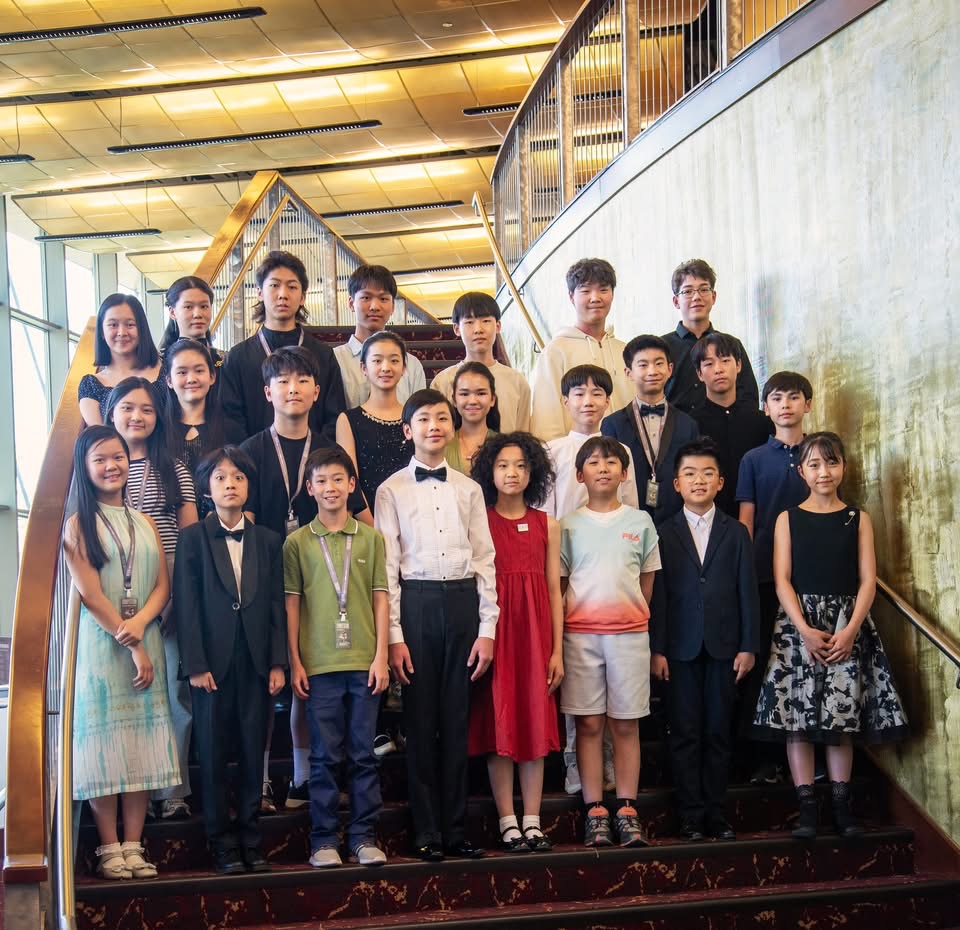
AFTERNOON SESSION
The first eight pianists playing their Round 1 program are, in order: John Samuell, Zeming Wu, Yixuan Miao, John Han, Yong-en Teng, Wilson Liu, Isabel Feng and Anselme Cho. Don’t let the 11-14 age group of these junior artists belie their bold competition choices. Many of the pieces audiences will hear would be worthy selections for more senior pianists. All of them already are building impressive portfolios as soloists and competitors. Indeed, their responses to questions provided by The Utah Review indicate their sensitive thoughtfulness as developing concert artists.
John Samuell started the proceedings with a gutsy program,which produced a sampler of his capacity for emotionally mature interpretations of two familiar works and some ferocious technical pyrotechnics in two pieces by one of the most widely recorded contemporary American composers. Opening with a meditative reading of Naoumoff’s transcription of In Paradisum from Fauré’s Requiem, op. 48, Samuell segued into the formidable Busoni transcription of Bach’s Chaconne in D Minor (BWV 1004). Not missing a beat for keyboard dexterity, Samuell tucked into the third and fourth movements of Lowell Liebermann’s suite for piano, Gargoyles, op. 29, an intriguing blend of tonal and jarring avant-garde elements. It’s a smart strategic selection for a prestigious competition: the third movement is intricate for how its inner figures are alternated between both hands while the fourth movement gallops with bravura leaps and crashing octaves which test the pianist’s stamina.
Zeming Wu handily picked up the baton in the competition relay in the program, starting with two pristine Scarlatti sonatas, followed by Chopin’s Ballade No. 2 in F Major, op. 38. These are precisely the pieces which demonstrate the pianist’s command of technical excellence to certify their place in the international arena of keyboard artistry. Liszt was 30 years old when he composed Réminiscences de Don Juan. Like his peer who just completed his program before him, Wu, also 14, dove headfirst into the pyrotechnics which require both hands to take leaps practically across the entire keyboard. It is a devilish piece. Scriabin injured his hand prepping this Liszt masterpiece when he was 20, an accident that led him to compose Prélude et Nocturne, pp. 9, written for the left hand.
Yixuan Miao met the bar set by the two young pianists who preceded her. Mozart considered the Piano Sonata No. 18 in D Major, K. 576 an easy piece but when both hands are required to simultaneously handle the finely articulated counterpoint passages, then competition-level skills are a must, as Miao effectively demonstrated. That was a mere warmup for her second offering — the theme and 14 variations from Book I of Brahms’ Variations on a Theme of Paganini, op. 35, which is based on Paganini’s Caprice No. 24 in A minor. This embodies a high-impact calisthenics workout for the pianist. Clara Schumann dubbed the work Hexenvariationen, which translates to Witch’s Variations. Miao’s cool-down for her keyboard workout was a delight: Chopin’s Andante spianato et grande polonaise brillante, op. 22. If one thought Rimsky-Korsakov’s The Flight of The Bumblebee was hard in its original form, then Hungarian pianist Georges Cziffra’s arrangement doubles the ante. What an explosive program closer!
John Han nicely intuited how E-flat major would signal Beethoven’s middle period. The first movement of Beethoven’s Sonata in E-flat Major, op. 31, no. 3, is like a sunny June day with a slight risk of a thunderstorm in the distance. It takes eight measures before Beethoven solidified the Allegro’s key. Closing out the program was a charming reminder of the power of youth in music: Prokofiev’s first published work (Sonata No. 1 in F Minor, op. 1), written when he was a teenage student at the St. Petersburg Conservatory. One can hear hints of Rachmaninoff in this young work, which is challenging for its relentlessly quick changes in dynamics. Between them, Han played Liszt’s Transcendental Etude No. 10 in F Minor and a worthy companion, Debussy’s L’isle joyeuse, with its own Lisztian sensibilities evoking the sensations of joy and regret found in Watteau’s 18th century painting, L’embarquement pour Cythère, which inspired the French composer. Intelligent performance to accompany an intelligently curated program.
Yong-en Teng opened with one of the Baroque keyboard warhorses: Bach’s Italian Concerto in F Major, BWV 971, with its generous display of elegant flourishes and ebullient embellishments. So buoyant! The Schumann-Liszt Widmung is quite a challenge for young pianists, not because of its evident virtuosic character but rather for the emotional intelligence needed to convey its profound love. Schumann had written the work as a wedding gift for Clara. There is no question about the sincere depth of love expressed but one can discern passages in the score where such deep love can be shadowed by pangs of insecurity and uncertainty. Likewise the musical colors pulse in Debussy’s Reflets dans l’eau from Book 1 of Images. Dessert was satisfying as well: Grünfeld arrangement of Johann Strauss’ Soirée de Vienne, op. 56. Many examples of understanding color in this music were evident.
Wilson Liu’s opener brought forward the irresistible late Baroque vibes in Rameau’s eminently polished Gavotte et six doubles from the Suite in A Minor, RCT 5. He kept the stride in two Chopin gems: Impromptu No. 3 in G-flat Major, op. 51 and Mazurka in A Minor, op. 17, no. 4. An, as with a fellow pianist earlier in the afternoon session, Liu turned to one of Liszt’s works composed during his twenties, Au bord d’une source, the fourth piece in the first suite of Années de pèlerinage. Providing a nice contrast to the earlier Chopin mazurka, Liu closed his program with Thomas Adès’ tribute to the 200th anniversary of Chopin’s birth, Three Mazurkas, op. 27. Liu has a finesse for gossamer textures.
Like millions of piano students, Isabel Feng has encountered Carl Czerny’s wealth of pedagogical materials in their lessons. However, it is rare to encounter his music in a concert setting. Feng performed Czerny’s Variations on a Theme by Rode, op. 33, a 19th century piece immortalized by Vladimir Horowitz in a 1944 recording. Keeping with the paragon theme of music to epitomize the pillars of superb piano technique, Feng offered Rachmaninoff’s Prelude in G Major, op. 32, no. 5, along with Chopin’s Nocturne in D-flat Major, op. 27, no. 2 and Scherzo No. 2 in B-flat Minor, op. 31.
Wrapping up the afternoon session, Anselme Cho also picked some titans from the solo repertoire, including Bach’s Toccata in C Minor, BWV 911 and Liszt’s Concert Etude No. 2 in F Minor (La leggierezza) before wrapping up with a work daunting in its demands even for veteran concert artists—Scarbo from Ravel’s Gaspard de la nuit. Cho’s Bach had a fresh lightness and crispness. Overall, the first session of this junior competition set a high bar of musicianship:this is going to be an exciting week.
EVENING SESSION
Three of the remaining four of the first 12 pianists in the first round have Chopin on their programs. Seven of today’s 12 pianists offered at least one piece by the Polish master. Bach also appears on three of the four evening session programs, which brings the total to six pianists today who presented at least one work by the Baroque master.
Once again demonstrating the poise, control and stamina which has been evident throughout the competition’s first day, Frederick Chen opened with Rachmaninoff’s Prelude in D Major, op. 24, no. 4, followed by two of the most recognizable movements from Rachmaninoff’s transcription of Bach’s Violin Partita No. 3 in E Major, BWV 1006. Chen also played the opening Sinfonia from Bach’s Partita No. 2 in C Minor, BWV 826. He closed with Chopin’s Scherzo No. 2 in B-flat Minor, op. 31, the second time this piece was performed in today’s portion of the first round. Indeed, there were noticeable differences in Chen’s interpretation from Feng’s performance in the afternoon session.
Haozhe Yang opened with a marvelous selection from Book 1 of Bach’s Well-Tempered Clavier, Prelude and Fugue in C-sharp Major, BWV 848. Chopin’s Nocturne No. 9 in B Major, op. 32, no. 1, followed, which, of course, is a favorite for performers and audiences. The challenge of playing a Haydn sonata on a modern grand piano is not to be minimized. Yang offered one of the composer’s most popular works for solo piano, Sonata in E Major, Hob. XVI:31. This elegant work stands out for its middle movement, cast in E minor and with an intriguing structure that suggests a chorale prelude as well as a three-part invention. This work is a test of utmost precision and clarity. Turning the treacherous mechanics up to a maximum of 10 in his closing work, Yang impressively tackled the infamous Arabesques on The Blue Danube by Adolf Schulz-Evler, which was once on the plate of every piano virtuoso near the end of the 19th century and early 20th century.
HyeonSeo Cho wasted no time in getting to the virtuosic materials with Bach’s Chromatic Fantasy and Fugue in D Minor, BWV 903. Like the Brandenburg concertos, this work lets us imagine how Bach flexed musically in the secular environment, when distanced from his ecclesiastical responsibilities in music. Its extroverted character, the audacious harmonies, improvisational sense in the fantasia and a fugue that puts the performer front and center combine to make this an astute choice for a competition where every pianist is focused on proving their precocious facility with a world-class repertoire. Mozart’s Sonata No. 9 in D Major, K. 311, composed when he was 21, is sweet, exquisite, virtuosic and neatly packaged. It is unexpectedly understated which makes it that much more challenging to pay honor to its ingenious provenance. Cho closed out his first round program with Rachmaninoff’s Etude-tableau in D Major, op. 39, no. 9.
Closing out the strong first day of competition, Shengkai Wang offered the first Schubert work to be heard so far: three movements of the Sonata No. 8 in E-flat Major, D. 568. One of Schubert’s lesser known works for solo piano, it is marked more often by its subdued lyricism (well handled by Wang) than by moments of strong drama. The work had its origins when the composer was barely 20 and he apparently struggled for the remainder of his short life to put the sonata into its final version (which was finally published a year after his death). Chopin’s Ballade No. 2 in F Major, op. 38 was heard for the second time today. Again, it was worth comparing Wang’s performance of it to that of Zeming Wu in the afternoon session. Wang closed out the evening with a glimmering Ravel’s Jeux d’eau.
1 thought on “The Bachauer at 50: Junior artists portion of the 2026 Gina Bachauer International Junior and Young Artists Piano Competitions: Daily Diary, June 14-20”