
In Utah, dance wears the empress crown in the performing arts. Choreographers and guest dance artists from around the world know well just how broad and deep the dance ecosystem in Utah is, as evidenced by the numerous commissions that have been set on local companies in ballet and contemporary dance over many decades.
For its seventh Choreographic Fest, Ballet West is celebrating that culture with Spotlight Utah, which will include a world premiere for the company, along with three works performed by dancers of the Repertory Dance Theatre (RDT), Ririe-Woodbury Dance Company and SALT Contemporary Dance. Two of the contemporary dance works scheduled were named among the top 10 moments of the Utah Enlightenment for 2025 by The Utah Review. The five-performance production run will be May 13-16 in the Jeanné Wagner Theatre in the Rose Wagner Center for Performing Arts.
In an interview with The Utah Review, Adam Sklute, Ballet West’s artistic director, said, “This has been a structure that I have been building with the choreographic festival and I have often brought in companies from around the country and around the world, including Scottish Ballet, Dance Theater of Harlem, women choreographers, women artistic directors and Asian choreographers.”

For this year, he explained, “I really wanted to celebrate some of our Salt Lake City giants.” Sklute, who is set to embark on his 20th season this fall as the company’s artistic director, added, “After having worked for over 16 years in New York City, after having worked for over 12 years in Chicago, both in classical ballet and dance, and being very connected to that field very broadly, it was a wonderful surprise to find how artistically, theatrically, and musically sophisticated Salt Lake City is, and, in fact, in many ways way more sophisticated than some of the largest cosmopolitan areas in the United States.”
This particular spotlight will be unique in Utah dance history. For the first time, four of the state’s professional dance companies will perform together on the same stage. Within a few years in the mid-1960s, Ballet West, RDT and Ririe-Woodbury were established and quickly cultivated their respective international reputations. Founded in 2013, SALT Contemporary Dance has experienced similar exponential artistic growth in its reputation.
“This program is in a way a celebration of that great depth and breadth of talent and artistry that we have here in the dance field of Salt Lake City,” Sklute said. “I’m so excited because I wanted to partner with these companies and I respect them tremendously and it is such an honor to bring them in and put us all on the stage together. Citing the reasonable challenges in the logistics of creating a representative program, he explained, “And, with absolute respect to the other great dance companies that I did not include because it was about a call of creating a program and I don’t want anyone to be slighted or feel I thought less of them as an artistic organization.”

The world premiere featuring Ballet West dancers by Tony Award–nominated choreographer Donald Byrd will be the classically-based Processional, set to Stravinsky’s Concerto for Piano and Wind Instruments. A Bessie Award winner, Byrd, Spectrum Dance Theater’s artistic director, has created works for Alvin Ailey American Dance Theater, Pacific Northwest Ballet, Dance Theater of Harlem, and The Joffrey Ballet, among others. His Tony nomination was for The Color Purple. When Sklute was associate director of the Joffrey Ballet, he worked with Byrd on a couple of works. “He has a wonderful history and his work brings interesting things to the dancers which is one of the reasons I brought him in,” Sklute added.
In an interview with The Utah Review, Byrd talked about the first time he visited Ballet West because he knew Mark Goldweber, a former Joffrey Ballet dancer who later became ballet master for Ballet West and director of Ballet West II. “Mark was a delightful person and he showed me around,” Byrd recalled. “The first time I saw the dancers here I didn’t really know Ballet West other than the historical stuff about it.” In Seattle, he knew some artists who had some relationships with Ballet West, adding that he always trusted Sklute’s judgment about dancers. Byrd said that most of the dancers he has met have come from the University of Utah. In fact, one of the dancers in Byrd’s company is Cooper Sullivan, who just completed his bachelor of fine arts degree at the University of Utah. “I have always thought of Salt Lake City as being a real dance place,” he said.

Donald Byrd, Processional
Processional is inspired by the fabled Défilé du Ballet (Ballet Parade), a tradition that the Paris Opera Ballet follows at the beginning of every season. It is a procession which commences with students from the ballet school, followed by the company’s corps de ballet, soloists, and culminating with the étoiles (principal artists). Watching videos of this tradition, Byrd was fixated on how the entire 20-minute spectacle unfolded from the back of the stage and a studio that is normally closed to the front of the proscenium. “While watching that processional of those dancers coming down and doing something very simple— just walking— one of the things I thought about was that ballet dancers really know how to walk,” he said.
He likened it to models walking during a runway show. The idea was that it was a processional, “starting from the most basic movement [walking] and the movement becomes more and more challenging, sophisticated and ornate. That is what I wanted to do here, mostly because I was fascinated by the walking and, in fact, that it can hold your attention.”
Processional emerges as a choreographic study of the psychology in such an event. “How I have thought about it is that if you’re watching a procession or parade and people are coming towards you and you’re watching them, what our mind does often is to telescope in on one, two, and eventually the entire group,” Byrd explained. “We have an opportunity to see them and understand something about them in detail.”
One of the first things Byrd noticed when he came to workshop his new piece with the company was not only how fantastic dancers are but also “the consistency in their dancing and how it is consistent across the board with very high standards.” Ballet West has turned out to be an ideal venue for Byrd’s focus on exploring neoclassicism and, in particular, this Stravinsky chamber concerto, which has plenty of exuberance and quirky effects (including tinges of jazz) that do not compromise the music’s consistent rhythmic precision. Indeed, Ballet West has a knack for dances with music by Stravinsky. In April 2025, the company’s triple-bill (The Rite of Spring, Symphony of Psalms, and Apollo) was a varied and exquisite Stravinsky feast.

In his youth, Byrd studied flute, adding that he always has had an “affinity for wind ensembles.” He played in his high school’s marching and concert bands and during his brief time at Yale University, he played in a wind ensemble that toured Europe. “I love the composers from that era of the early 20th century (Stravinsky, Bartók, Hindemith) and the music they wrote for wind ensembles,” he explained. “Now I am able to revisit the music from my youth in a different medium than what I was introduced to and able to express my love for it in this other form. It’s a collaboration between the music and my love for that music and my understanding of dance.”
Talking about his transition to dance during his youth, Byrd said, “I knew who Stravinsky was because of my music training. But I didn’t know who [George] Balanchine was and I would have read about him but I didn’t know what it was and what it meant so I went to a lecture-demonstration when I was 16 with a friend. It featured Eddie Villella and Patricia McBride [former New York City Ballet principal soloists] and they did excerpts from what would become Rubies as part of Balanchine’s Jewels set to Stravinsky’s Capriccio for Piano and Orchestra.” He still remembers the impact: “I was so fascinated by it; the first thing I thought was people in New York are so sophisticated. When I finally went to New York I was surprised that everybody didn’t look like Eddie Villella or Patricia McBride; that they were just regular people.”
As for the dancers in Processional, Byrd added, “It is an opportunity for them — they might not know this, per se— but they have points of view about what they’re doing; about their academic language and vocabulary. They usually just do it and are able to replicate it and they may not be conscious of how they are articulating their understanding of it in their body because their bodies are talented. They intuit it but also their main way of communication is in the body and physicality; not talking about it. If you query them a bit, then you start to hear things and understand that I wanted to see how they understand the academic vocabulary language of it and the choices they make as a result of their understanding.” In the studio, Byrd connected with the dancers asking them questions that were not necessarily about dance. “It also helped me to remember who they are,” he said, with a chuckle.
“There are some dancers in the company that I have fallen in love with because they are fantastic and brilliant with what they are doing and then there also are a few I have fallen in love with because of their work ethic,” Byrd said. “I love people who work really, really hard —not to say that all of these dancers are working hard because they are — but there are some people who have blinders on, in terms of connecting to the work and are trying to give you what you want. They are very open to the process and bring a great level of enthusiasm.” Recalling how the dancers worked on one thing all day during a rehearsal, he said he appreciated when he asked them near the end of rehearsal if they could run it again, they said sure, without missing a beat.
Observing the dancers in Processional, Byrd said he has been impressed by them as they continue to persevere in their artistry, including those who carry years of battle scars on their bodies from dancing. One example he noted was Tyler Gum, who started 17 years ago with Ballet West II and eventually worked his way up to principal in 2023. “Tyler [Gum] is a soldier,” Byrd said. “His partnering is exemplary and he has such a connection and is willing to actually give his attention to his partner and not pull it toward himself.” He added that New York City Ballet’s male dancers had that same quality, especially during the Balanchine era because that legendary choreographer insisted on it. Byrd said that same sort of attentive focus is prominent among male tango dancers.
The following highlights the works to be performed by the guest companies:

Norbert De La Cruz III. Photo: Sharon Kain.
Repertory Dance Theatre: Scherzo Fantastique by Norbert De La Cruz III
Commissioned by RDT for last fall’s Ovation as part of the company’s 60th anniversary, Scherzo Fantastique by Norbert De La Cruz III exemplifies how a tightly knit network of dancers can forge artistic relationships and pave a path for a commission. “Out of the blue, Linda Smith [RDT cofounder and artistic director emerita] reached out to me after Jake Lewis [one of the company’s current dancers who had participated in an Ailey School program] championed my name,” De La Cruz said in an interview with The Utah Review. With that, Cendese and Lynne Larson, executive/artistic co-directors, set the process in motion for bringing De La Cruz to Salt Lake City. The Ovation production was named by The Utah Review as the top moment of the Utah Enlightenment for 2025
“My dances, like me, are hybrid creatures: part classical, part improvisational, and personal. I was trained in Western ballet in Los Angeles and New York City,” De La Cruz, who was born in the Philippines and raised in California, explains in his artistic statement. “Yet, these canonical movements map differently on my body, a body that has been underrepresented in the canon. I make modifications, bend rules, and break them, as I search for movement that feels authentic, and I innovate inside the dominant paradigm. This is a gift that immigrant voices give to the field. We revamp the rules and interrogate the forms, in order to bring together multiple histories on our bodies.”
He counts among his mentors distinguished dance teachers such as Risa Steinberg and Aszure Barton. Among the paragons for cultivating and nurturing his creative language, De La Cruz cites historic legends such José Limón and Martha Graham and contemporary titans such as Crystal Pite, as well as major contemporary ballet choreographers such as William Forsythe and Alejandro Cerrudo.
De La Cruz capitalizes on the dancers’ amazing capacity to use their body as an instrument or vessel to make the most of the memory of many physical and movement languages they retain as performers in a repertory dance company. One personally surprising aspect as De La Cruz began working with RDT was discovering how the company has connected so naturally to the ambience of classical music within the realm of the dance languages and vocabularies they encounter in their work.

The idea for his piece was sparked when he thought about the possibilities of turning the mundane actions of standing and sitting in his office chair into a dance that finds light and hope amidst darker moments of grief and loss. Hence, the dancers for this Scherzo Fantastique use chairs as props.
His choice of music came quickly to mind, which also became the title of his commissioned choreography: from Josef Suk, whose career spanned the late 19th century and the first part of the 20th century. Suk studied under the great Antonín Dvořák’s and, in fact. married Dvořák’s daughter, Otilie Suková. Although Suk composed Scherzo Fantastique a year before the deaths of Dvořák and his wife occurred within a 14-month span, the piece received its Prague premiere in 1905 and took on a bittersweet context. The musical colors are exuberant and whimsical and the score bristles with a distinct Czech energy that would have made Dvořák eminently proud of his favorite student.
De La Cruz said the RDT dancers are impressive in their artistic maturity. “They are faithful to not taking their work so seriously that they have to sidestep finding their own joys for dance,” he explained, adding that this piece reinforces that sense of play for the dancers. “I had such a great time with them in the studio,” he said, “observing their self awareness, their genuine love for the company and their abilities as team players and problem solvers.”
De La Cruz’s choreographic career began under the mentorship of Tom Mossbrucker and Jean-Philippe Malaty at Aspen Santa Fe Ballet, where he received the Jerome Robbins Foundation’s NEW Essential Works Grant for his ballet Square None (2012). He has since been commissioned by companies including Ballet X, Richmond Ballet, Dallas Black Dance Theatre, Grand Rapids Ballet, Nashville Ballet, and Hubbard Street 2. A recipient of the Princess Grace Foundation-USA Choreography Fellowship (2012), he has also been recognized by the Alvin Ailey New Directions Choreography Lab, Joffrey Academy of Dance’s Winning Works, and the National Choreographic Initiative. His work has been presented at prestigious venues such as the Winspear Opera House for TITAS Command Gala and through collaborations with the New York Choreographic Institute and Dance Lab New York.
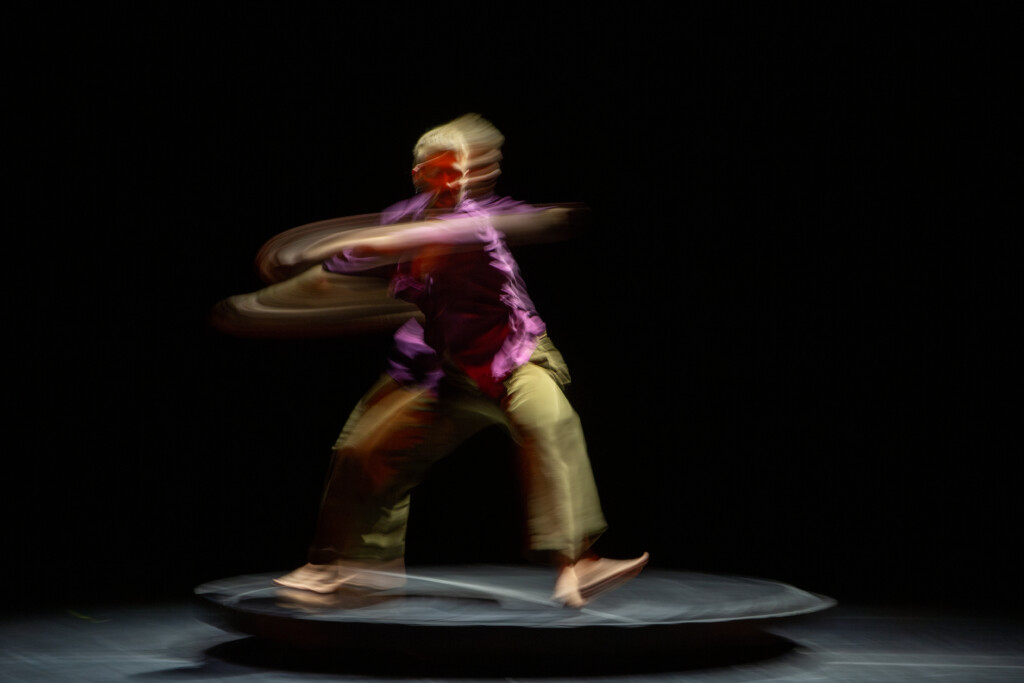
Ririe-Woodbury Dance Company: The Rate We Change by Kellie St. Pierre
In 2025, Ririe-Woodbury Dance Company performed the exhilaratingly athletic and keenly original The Rate We Change by local artist Kellie St. Pierre, which the choreographer created as part of her master’s degree thesis at the University of Utah. The work featured the company’s six dancers performing on a human-powered rotating platform, accompanied by a well-sculpted minimalistic score by local musician Daniel Clifton. The work was honored with the Grand Prize Award at the Palm Desert Choreography Festival. It also was named by The Utah Review as one of the top 10 moments of the Utah Enlightenment for 2025.
The choreographer created the work as part of her master’s degree thesis at the University of Utah. It features the company’s six dancers performing on a human-powered rotating platform. In a previously published interview with The Utah Review, St, Pierre, who likes to incorporate kinetic set pieces, said “the idea was to build a nonstop work in creating an ever-shifting and rotating environment and how to respond to this, without stopping.” The challenge was to give dancers a new movement vocabulary and skill, according to her, including how to stand, sit and move safely on the rotating platform and find their ideal momentum and comfort levels while performing on it. For her thesis, she set the work on six dancers and then with five dancers for a performance at the American Dance College Association conference.

The setup and premise in the work are pitched to generate countless versions of unique performances, as each cast approaches the piece with its own intellectual curiosity about how they approach the movement and partnering demands by understanding the trust and confidence they build with each other in presenting it. Indeed, as St. Pierre explained, dancers respond to their own sense of humility, as they individually confront their own fears and circumstances in becoming more familiar and comfortable with a continuously rotating platform set. “These dancers have established such a lovely fit in working together and it has been beautiful to watch them as a team helping each other,” she added.
SALT Contemporary Dance: Time Comprises A Net by Noelle Kayser
The company will perform Time Comprises A Net by Noelle Kayser, which premiered during SALT’s spring concert Memento in March. An award-winning choreographer, director and multi-disciplinary performer based in Chicago, Kayser has had a close relationship with SALT from choreographing for its LINK Audition Festival/Workshop and the sister company SALT2.

What made this piece noteworthy is that it marked Kayser’s first choreographic commission for the main company. The piece is set to a score filled with excerpts from Beethoven’s Symphony No. 5 in C Minor, piano ballads by Aphex Twin, and narrated text with quotes from the book Felt Time by Marc Wittman.
Kayser is the inaugural resident choreographer for Open Space, a Whim W’him Choreographic Shindig winner, the 2025 BalletX Choreographic Fellow, and a 2026 Ballet Collective Commission for Developing Choreographers recipient. She has created work for companies including Dance Aspen, DanceWorks Chicago, MADCO, Visceral Dance Chicago, and SALT II among many others. As a guest ballet mistress at the Lyric Opera, she was the founding rehearsal director and administrator for PARA.MAR Dance Theatre (2022 Dance Magazine Top 25 to Watch), and named one of NewCity Magazine’s The 50 People Who Really Perform for Chicago. Her screendance, dust, produced by Open Space, was awarded Best Dance Film at the Athens International Monthly Art Film Festival and the Mannheim Arts and Film Festival. The dance is an official selection at the Swedish International Film Festival and ARTSinTANK Dance Festival in Korea.

For tickets and more information about Choreographic Fest VII: Spotlight Utah, see the Ballet West website.